Kingdom
Demography: A Transformation to be Turned Into Opportunities
Profound transformations are gradually reshaping Moroccan society. The National Observatory for Human Development (ONDH) has produced a Policy Brief to explore ways to prepare Morocco for the future.

The Kingdom is entering a new phase in its demographic history, as evidenced by the results of the latest General Population and Housing Census (RGPH 2024). Declining birth rates, an aging population, accelerated urbanization, and the reshaping of the family model now stand as the markers of an advanced demographic transition.
These developments, highlighted by the National Observatory for Human Development (ONDH), pose major challenges for public policies and the country’s development model.
For the institution headed by Otmane Gair, the central issue is no longer simply demographic growth, but rather the Kingdom’s ability to turn these changes into opportunities for its human development.
Aging: An economic and social challenge
The Moroccan population continues to grow, but at a slower pace, due to declining fertility, now below the replacement level. At the same time, life expectancy is increasing, leading to growth in the elderly population, which rose from 9.4% in 2014 to 13.8% in 2024.
This dual trend (declining birth rates and longer life expectancy) is profoundly transforming the balance between generations. It also implies major changes in the country’s economic and social organization.
The increase in the number of elderly people is one of the major challenges of the coming decades. This phenomenon will have significant repercussions on the labor market, the healthcare system, and social protection.
Today, the overwhelming majority of seniors are inactive due to labor market regulations. Yet this population often possesses valuable experience and skills that could be mobilized in service of the economy. Experts therefore advocate for greater flexibility in work organization to allow seniors who wish to remain active longer.
Aging also raises the issue of healthcare and social support. The challenge is not only to extend life expectancy, but to ensure more years lived in good health and autonomy. This requires a transformation of the healthcare system toward greater prevention, home care, and specialized services.
The growth of what is referred to as the “care and support economy” could thus become a strategic sector, both to improve the quality of life of elderly people and to create new jobs.
Investing in human capital
That said, despite signs of aging, Moroccan society remains relatively young. This situation offers a window of opportunity known as the “demographic dividend,” provided that the working-age population can access education, training, and employment.
For Morocco, the challenge is therefore to anticipate ongoing transformations and adapt its development model in order to fully benefit from these changes.
Through effective governance of human capital, the country could not only improve its level of human development but also take a decisive step toward escaping the middle-income trap.
In the face of these transformations, the ONDH stresses the importance of investing in human capital. The success of the demographic transition will largely depend on Morocco’s ability to improve the quality of its education system, strengthen vocational training, and ensure access to healthcare throughout life.
The development of preschool education appears in particular as an essential lever for reducing social inequalities from an early age.
Similarly, adapting the training system to the demands of the digital economy and new professions has become indispensable. Artificial intelligence and digital technologies could play an important role in improving learning methods, provided their development is part of a national strategy for digital sovereignty.
A transforming family model
Demographic changes are also accompanied by a transformation of the family model. The average household size is now around 3.9 people, meaning that most families have one or two children.
This evolution marks a break with previous generations, which were characterized by larger families. It also changes educational practices and relationships within the household.
With fewer children, parents often devote more attention and resources to their education and well-being. Schools are therefore called upon to play a central role in transmitting civic values and preparing young people for collective life.
Another growing social phenomenon is the rise in singlehood, particularly in urban areas. This trend may be linked to several factors, including economic transformations, changing individual aspirations, and difficulties in accessing housing and employment.
While singlehood is gradually becoming more socially accepted, it can also lead to situations of loneliness, particularly among the elderly and women. This loneliness can have significant consequences for physical and mental health.
It therefore constitutes a social issue that will need to be taken into account in public policies, particularly in strategies related to the care economy (personal care) and social cohesion.
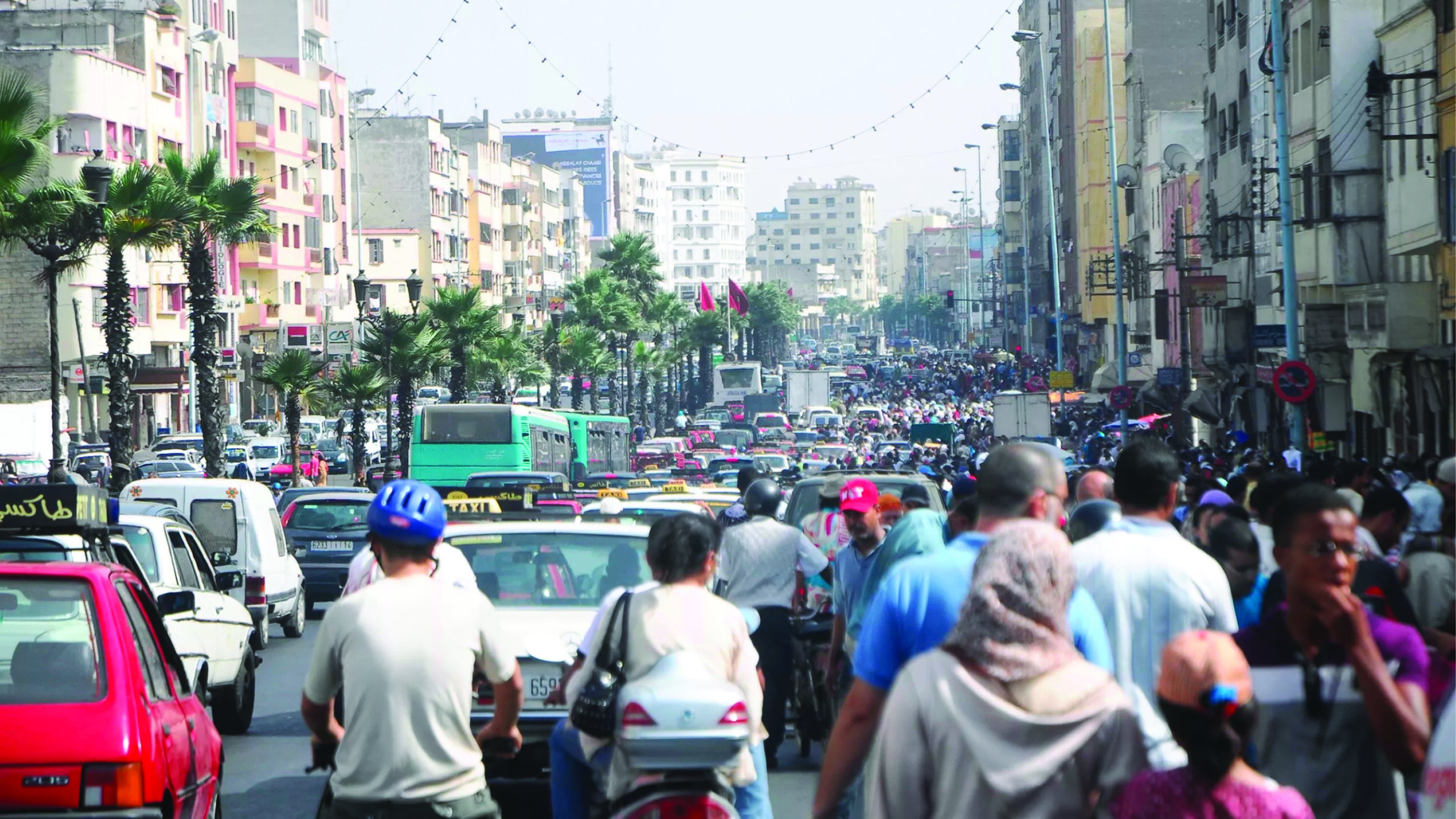
Finally, rapid urbanization is another major dimension of Morocco’s demographic transition. Cities are attracting more and more inhabitants, which raises significant challenges in terms of spatial planning, housing, and public services. Climate change is intensifying these issues.
Heatwaves, prolonged droughts, and floods directly affect the quality of life in both urban and rural areas. In this context, experts emphasize the importance of developing more resilient urban planning.
This includes, in particular, the creation of green spaces, improving the thermal insulation of buildings, and implementing stricter environmental standards. The objective is to design cities capable of coping with the effects of global warming while providing a sustainable living environment for populations.
Contrasting regional dynamics
Demographic changes do not occur uniformly across the territory. Regional analysis highlights significant disparities between areas.
Internal migration flows are mainly concentrated around major metropolitan areas and along the Atlantic axis linking Tangier to Agadir. These movements contribute to the formation of economic hubs around regional capitals and increase population concentration in large urban areas.
The outskirts of cities such as Casablanca, Tangier, Rabat, Marrakech, Fez, and Agadir are thus experiencing the strongest demographic growth. This phenomenon is explained in particular by the presence of economic infrastructure, businesses, and logistics platforms that attract populations in search of job opportunities.
Conversely, some rural areas are experiencing lower demographic growth and are affected by climate change, particularly drought. These factors risk intensifying rural exodus and widening territorial inequalities if no balanced spatial planning policy is implemented.