Business
Dakhla, the Future Guangzhou of West Africa
With its mega deep-water port project on the Atlantic, the city is positioning itself as a strategic logistics hub for Afro-Atlantic connectivity, akin to the port of Tangier in the western Mediterranean and that of Guangzhou in southern China. While many challenges remain to realize this ambition, the first milestones have nonetheless been laid.

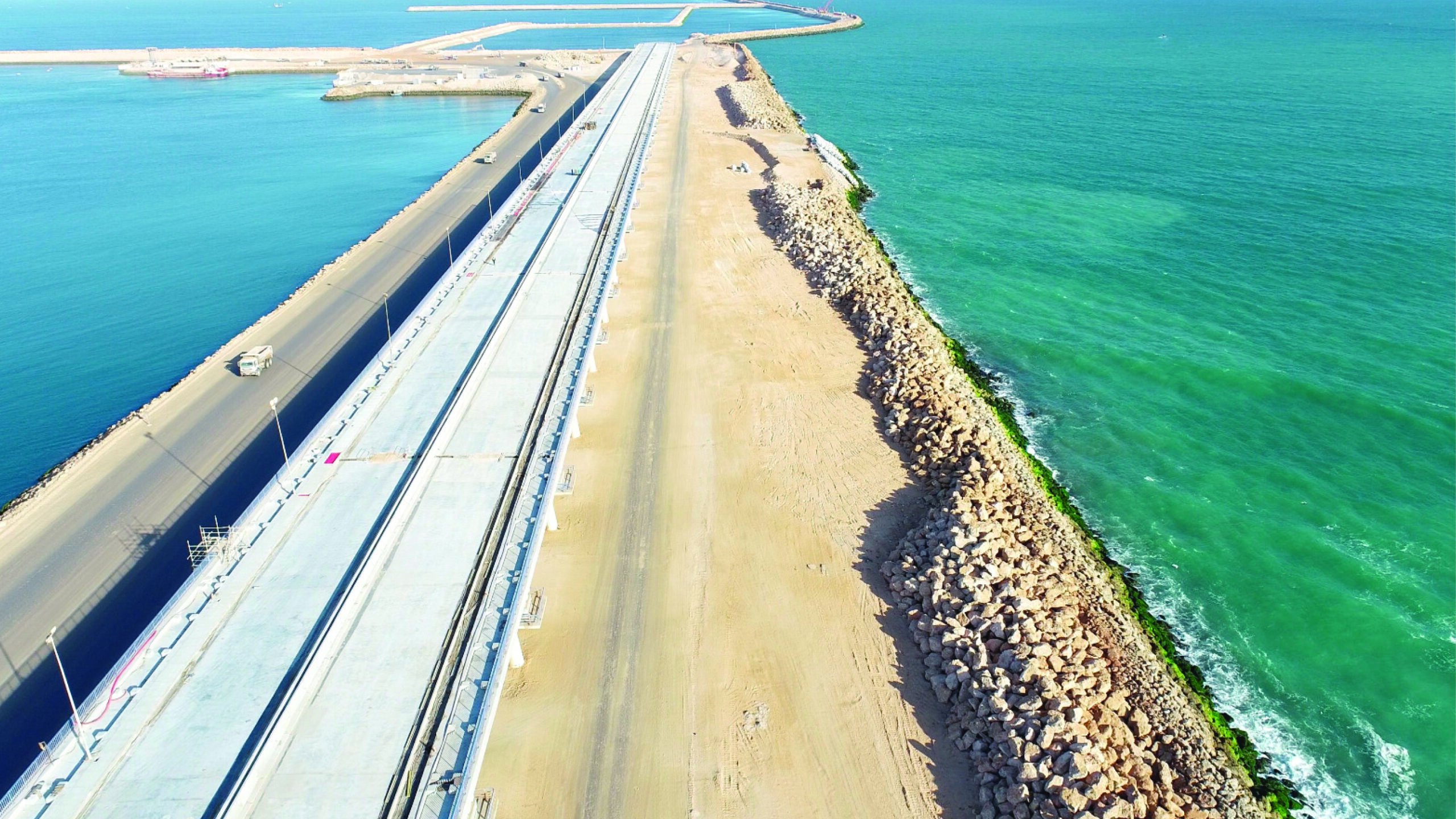
Already known worldwide for its paradise beaches and generous wind that delight windsurfing and kitesurfing enthusiasts, Dakhla could well, in the coming decades, become internationally renowned as a global-scale commercial and logistics hub on the Atlantic, akin to Tanger Med in the western Mediterranean or Guangzhou in southern China.
The comparison with one of the world’s largest ports may certainly seem incongruous, but this ambition is not merely a flight of fancy.
Dakhla is indeed at the heart of the royal vision for the Atlantic, which aspires to redraw the region’s economic and geopolitical map and lay the foundations for a new pole of development and regional cooperation.
In this vision, which aims to turn the Atlantic coast into a gateway to Africa, a platform for economic integration, and a crossroads of global connectivity, Dakhla will have a central role to play.
The Saharan city occupies a unique position at the intersection of three strategic spaces: the Atlantic, which opens onto West African and American markets; the landlocked Sahel, which seeks new maritime outlets; and Europe, Morocco’s natural partner in the global value chain.
This positioning makes Dakhla a natural logistics pivot for West Africa and the Atlantic world, with the potential to become an integrated logistics and commercial platform serving African competitiveness. The first building blocks for realizing this ambition are already in place.
The city is at the center of large-scale, structuring projects that consolidate its hub positioning: the Africa Atlantic Gas Pipeline, the Morocco-Mauritania electricity interconnection, the Tiznit-Dakhla expressway, and industrial and logistics zones for processing and export.
Diplomatically, Dakhla already hosts several consulates from countries in the region, facilitating cooperation and coordination between states. But it is above all the mega-project of the Dakhla port, currently under construction, that constitutes the centerpiece of this vision.
This future deep-water energy and industrial port, with a draft exceeding 21 meters, capable of accommodating the world’s largest merchant ships, container carriers, oil tankers, and even bulk carriers, is intended to emerge as a new benchmark port at the continental level, similar to what Tanger Med achieved in the Mediterranean.
This pharaonic project, scheduled to be operational in 2029, will fill a glaring gap that hinders development in the region’s countries: the lack of efficient logistics infrastructure, whether in terms of deep-water ports or logistics corridors.
From this perspective, the port of Dakhla represents a strategic turning point. Backed by a processing and export industrial and logistics zone, it is intended to become a support port for African trade, offering an outlet on the Atlantic and providing efficient logistics services for neighboring countries.
Logistics, the Weak Link of African Trade
For countries on the continent, and particularly for West African nations, logistics is now identified as the crux of the matter.
“Africa’s development can only be achieved by mastering its flows, streamlining exchanges, and strengthening its logistics capacities,” states Yanja Khattat, President of the Regional Council of the Dakhla-Oued Ed-Dahab region, who recently addressed a gathering of investors, logistics professionals, and officials from countries in the region at the first Dakhla Africa Logistics Forum, an event whose goal is precisely to lay the groundwork for concerted logistics integration between the various concerned countries.
It must be said that today, this lack of logistics integration at the regional and continental level comes at a high cost. As Khattat observes, “Africa trades too little with itself. Intra-African trade does not exceed 15%, hampered by a lack of interconnections and high logistics costs.”
It is important to know that the average cost of logistics on the continent still represents nearly 35% of a product’s final price, compared to 10% in developed economies. A reality that limits the competitiveness of African businesses and hinders regional integration, even as the African Continental Free Trade Area (AfCFTA) offers enticing prospects.
“The AfCFTA represents a historic opportunity. But a market without roads, without corridors, without interoperability, without efficient ports, remains an unfulfilled promise,” insists the official. For this integration to become a reality, we need fluid corridors, modern infrastructure, and a common vision for continental logistics, he summarizes. This is precisely what Dakhla and its future port propose.
Versatility and Multimodality, Keys to Logistics Competitiveness
Due to its scale and its positioning at the crossroads of strategic maritime routes, the port should offer a sustainable and, above all, competitive alternative to the various regional maritime entry points, which are primarily located in the Gulf of Guinea, notably via the ports of Cotonou in Benin or Lomé in Togo, which are congested and have particularly high freight costs.
Thanks to its size, versatility, and multimodal character, Dakhla thus appears as an ideal solution to lower freight costs for West Africa.
“Dakhla Atlantique is designed as a versatile port, dedicated to the fishing industry, renewable energies, the mining industry, containers, international road transport, agriculture, hydrocarbons, agriculture…,” lists Abid Mrayzig, Head of Works Service at the Dakhla Atlantique Port Development Directorate. In the future, he adds, “the port will be a platform for the export of ammonia as part of Morocco’s green hydrogen offer.”
Versatility is complemented by multimodality, that is, the integration between maritime and road connections, another decisive asset. The Tiznit-Dakhla expressway in particular will allow for the consolidation of flows. But not only that. “We will eventually equip the region with all the logistics infrastructure.
Under the Rail Plan 2040, the Agadir-Dakhla connection is on the table. After the 2030 World Cup, the Agadir-Laayoune section is planned for 2035, then towards Dakhla in 2040.
At the air level as well, there will be projects,” indicates Ahmed Khatir, President of the Dakhla Regional Investment Center. It must be said that the stakes are considerable. As Khatir explains, “in 2023, imports for West African countries amounted to 117 billion dollars. Moroccan exports represent only 1.8% of this total.
From our point of view, this low level is linked to logistics. This is where the Dakhla region can fill this need, to eventually become the future African Guangzhou. We are strengthened by the royal vision and the success of Tanger Med.
We will deploy the necessary means so that Dakhla Atlantique becomes an energy, commercial, and mining hub, and thus the Atlantic lung for the Sahel countries.”
Investor Interest in Logistics Corridors
The challenge remains to convince investors to bet on this model of the future. According to the President of the CRI, the interest is real and growing. “Currently, we do not yet have all the infrastructure that will attract investors. But the core framework is in place.
The international dimension of the port and its positioning will make this project profitable for investors. Our role is to get investors to see Dakhla’s potential.
We look for this potential more in projections with Sahelian and African countries. The port project is attracting more and more investors, interested in this hub strategy established by Morocco. We observe this daily at the CRI,” he states.
The CRI’s current efforts therefore consist of building an attractive offering to attract investors. “Apart from warehouses, we are interested in having much larger logistics facilities. We want logistics providers in the mining, agri-food… sectors,” emphasizes the head of the CRI.
Projects moving in this direction are already materializing. Indeed, as the regional president recalls, the structuring project of the Dakhla Atlantic port is accompanied by a vast logistics zone of over 1,600 hectares, supplemented by two logistics zones in Bir Gandouz and Guerguarat, of approximately 30 hectares each, true gateways to Sub-Saharan Africa.
“The goal is to create a corridor between Morocco and its African neighbors, facilitate trade exchanges, and open new cooperation opportunities with our partners on the continent,” he indicated.
Reconfiguration of Maritime Routes
In short, Dakhla is patiently weaving its network. Missions to neighboring countries are multiplying for better coordination and convergence on logistics, but also customs aspects, to improve interoperability between the various West African ports.
The Dakhla Africa Logistics Forum notably brought together several representatives from countries in the region, including the spokesperson for the President of Liberia. Far from a coincidence, the Liberian flag is the second most important in the world, behind Panama’s. This emerging logistics integration is well worth the effort, in a context of global reconfiguration of maritime routes.
“In the new global geopolitics, the Atlantic is becoming a strategic space where transatlantic trade exchanges are experiencing sustained growth and West Africa is increasingly positioning itself as a key player in global supply chains,” states Sanaa Hassini, President of the Moroccan Association for Logistics.
“We are at a moment where value chains are reorganizing, where competition around logistics corridors, trade routes, and maritime access is becoming an essential determinant of development and economic sovereignty,” she analyzes. A boon for the sub-region and for Dakhla to firmly anchor the continent to the global economy.
Dakhla Atlantic Port: The Midway Construction Site
Designed as an island port connected to the mainland by a 1.3 km maritime bridge, Dakhla Atlantique will have an expandable initial capacity of 35 million tons, including 1 million TEU containers, 25 million tons of goods, 5 million tons of hydrocarbons, and 1 million tons of seafood products.
“We are already discussing the port’s expansion. The investment program spans years. The current port project is only the first stage,” emphasizes the President of the Dakhla-Oued Ed-Dahab CRI.
The construction site is progressing at a steady pace. Carried out day and night by the SGTM-Somagec tandem, the works have reached a 46% completion rate. The maritime bridge is nearly complete.
The work now focuses on protective structures (breakwaters). The next stage will be the construction of platforms and the realization of quays over 2,700 meters long. Completion of the works is scheduled for the end of 2028, for commissioning in 2029.
With a total cost now estimated at 15 billion dirhams, the port complex will consist of three basins: a commercial basin, a basin dedicated to deep-sea fishing, and a terminal for ship repair, with depths varying from -12 to -16 meters. It will also include a petroleum quay, a container quay, and even a RoRo quay for passengers.
“We adapted the initial master plan to meet the needs expressed by investors, who wanted more depth,” clarified Abid Mrayzig, Head of Works Service at the Dakhla Atlantique Port Development Directorate. Drafts exceeding 20 meters are now planned to accommodate the heaviest cargoes, such as wind turbine parts.
Similar to the Tanger Med port complex, Dakhla Atlantique will be backed by an industrial-logistics zone (ZIL) of 1,650 hectares, intended to host activities in agri-industry, renewable energies, and the fisheries industry.
This ZIL will notably integrate a 650-hectare port zone, a 200-hectare seafood products competitiveness cluster, a 65-hectare shared services hub, and a 150-hectare logistics hub. A 450-hectare land reserve also remains available in case of needs expressed by investors.