Influences
Cybercrime: Morocco Signs UN Treaty in Hanoi
Adopted last December by the United Nations General Assembly, this convention will enter into force 90 days after its ratification by member states. It marks a decisive step in the fight against new forms of crime.

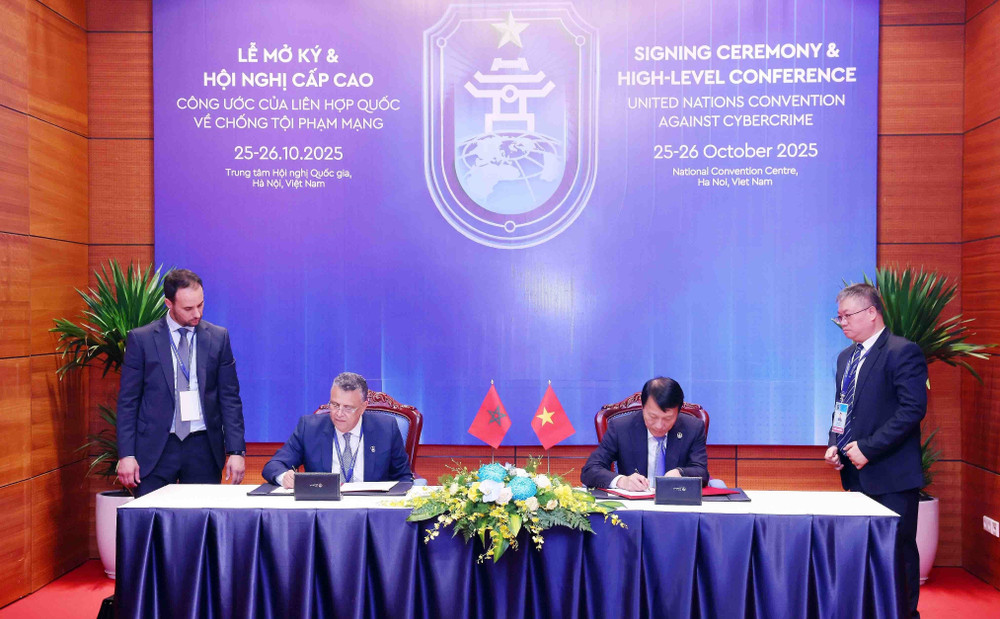
Morocco signed the United Nations Treaty against Cybercrime on Saturday in Hanoi, during an international conference organized in the Vietnamese capital with some sixty countries in attendance.
The Kingdom was represented at the event, which was marked by the presence of UN Secretary-General António Guterres, by the Minister of Justice, Abdellatif Ouahbi.
Adopted last December by the United Nations General Assembly, this convention will enter into force 90 days after its ratification by member states.
In a speech delivered on this occasion, Mr. Ouahbi described the meeting as a “historic moment” and a “major symbolic event in UN action over the decade,” stressing that it marks a decisive step in the fight against new forms of crime and illustrates a model of international cooperation to contain them.
The minister recalled that the rise of digital technology has made the Internet a central player in contemporary life, but also a vector for the rapid expansion of criminal activities. Offenses targeting data and computer systems are no longer limited to individual attacks, but now threaten the political and economic stability of states, he observed.
Faced with this development, the international community has seen various initiatives emerge to strengthen digital security, ranging from national legal frameworks to regional agreements such as the Arab Convention against Cybercrime and the Budapest Convention, he continued.
Morocco, he recalled, has been fully involved in the treaty’s development process since the creation of the intergovernmental committee responsible for drafting it, under General Assembly Resolution 75/282, adding that the Kingdom actively participated in all phases of the negotiations, contributing to the development of the final version of the text.
Reaching an international agreement in the current geopolitical context was not easy, Mr. Ouahbi acknowledged, noting discussions marked by significant political and technical debates. This achievement, he added, demonstrates a collective will based on flexibility and openness, and reflects “a shared understanding of digital crime as well as a renewed commitment to judicial and technical cooperation.”
The minister also warned of the rise of cyber threats on a global scale, the repercussions of which affect the social, economic, and psychological fabric of societies.
“In a regional environment marked by the resurgence of extremist groups spreading messages of violence and sponsoring terrorism, who now use the digital space to disseminate their destructive ideologies, incite hatred, shed blood, and sow terror among the innocent, strengthening cybersecurity appears more than ever as a major issue for the protection of individuals and societies, as well as for the preservation of stability,” Mr. Ouahbi emphasized.
Morocco, he recalled, has been part of this global dynamic for several years, adopting national laws and strategies aimed at developing the digital economy while protecting its citizens. The country has thus established a specific legal framework for cybersecurity and has updated its penal and criminal procedure codes.
Mr. Ouahbi insisted on the need to strengthen international cooperation to facilitate access to digital evidence, which has become a major challenge for all states. In this regard, he reaffirmed Morocco’s readiness to collaborate fully with its partners for the effective implementation of the convention and the improvement of its procedural mechanisms.
Initially proposed by Russia in 2017 and approved by consensus last year after lengthy negotiations, this convention represents the first international legal framework specifically dedicated to combating cybercrime.
It covers various types of cybercrime, from phishing and ransomware to child pornography and money laundering, activities that cost the global economy billions of dollars.