Kingdom
Craftsmanship, a New Economic Ecosystem Taking Shape
Change of direction. Craftsmanship is no longer a “marginal” activity; it is becoming one of the drivers of the national economy. With a 7% share of GDP and exports soaring, the sector is on the verge of changing its role.

In some countries, craftsmanship is part of historical heritage. It is displayed in museums as a sign of a bygone era. In others, world‑renowned companies in the luxury sector are, in reality, structures that produce craftsmanship.
Between these two models, Morocco has made its choice. Although the health crisis accelerated the major reform in the sector, a vision of renewal was already present. A new legal framework has been established and a national register of craftsmanship has been created.
The first clearly defines the craft profession, its practitioners (men and women), ranging from apprentice to master artisan, as well as the artisan enterprise and the artisan cooperative… the other provides a professional database for the sector.
Everything began there. The rest is yet to come. A new law governing the Chambers of Crafts and a new legal framework for the social economy. The legal texts and their implementing decrees are ready. As for the rest, everything will be decided on the ground. The State Secretariat, and through it the government, has decided that everything must start from the grassroots.
Morocco currently counts more than 170 trades and a large number of craft activities. The idea is that in each trade, the public authority can deal with a single representative.
This is where the organization of the entire sector begins. The rest comes afterward. Methodical and deeply knowledgeable about the sector—having, in a way, come from it himself—State Secretary Lahcen Essaady explains that it was necessary to start with organizing and restructuring the sector.
Then comes the acceleration of development and the takeoff. At the same time, it was also necessary “to distinguish between the two branches of craftsmanship: products and services. And then to act according to the specific characteristics and needs of each branch.”
Promotion, marketing, and visibility in foreign markets for the first branch, and training and organization, among other things, for the second. Tens of thousands of training places will be launched, along with a marketplace for craft products.
At the same time, the State Secretariat has signed more than a hundred partnership agreements—most of which are already operational—with various stakeholders to facilitate the training of young artisans and the promotion and commercialization of their products.
The first successes are already visible, despite strong resistance from opponents of development—those whose interests are served by the sector’s informal character. In short, the figures speak for themselves.
Craftsmanship now employs more than 1.6 million people and generates a turnover of 145 billion dirhams, including 1.23 billion dirhams in exports. And the potential is still enormous. The markets exist and are demanding, particularly the United States market.
This success is also due to the fact that the government has changed its approach. It has decided to change its perception of the sector, which is now considered a fully fledged economic activity and a generator of wealth, whereas in the past it was relegated to the status of a marginal activity.
Major turning point
Craftsmanship is being promoted as an economic ecosystem, with the State making efforts to guarantee financing, promote investment, and ensure the availability of raw materials.
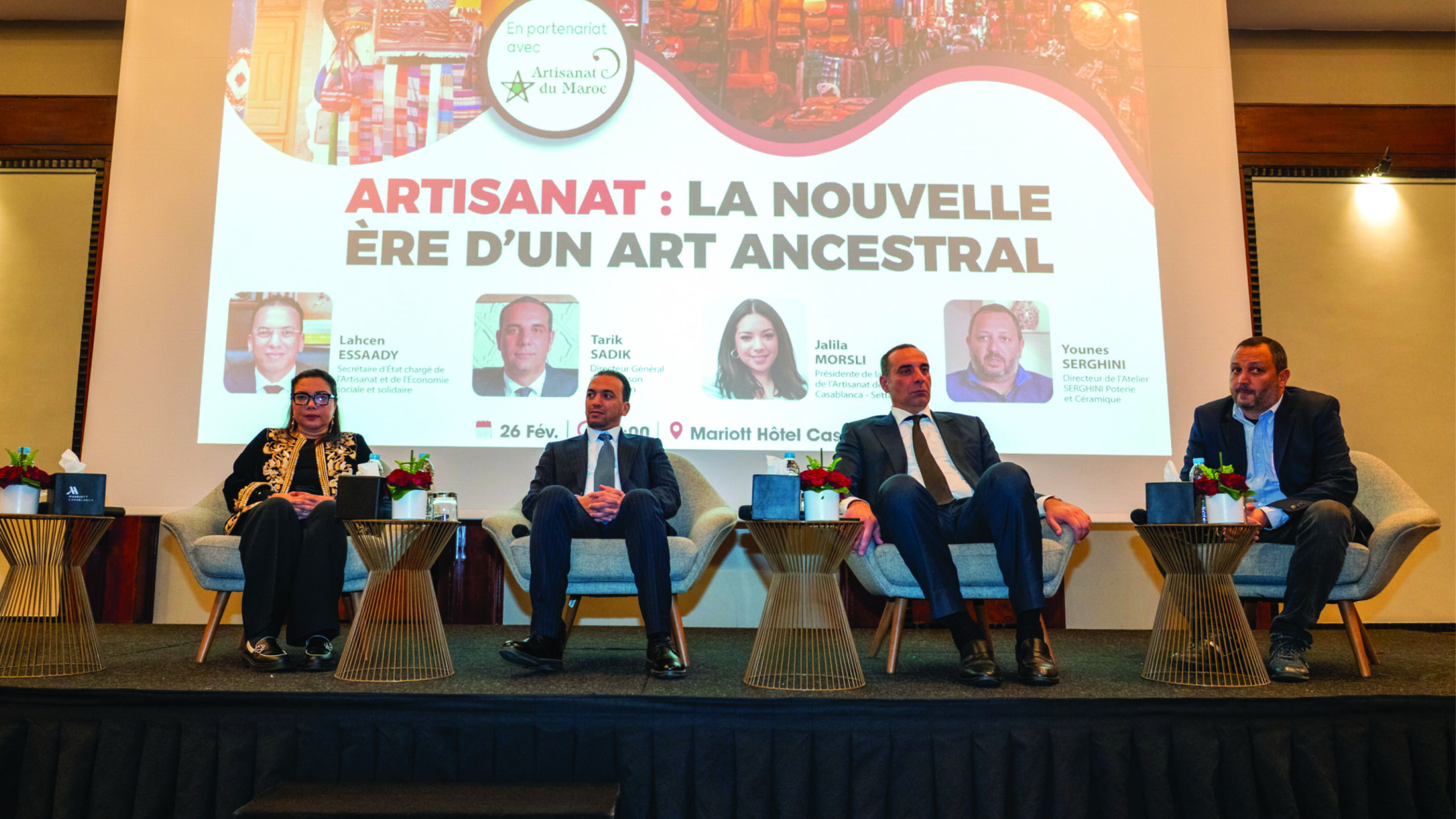
Participants at the conference organized Thursday, February 26, by La Vie Éco all praised this change of direction. Jalila Morseli, president of the Chamber of Crafts of the Casablanca–Settat region—which, contrary to expectations, has the largest number of artisans and achieves the highest export turnover—states in this regard that “what has been accomplished over the past few years far exceeds what was done for craftsmanship over the previous fifteen years.”
“Moroccan craftsmanship is today at a pivotal moment in its evolution,” confirms Tarik Sadik, president of the Maison de l’Artisan. And, he emphasizes—somewhat echoing the vision of the State Secretary—“these transformations are not merely a matter of rhetoric or intentions. They are based on the methodical work of all the stakeholders in the sector.”
Thus, thanks to the collective mobilization of the various partners from both the public and private sectors, as well as their awareness of the sector’s strategic importance, a new dynamic—structured and sustainable—has been established. The National Register of Crafts has thus been created, a nomenclature and a definition of craft activities have been developed, and the National Council of Crafts has been launched.
This has taken place within a new legal framework, since the government activated Law 50‑17 in January 2022 by publishing the implementing texts without which it had until then remained a dead letter. Subsequently, the government launched a vast project to digitalize the Chambers of Crafts and their federation. This has made it possible to launch the ongoing operation of issuing the professional artisan card.
To structure all this work at the territorial level, it was decided to create regional, provincial, and national craft corporations, which now serve as the single interlocutor for the Department of Crafts and the central administration. Organized in this way, the sector currently includes 172 craft activities or trades, divided into 13 sectors, including 56 activities related to service crafts and 116 related to artistic and production crafts.
The most significant change carried out by the government is that craftsmanship is now considered a fully fledged economic sector. The two main actions undertaken in this regard have been the integration of the sector into the new Investment Charter and into the new roadmap for foreign trade.
This translates into specific support for craft enterprises, the creation of a public complementary insurance mechanism to cover export risks, and, finally, effective promotion of Moroccan products through the valorization of the sector and the search for new markets.
In parallel, other measures have been taken, notably accelerating digitalization and strengthening territorial support. Ultimately, since 2022, a major turning point has been achieved, and craftsmanship is now navigating toward a new course.