Kingdom
Civil Nuclear Power: Is Morocco About to Take the Leap?
The need is being felt more and more. With its desalination policy, its green hydrogen projects, its resources, and its ambition for energy sovereignty, the Kingdom is closer than ever to embarking on nuclear power generation.

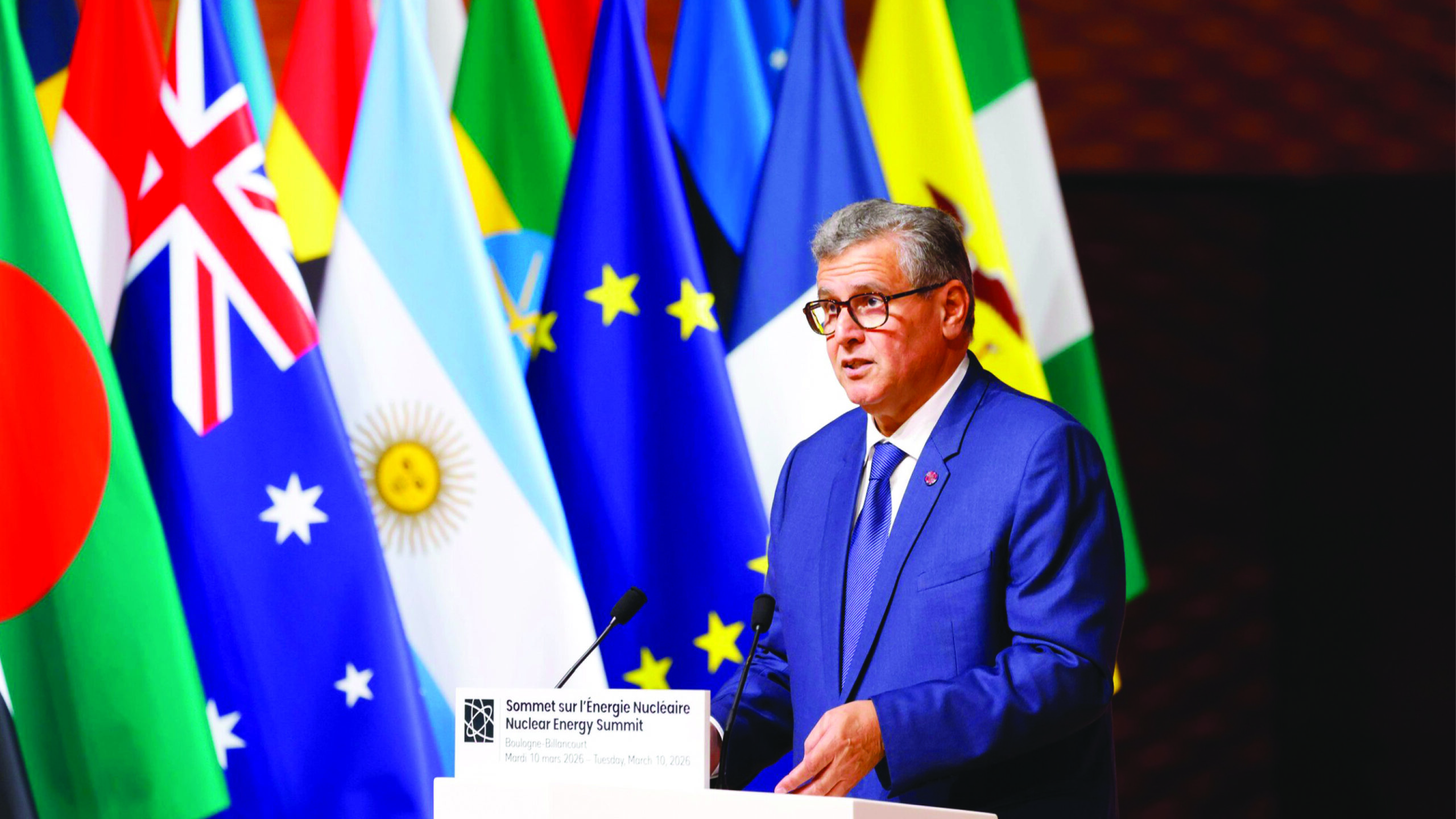
Paris — At the second World Nuclear Energy Summit, the Head of Government Aziz Akhannouch reiterated on Tuesday, March 10, the Kingdom’s intention to acquire this technology for civilian use.
“Morocco considers that the responsible and gradual integration of civil nuclear power into the energy mix is a natural extension of its strategy, and the Kingdom has a solid scientific and institutional foundation in this field,” emphasized the head of the executive branch, who represented the Sovereign at this international meeting.
Morocco launched an integrated energy strategy as early as 2009, based on three fundamental pillars, Akhannouch explained: diversification of the energy mix, the massive development of renewable energies, and strengthening national energy security.
Thanks to this vision, renewable energies accounted for more than 46% of the installed capacity of Morocco’s electricity system by the end of 2025. This share will rise to 52% before 2030—well ahead of the originally set deadline.
By strengthening its renewable energy production capacity, with several projects recently launched, and with the support of hydropower—particularly boosted by the recent rains the country had not seen for several decades—the Kingdom intends to complete its energy mix in the medium and long term through the use of civil nuclear power.
In fact, the head of government noted that beyond electricity production, “civil nuclear energy opens multiple horizons, notably the production of green hydrogen, seawater desalination, nuclear medicine, and food security.”
However, it is mainly the acceleration of climate change, the increase in global energy demand, and the vulnerability of supply chains that “now require a profound transformation of energy systems,” Akhannouch explained, while stressing that “low‑carbon solutions such as nuclear energy can be explored.”
Moreover, in a world where the stability of energy supply goes beyond an economic issue to become a matter of sovereignty, “the question of civil nuclear power emerges as an unavoidable strategic lever.” The Kingdom has been aware of this reality for years. Today, Morocco is ready in every respect to adopt this technology.
Its cooperation with the International Atomic Energy Agency (IAEA) is considered exemplary, and its expertise in the various aspects of nuclear safety and security is well established. In the eyes of the global organization, the Kingdom is ready to take the next step.
Technically, the announcement of the construction in El Jadida of a uranium concentrate production unit (yellowcake, U3O8), with an investment of 100 million dollars, is a sign that Morocco is concretely engaged in this path.
The next step will be to acquire the reactor technology that best suits its needs. In terms of available options, Morocco has many choices: Russian reactors from Rosatom, Canadian technology, French small modular reactors (SMRs), as well as American, Chinese, or South Korean models.
The Russians already have technology dedicated to desalination. In 2023, a memorandum of understanding was signed between the Rosatom group and the Moroccan company Water and Energy Solutions to study desalination projects using nuclear technologies. Cooperation with the United States in this field dates back several decades.
It was in fact General Atomics that supplied the 2‑MW experimental micro‑reactor, operational since 2007 at the National Center for Nuclear Energy, Science and Technology (CNESTEN) in Maâmoura. The company is currently developing modular technologies for civilian applications such as desalination.
Awaiting a decision
Similarly, during his visit to Rabat in April 2024, the former French Minister of the Economy, Bruno Le Maire, proposed strategic cooperation with Morocco in the field of civil nuclear power, particularly focusing on small modular reactors (SMRs).
According to certain sources, this technology appears to be the best suited to Morocco’s diverse needs in this area. According to experts, Morocco seems to be focusing precisely on SMRs—compact reactors ranging from 70 to 470 MW—for several reasons.
First, their modularity; second, their lower cost (estimated between 15 and 20 billion dirhams for a 300‑MW model); third, their rapid construction time (generally 3 to 4 years); and finally, their high capacity factor, which can reach up to 90%. Wind energy, for example—the cheapest source—has a capacity factor of around 60%, while solar is around 20%.
Nuclear technology thus presents itself as a natural option, especially since the required investment is comparable to that of several projects recently launched, particularly in energy but also in transport and logistics.
As for practical matters, the locations of these facilities have already been identified for years. Regarding fuel, Morocco possesses vast uranium reserves—estimated at around 6.9 million tons—contained in its extensive phosphate deposits. This potential positions the Kingdom as a major strategic player.
The head of government confirmed that “the Kingdom’s phosphate deposits, which contain significant quantities of natural uranium, give Morocco an additional strategic dimension in the international debate on civil nuclear power.”
As for enrichment, the Kingdom could initially outsource it to specialized operators, particularly in Russia, France, or even the Netherlands, since Morocco’s needs are too limited to justify developing such an industry domestically.
Ultimately, the final words of Akhannouch’s speech at the second World Nuclear Energy Summit summarize Morocco’s vision: “The energy transformations we are undertaking today, in shared responsibility, will shape the world of tomorrow. The objective is clear: to make civil nuclear power a pillar of regional stability, a vector of lasting peace, and a legacy of progress for future generations.”
As things stand today, after a succession of official statements, Morocco is closer than ever to acquiring this technology. Everything suggests that a decision in this direction may even be imminent.
Favorable global trend
During the second World Nuclear Energy Summit, several themes were discussed, closely aligning with the Kingdom’s expectations in this field.
The discussions mainly focused on the strategic role of nuclear power in the transition toward clean and reliable energy, in the face of rapidly growing global electricity demand.
Participants also addressed the diversification of nuclear fuel supply chains and the financing of nuclear power projects, which is a key factor for large‑scale deployment. There were calls for greater investment from multilateral banks and for the development of innovative financing models.
The emergence of technologies such as small modular reactors (SMRs), innovation, safety, skills training, and waste management were also discussed, along with regional approaches—particularly the potential of nuclear energy in emerging economies and in Africa.