Kingdom
Chronology: 50 Key Dates
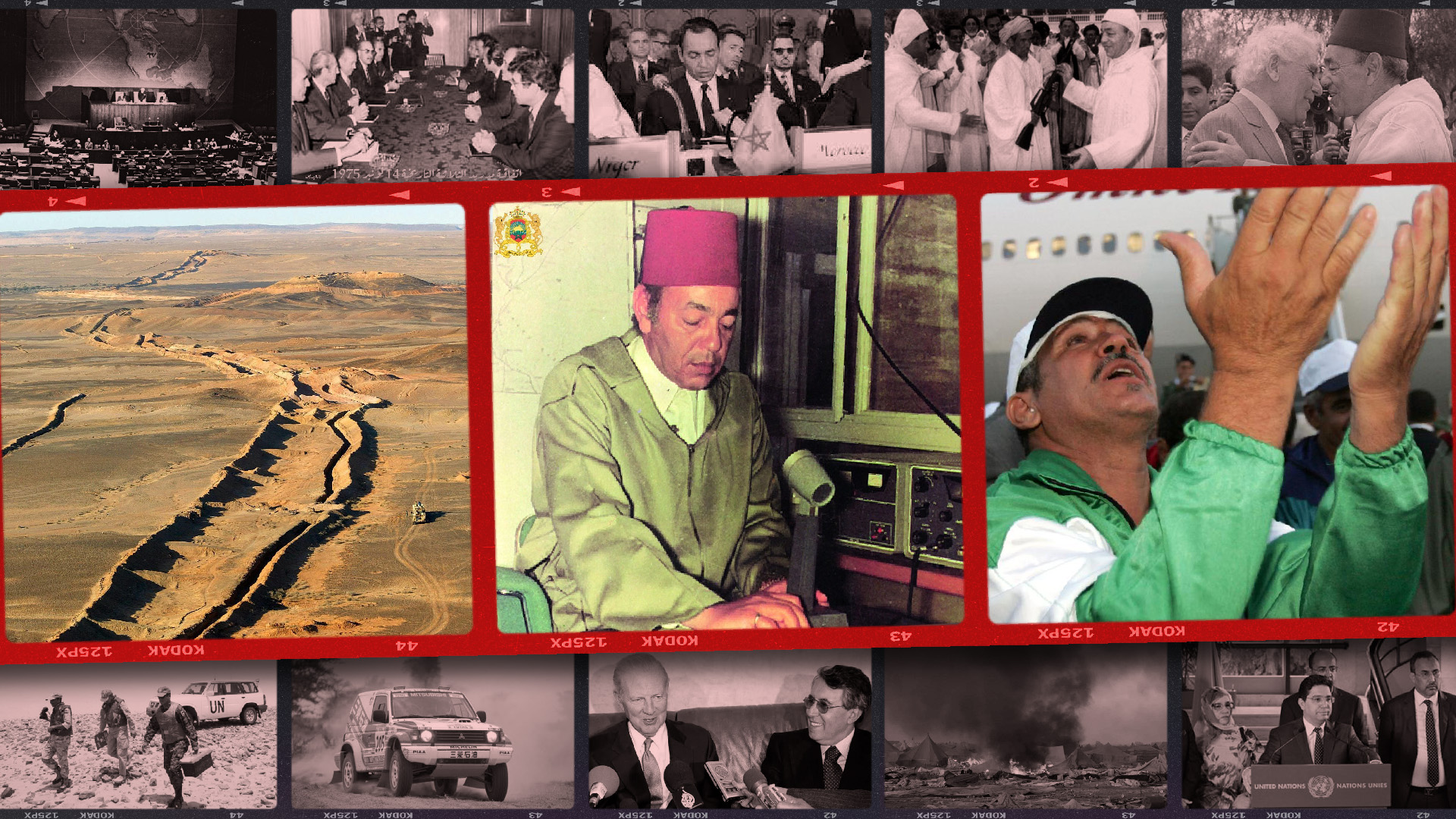
And if we were to select about fifty historical moments to revisit the Kingdom’s visionary management of this premeditated conflict aimed at undermining its territorial integrity. A Selection.

1963
Morocco has the territory of Western Sahara inscribed on the UN list of Non-Self-Governing Territories.
1965
The UN adopts, on December 17th, a resolution calling for the decolonization of the Sahara, despite the opposition of Spain and Portugal and the abstention of France, the United Kingdom, the United States, and South Africa.
1974
Spain conducts, in September, a census of the Sahara’s population. The “Censo-1974” shows a total of 73,497 Sahrawis, including 38,336 men and 35,161 women; 35,909 counted (18,876 men and 17,033 women) are over seventeen years old.
1975
Spanish troops in Western Sahara leave the city of Dakhla on January 12th. This will put an end to the presence of the occupant in the territory of the Moroccan Sahara.
1975
The late Hassan II calls, on October 16th, for the organization of a popular march towards the Sahara, the Green March, following an advisory opinion issued by the International Court of Justice (ICJ) in The Hague.
1975
From the city of Agadir, the late Hassan II officially announces the departure of the Green March on November 5th. He declared: “Tomorrow, the March will begin.”
1975
Signing of the Madrid Accords between Morocco, Spain, and Mauritania on November 14th, establishing the terms of the Spanish withdrawal and the partition of the territory between the two countries. The Declaration was registered on December 9, 1975, and published in the United Nations Treaty Series.
1976
Outbreak of clashes in Amgala which nearly turned into an international conflict between the Royal Armed Forces (FAR) and Algerian troops who provided support to the Polisario. Over 100 Algerian soldiers and officers were taken prisoner, including the current Chief of Staff, Saïd Chengriha, during these battles between January 27th and 29th.
1976
The Permanent Representative of Spain to the UN informs, on February 26th, the Secretary-General that the Spanish government was definitively ending its presence in the Sahara and disengaging from any responsibility of an international character.
1976
Recognition of the SADR (Sahrawi Arab Democratic Republic) by Algeria on March 6th. Rupture of Algerian-Moroccan diplomatic relations.
1979
Morocco recovers Oued-Eddahab, previously attached to Mauritania, on August 14th.
1981
The late Hassan II proposes, on June 26th, the organization of a self-determination referendum to settle the question of the Sahara, during the Summit of the Organization of African Unity in Nairobi.
1984
Official signing of the Union of States between Morocco and Libya on September 1st. A year earlier, Algeria and Tunisia had signed a treaty of brotherhood. It was the most serious attempt to diplomatically isolate Rabat. Morocco’s response materialized with the signing of the Arab-African union treaty in which Gaddafi announced the cessation of his support for the Polisario. The agreement was finally abrogated on August 29, 1986.
1985
The late Hassan II announces, on July 9th, the launch of the first national loan for the needs of the Sahara. The operation resulted in the collection of an amount of 1.65 billion dirhams. Individuals subscribed for 35%, the remainder being subscribed by companies and banks.
1987
An exchange of Algerian and Moroccan military prisoners takes place on May 25th, at Zouj Bghal, a border post located halfway between the Moroccan city of Oujda and the Algerian locality of Akid Loutfi. This operation led to the release of 102 Algerian soldiers captured by the FAR on January 29, 1976, in Amgala, while they were fighting in the ranks of the Polisario.
1987
Completion of the sixth Moroccan defensive wall encompassing 7/8 of the territory of the Sahara. Between August 1980 and April 1987, six walls of different lengths were built.
1988
Morocco and Algeria announce, on May 16th, the normalization of their diplomatic relations at the ambassadorial level, in a joint communiqué broadcast simultaneously in both countries. Relations between the two countries had been interrupted for 12 years.
1988
Javier Pérez de Cuéllar, then UN Secretary-General, presents a peace proposal providing for the signing of a ceasefire and the organization of a referendum on August 11th. The document was validated by both sides by August 30th, but would not lead to an official cessation of hostilities until September 1991.
1989
Omar Hadrami, former head of military security for the Tindouf camps, joins Morocco on August 9th. He had made contact with the Moroccan embassy in the United States to request permission to return to the country. His return was followed by that of Guejmoula Bent Abbi (1991), Brahim Hakim (1993), Cheikh Ali Ould El Bouhali (2000), Lahbib Ayoub (2002), Kalthoum Elkhayat (2003), Hamatti Rabbani (2005), and Ahmadou Ould Souilem (2009), among others.
1990
The United Nations Mission for the Referendum in Western Sahara (MINURSO) was created by Security Council Resolution 690 on June 27th. It was mandated to monitor the preparations and conduct of the self-determination referendum for the populations of the Sahara.
1994
On January 3rd, the Paris-Dakar crosses the Moroccan Sahara for the first time. The sixth stage links Tan Tan to Dakhla over a length of 953 km. During the 7th stage, participants traveled from Dakhla to Nouadhibou over 570 km.
1996
The Security Council decides, on May 29th, to suspend the identification process of persons eligible to vote in the referendum, “until the two parties provide concrete and convincing evidence that they are resolved to resume and complete this process without introducing new obstacles, in accordance with the Settlement Plan.”
1996
A “secret” meeting took place between Polisario and Moroccan officials on September 11th and 12th, under the auspices of the United Nations and Erik Jensen, the personal envoy of Secretary-General Boutros Ghali.
1997
On March 17th, the UN Secretary-General, Kofi Annan, appoints former US Secretary of State James Baker as his Personal Envoy for the Western Sahara.
1997
Signing of the Houston Agreements on September 16th between Morocco and the Polisario. They concern the modalities for organizing the referendum, scheduled for December 7, 1998.
2001
James Baker presents a draft framework agreement on the status of Western Sahara on May 8th. This draft provides for local autonomy for five years, followed by the organization of a referendum.
2004
Launch, on March 5th, of the program for the exchange of visits between Sahrawi families from the Tindouf camps and their relatives residing in the southern provinces of Morocco. The program is run by UNHCR, in coordination with MINURSO and with the agreement of both parties.
2005
The last 404 Moroccans detained by the Polisario disembark on August 18th in Agadir aboard an aircraft chartered by the US Department of Defense. They were released following mediation by Washington and after an agreement between the International Committee of the Red Cross and the Sahrawi Red Crescent.
2006
His Majesty King Mohammed VI announces, in a royal speech delivered in Laayoune, the creation of the Royal Advisory Council for Saharan Affairs (CORCAS). The CORCAS was intended to align the Sahara dossier with the evolution of national policy.
2007
Morocco presents to the UN Secretary-General, on April 11th, the Moroccan Initiative for the Negotiation of an Autonomy Statute for the Sahara Region.
2007
The United Nations Security Council adopts, on April 30th, a new resolution (No. 1754) which calls on the parties to negotiate “with a view to achieving a just, lasting and mutually acceptable political solution which will provide for the self-determination of the people of Western Sahara.” The referendum option is definitively buried.
2008
On April 21st, the Special Envoy of the UN Secretary-General, Peter van Walsum, states that the independence of Western Sahara was not, in his view, “an attainable objective.”
2010
On November 8th, security forces dismantled the Gdeim Izik encampment, which consisted of approximately 6,500 tents set up a month earlier near Laayoune by protesters.
2012
End of the 9th round, on March 13th, of informal talks on the Sahara under the auspices of the United Nations in Manhasset, a suburb of New York (the 1st round took place in June 2007). Two months later, Morocco withdraws its confidence from the Personal Envoy of the UN Secretary-General, Christopher Ross.
2012
On the occasion of the Green March Anniversary, the King tasks the Economic, Social and Environmental Council with developing a new development model for the Southern Provinces. The program was launched in 2013 with a budget envelope of 77 billion dirhams, or more than 7 billion dollars, dedicated to structuring projects.
2014
Commissioning of the Tarfaya wind farm. With a total capacity of 300 MW, it was considered the largest wind farm in Africa.
2015
The King announces, on November 6th, the future construction of an expressway, to international standards, between Tiznit, Laayoune and Dakhla.
2016
The UN Secretary-General, Ban Ki-moon, visits the Tindouf camps on March 5th and explicitly uses the term “occupation” to describe Morocco’s control over the Sahara.
2017
The Kingdom rejoins the African Union. Its return was endorsed during the 28th AU Summit in Addis Ababa on January 30th, with near-unanimity from African heads of state and government. Previously, Morocco ratified the organization’s Constitutive Act, deposited its instruments of ratification, and obtained the support of at least 28 countries.
2018
In a resolution later submitted to the UN, the African Union, meeting at an Extraordinary Summit in Mauritania, found a compromise to allow the AU to play a role in this dossier, without substituting itself for the UN. A troika set up by the AU is now the only body to handle this matter.
2018
Holding, on December 5th, of the first roundtable discussion on the regional dispute over the Moroccan Sahara at the Palais des Nations in Geneva, under the auspices of the Personal Envoy, Horst Köhler. A second roundtable took place in March 2019.
2019
Côte d’Ivoire opens the first honorary consulate in Laayoune on June 26th. On December 18th, the Comoros Islands inaugurated the first general consulate in the Sahara, in Laayoune. For the Kingdom, this inauguration is “the supreme expression of the Moroccan identity of the Sahara.”
2020
Morocco intervenes, on November 13th, at the El Guergarat crossing point against Polisario militias to secure the flow of goods and people.
2020
On December 10th, Donald Trump announces that the United States recognizes Morocco’s sovereignty over the Sahara. A trilateral declaration was signed between Morocco, the United States, and Israel on December 22nd, formalizing this recognition.
2022
Spain decides, on March 18th, to support the Moroccan Autonomy Plan for Western Sahara.
2024
Via a letter addressed to His Majesty King Mohammed VI on July 30th by President Emmanuel Macron, France recognizes the Moroccan identity of the Sahara and supports the Autonomy Plan. Henceforth, for Paris, the present and future of Western Sahara fall within the framework of Moroccan sovereignty.
2025
Morocco and the European Union signed, on October 3rd in Brussels, the exchange of letters amending the Agricultural Agreement linking the two parties. This agreement had previously been annulled by the European Court of Justice. Once again, agricultural products from the Moroccan Sahara benefit from the same conditions of preferential access to the European market as those from the rest of the Kingdom.