Kingdom
AU: How Morocco Is Building Its Power
Less than ten years after its reintegration into the African Union (AU), the Kingdom has become a key player within the organization. And it has no intention of stopping there. The most recent summit showed it: the country continues to gain influence. Analysis.

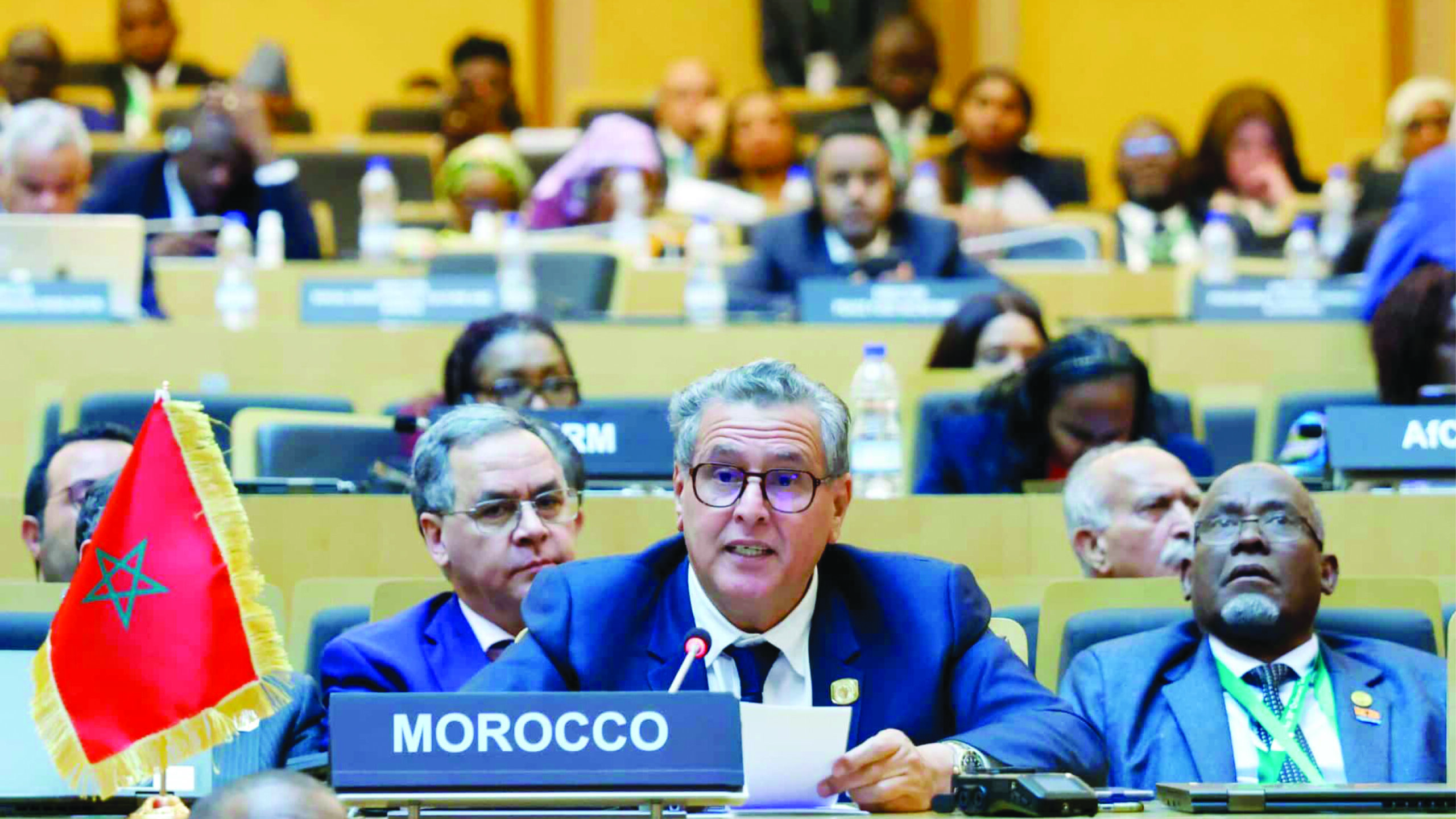
Morocco was elected, for the third time in nine years, to a two-year term on the AU’s Peace and Security Council (PSC). The election itself comes as no surprise.
Since rejoining the organization in January 2017, the Kingdom has definitively abandoned the empty-chair policy and has, ever since, resumed the place that befits it within the Union.
What is interesting to note, however, is the number of votes it secured: 34 in favor—well above the required majority, almost two thirds, moreover obtained in the first round.
This is despite the fact that several countries—longstanding friends and supporters of the Kingdom—are still barred from voting. It is hard, at this point, not to think of the prospect—now within reach—of excluding the SADR from the pan-African organization.
All the more so because, backed by its Algerian mentor, the Polisario put itself forward as a candidate for the seat, before being forced to withdraw its candidacy for lack of support within the AU.
This election “is a major diplomatic success that reflects growing confidence among African states in Morocco. It validates Morocco’s approach, focused on promoting the ‘peace, security and development nexus,’ and positions the Kingdom as a central player in resolving conflicts on the continent,” some analysts comment.
The Head of Government, Aziz Akhannouch, who represented the Sovereign at this 39th AU Summit (February 14 and 15), moreover emphasized the central role played by the African Union’s Peace and Security Council (PSC).
“Morocco’s election for a new term—its third—within this organ of the pan-African organization reflects the confidence the Kingdom enjoys and its contribution to strengthening peace and stability on the African continent.”
Morocco, he said, “will continue to play an active role within the PSC, in service of security, peace and development issues in Africa.”
The PSC, it should be recalled, is one of the Union’s key bodies, tasked with managing issues related to crises, security challenges and the stability of the African continent. In short, this election is both a confirmation of Morocco’s weight within the continent and a sign of the continued loss of influence of those opposed to its territorial integrity.
A pivotal regional player
All the more since the latter suffered another setback during this same summit. Efforts to “have” the Polisario invited to the Italy–Africa Summit, held at the African Union headquarters in the Ethiopian capital, ran up against a categorical refusal by the European partner.
The invitations issued by Rome were addressed exclusively to African states recognized by the United Nations. A concrete reflection on the ground of the new position of the 27 on the Sahara issue and the EU’s support for the Autonomy Plan within the framework of UN Security Council Resolution 2797.
Naturally, as was to be expected, Italy placed this summit within the framework of the Mattei Plan, a strategy presented by Rome as a new pillar of its Africa policy. A plan in which the Kingdom, a partner country, is even presented as one of the pivotal actors, notably in renewable energies, and more particularly green hydrogen.
The same goes for the other major Europe-wide plan to which the Mattei Plan is tied, the EU’s Global Gateway (sustainable infrastructure, digital and energy transition), in which Morocco is also a key partner.
As for the rest, the Kingdom reaffirmed, during this AU summit, its commitment to African collective action aligned with the Union’s Agenda 2063.
In particular, it promoted the 2026 theme on sustainable access to water and sanitation—a field in which it now has proven experience and know-how, whether in hydraulic engineering, seawater desalination, or wastewater recycling.
That is why it proposed hosting a high-level conference on South–South cooperation in this area. Discussions on health sovereignty were also on the agenda of the Health Minister’s participation in Addis Ababa. Amine Tehraoui, speaking at a high-level presidential meeting on operationalizing the African Medicines Agency (AMA), reiterated “Morocco’s full support for this strategic phase of the Agency’s ramp-up.”
This, while stressing the need to swiftly provide it with the resources enabling it to fully play its “central role in strengthening national health systems and in preventing and managing health crises.”
The AMA—whose mandates include harmonizing regulatory frameworks for medicines and medical devices, strengthening the quality and safety of medical products, and improving the supply of medicines and medical devices—is a crucial tool for South–South cooperation in the field.
Morocco, it should be noted in passing, has just launched a continental-scale vaccine production facility, with the aim of meeting the needs of various countries in this area. The Kingdom, with a cutting-edge pharmaceutical industry, intends to strengthen its access to Africa’s health market.
Action diplomacy
In the run-up to the summit, the Foreign Minister held talks with several of his counterparts from all regions of Africa.
While, overall, these meetings—held on February 11 and 12—illustrate Morocco’s proactive approach, having multiplied contacts to consolidate its return to the AU since 2017, some merit particular attention. They strengthen the Kingdom’s position as an African diplomatic pivot.
It is in this context that one can place the talks between the Moroccan and Ethiopian foreign ministers—two countries that have just concluded a military cooperation agreement—of a kind that can strengthen the Rabat–Addis Ababa axis.
The two sides agreed on a major relaunch of bilateral cooperation and increased coordination within AU bodies, whose headquarters are in Ethiopia. A forthcoming meeting of the joint ministerial commission is also envisaged, and beyond that, a strengthened alliance between these pillars of the continent.
With Botswana and the island of Mauritius, the meeting is part of what observers call “diplomacy of persuasion” toward countries once hostile or neutral.
The aim of this kind of meeting is to neutralize adverse narratives and open new channels of economic cooperation. The meeting with the Mauritanian foreign minister is no doubt driven by the imperatives of security coordination, notably in the Sahel context, with a view to the deployment of the Sahel–Atlantic initiative.
This, in addition—among other shared topics of interest—to aligning positions on regional stability and the AAGP Gas Pipeline project. Other meetings are part of the regular work of Moroccan diplomacy to consolidate the bloc of historic allies, of which the recent vote within the PSC is a new sign of solidity.