Business
Assertion of a regional military power
Anticipating the evolution of conflicts, Morocco is betting on the weapons of the future: drones. A technological base for the defense industry is being established at a time when, at the regional level and in terms of security, the Kingdom is called upon to play a leading role.

In its recently published 2025 annual report, NATO devotes increasing attention to the southern neighborhood, presented as “a space where security instability, transnational challenges, and urgent needs for cooperation intersect.” In the organization’s new vision, Morocco is portrayed not as just another partner, but as “an actor called upon to play an increasingly structuring role.” This is one signal. The recent U.S. announcement of the creation in Morocco of a drone training center open to the armies of African countries is another. And this comes at the same time as the conflict in the Middle East, in which drones play a crucial role. The Kingdom is thus on track to become a leading regional player in this field.
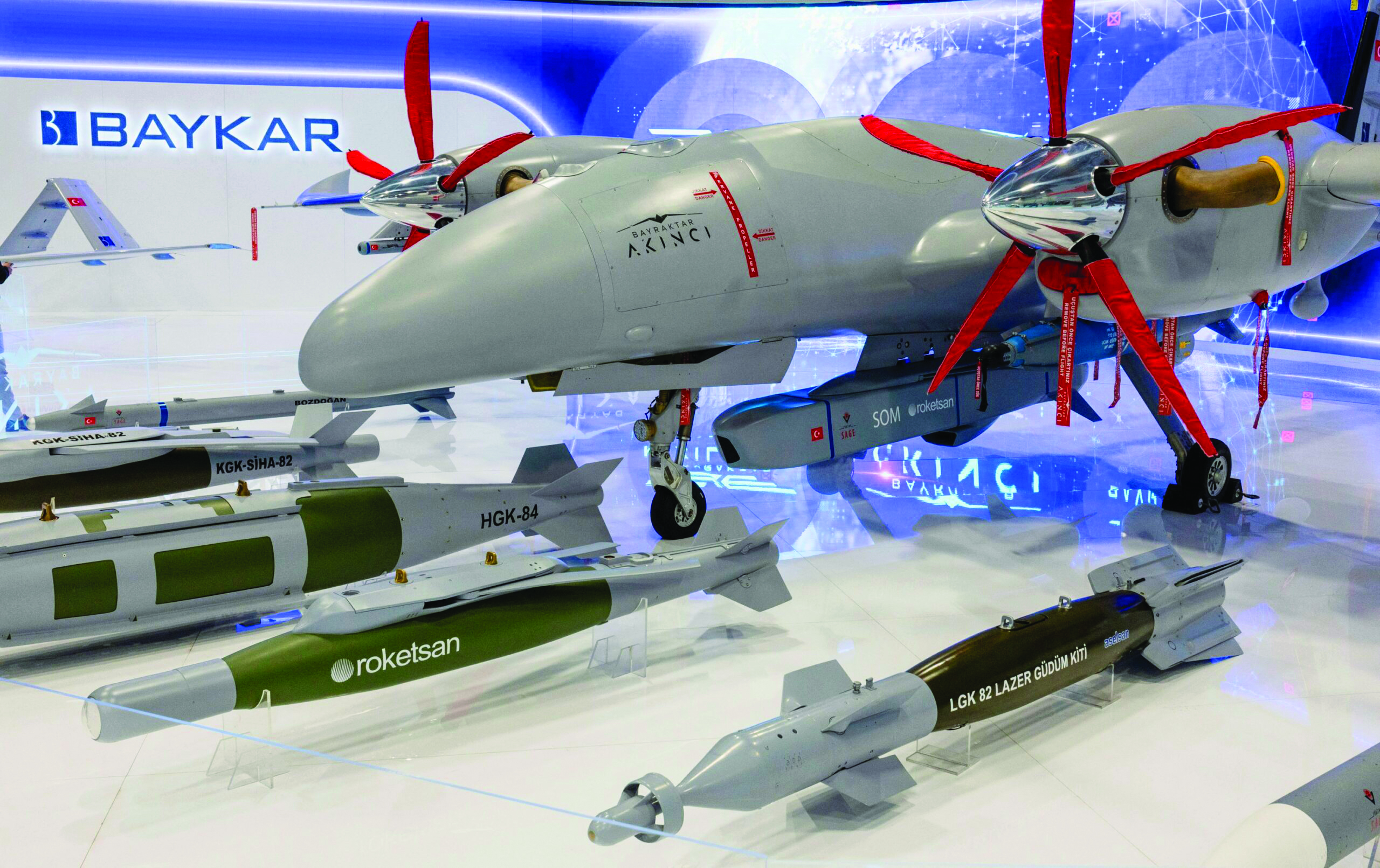
In the defense industry sector, Morocco is, proportionally speaking, in the process of replicating the American model. The industry is developed by private actors under state oversight. This is the case of Turkey’s Baykar, as well as Israel’s BlueBird Aero Systems and India’s Tata Advanced Systems, among other partners that have chosen Morocco as a platform for the external development of their activities.
For the Kingdom, this is a “momentum” it has managed to seize to enter the defense industry. The war in Ukraine has already highlighted the obsolescence of conventional warfare, with armored vehicles, troops, and air cover, and the role of drones in modern wars.
The wars of tomorrow
In the Middle East, for over a month now, the new form of warfare has evolved even further, and drones, kamikaze drones, and anti-drone systems (low-cost technology notably developed by Ukraine) have demonstrated their importance alongside AI and information technologies. According to experts, “the war in Iran has acted as a laboratory for future high-intensity conflicts, highlighting the crucial importance of informational superiority, drones, and multilayered defense systems.”
Morocco, with two production platforms currently being set up, is mentioned as a partner in the production of this type of technology—low-cost attack (kamikaze) and interception drones—within the framework of “friendshoring.” It is worth recalling in this regard that last year, agreements between the UAE’s Tawazun Council (an independent government entity overseeing the development of the defense and security sector) and international actors highlighted the ambition to create “agile and technologically competitive defense hubs,” of which Morocco could become an essential African component. Like Saudi Arabia, the United Arab Emirates has a solid defense industry base and has recently concluded an agreement with Ukraine for drone production.
That said, the major turning point in Morocco’s strategy lies in the transition from a model based solely on arms acquisition to one of co-development and local production. The objective is to make the defense industry a sovereign champion capable of projecting its technological credibility beyond its borders. While building its technological and military sovereignty, consolidating its alliances with the United States, Europe, Israel, the GCC, and other allied countries, and forging new ones, mainly in East Africa, the Kingdom is already establishing itself as an active player in the new regional order in the aftermath of the war in Iran.