Business
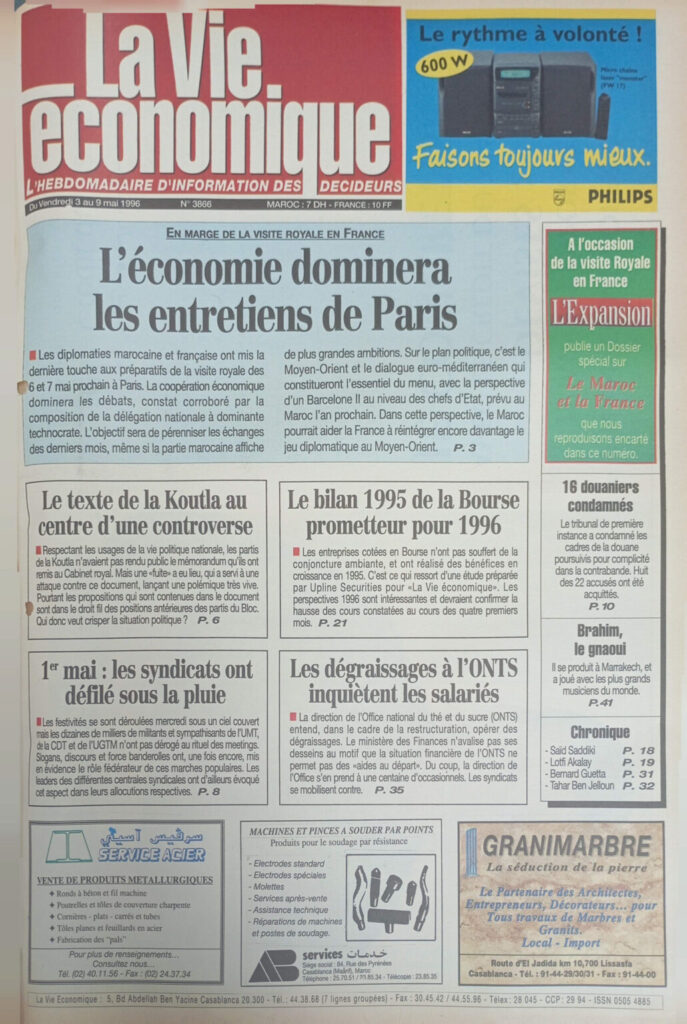
Archives LVE 1996. Morocco–France: The economy first
Thirty years ago, Moroccan and French diplomacy put the finishing touches to the preparations for the royal visit to Paris on 6 and 7 May. Economic cooperation dominated the discussions.


Relations between Morocco and France have warmed since Jacques Chirac came to power. He had been keen to make Rabat his first trip outside Europe.
Since the July 1995 Summit, no fewer than 12 ministerial visits have taken place, most often marked by the signing of bilateral agreements. The primary aim of the royal visit is to maintain this momentum, in the words of a French diplomat. Is everything going perfectly? Yes—but with different tones in the two capitals.
One of Morocco’s main “demands” concerns the nature of the cooperation being sought. “We cannot have economic cooperation—whether public or private—at the level of the political ties that exist between the two countries while using the same tools as 20 years ago.”
This point had already been presented to the French delegation during Mr Chirac’s visit to Rabat. When receiving a delegation of Moroccan journalists at the Élysée in October, the French President declared: “We understand this Moroccan sensitivity and its validity.” He also asserted that technocrats on both sides were working to implement it.
Within the Moroccan delegation’s circle, it is said that “there will be no specific dossiers, but rather an expectation that France will adopt an ambitious and innovative approach, defining clear objectives for cooperation between the two countries.”
However, it is on the issue of debt that the Moroccan side is waiting to see what effort France is prepared to make.
France is the Kingdom’s leading creditor, and easing the debt burden would help reduce budgetary pressures, even if Morocco’s priority is to convert that debt into investment.
Members of the delegation are also leaving with projects to propose to the French private sector: seaside development, agro-industry in the North, etc. The presence of Abderrahmane Saaidi is intended to attract French investors’ interest in the privatisation process, in which they have so far participated only minimally.
On the French side, the tone is rather one of self-satisfaction. In less than a year, several bilateral agreements have been signed. The visit of Mr Jean Arthuis, Minister of the Economy, led to an agreement involving over one billion francs in debt relief.
France emphasises what has already been achieved, but also the support its diplomacy has given Morocco during negotiations on fishing and association agreements with the European Union. It therefore does not expect spectacular new initiatives, even though, in all discussions, tribute is paid to Morocco’s role in the Mediterranean.
Between Moroccan ambitions and French satisfaction, will the friendship linking the two heads of state succeed in forging a middle ground? Beyond sentiment, however, Morocco holds a strong card: politics.
French diplomacy repeatedly stresses the importance of Morocco’s involvement in the Mediterranean. A pole of stability in the Maghreb, Morocco is also highly influential in the Middle East peace process.
France has multiplied its efforts to play a role in this process and needs Morocco’s support to re-enter the diplomatic arena in the region. This prospect is all the more plausible given Jacques Chirac’s assertive stance during the recent Lebanese crisis, to the point that Shimon Peres stopped in Paris on Wednesday after signing a military agreement with Washington.
In return, French diplomacy is working actively to help Morocco host a major event: Barcelona II, a meeting of countries from both shores of the Mediterranean.
France proposed that this forum be held in Morocco in the first quarter of 1997, and that it be elevated to the level of heads of state, whereas Barcelona I had been held at the ministerial level. In Europe, this proposal has received considerable support.
Opposition comes from two Arab countries: Tunisia, which—as usual—is seeking to host the event itself, and Syria.
Damascus opposes it for political reasons: it does not want such a meeting to take place in a southern Mediterranean country as long as the peace process has not progressed. Syria had already boycotted both the Casablanca conference and the Barcelona meeting for the same reasons.
In any case, the Paris–Rabat partnership is back on track, and the royal visit should help consolidate a privileged relationship… fully grounded in formal legitimacy.
La Vie Économique