Kingdom
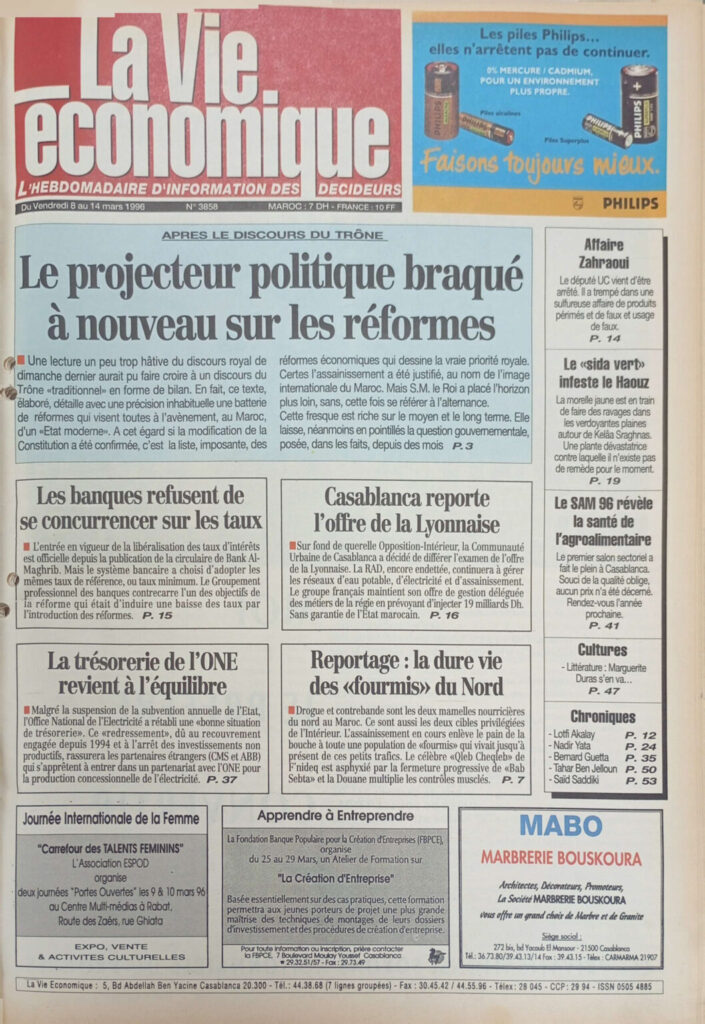
Archives 1996: On Board the “Western Train”
Thirty years ago, green trains dating from the 1960s carried crowds of small-time smugglers loaded down with bundles of contraband. The last one departing from Tangier, famous under the nickname “the Western train,” was one of them.


This woman is fat, undeniably so. She must measure easily 1.5 meters around the hips. What’s curious is that she also measures 1.5 meters around the bust and likewise—stranger still—1.5 meters around the waist.
A tower, in a way. In fact, a perceptive observer will quickly understand that this woman is hiding under her bright yellow djellaba the equivalent of three or four thousand dirhams’ worth of goods.
Mostly leftover stock from Fnideq: about thirty pairs of pajamas, which she has wrapped around her body in a perfectly even way. She isn’t the only “tower” on board the night train. Moving through the compartments, you come across mauve ones, gray ones, and multicolored ones. Another trick in vogue for getting goods through: the fake baby.
The idea is to strap a bundle onto one’s back the way you would carry a child, and wedge it against the corner of the carriage so as to hide it from a potential inspector’s view. Which isn’t very convincing, since a real baby in that position would have time to suffocate a hundred times over during the journey.
Of course, these crude ruses fool no one—least of all the ONCF inspectors. These caricature-like scenes are the direct result of the anti-smuggling campaign: a new regulation has been introduced under which a traveler is allowed a maximum of two pieces of hand luggage.
Anything extra must go in the luggage hold… which is practically the same as being lost, since customs officers have taken to regularly emptying it of anything that looks even remotely like contraband.
The result: smugglers—generally women—compete in ingenuity so they only appear to be carrying two packages while roughly hiding the rest. No one is fooled, but a kind of psychological warfare sets in this way.
The “tower women,” or those with fake babies, seem to be saying to the inspectors: “Take my goods if you can.” And the inspectors play along, pretending to find perfectly slender the many Michelin-men they pass from carriage to carriage. The atmosphere remains friendly.
To an old woman who is apparently unaware of the new regulation and is carrying three packages, the inspector—reluctant to use his authority—will suggest repacking her bundles so as to sacrifice only the least valuable goods.
Fatima, the “pajama tower,” lives in Casablanca, “in a working-class neighborhood,” she specifies. She has four daughters, two of whom are in private school because they were expelled from “makhzen” schools, and Fatima is absolutely determined that they study. No husband? Yes—unemployed. Wrongfully dismissed from a textile factory for excessive union activity, still uncompensated to this day. Legal proceedings are ongoing.
The trafficking? Fatima does it so her family can eat, and she insists she takes no pleasure at all in playing the clown every night—especially since customs officers and gendarmes are not as understanding as the inspectors. And they board the train about every other trip.
Absurd question: doesn’t Fatima ever think she’s breaking the law, at least a little? A slight smile: “Apparently, yes. But why don’t they stop us at Benjdia (when leaving Casablanca)? And anyway, what else can we do? Do you want me to tell my daughters to become prostitutes?
Tell the ‘Makhzen’ to give us a minimum allowance, enough to buy oil and bread, and we’ll consider anything—even selling harira to construction workers.” General laughter in the compartment.
A young man follows up after Fatima: to survive, the state leaves him only “makeshift” solutions like this. He is a boxer by trade, and the wrongdoing he has observed within the federation reflects all the many others in the country.
Another young man joins in, and it becomes a collective tirade against corruption, politics and politicians, bureaucratic incompetence, gerontocracy, and so on. Fatima follows the debate with a distracted eye.
Politics—all that—she understands nothing about it and wants to understand nothing. All that matters to her is securing her daily “piece of bread.” The boxer replies: “You’re doing politics without even realizing it, mother.”
A.R. Benchemsi