Kingdom
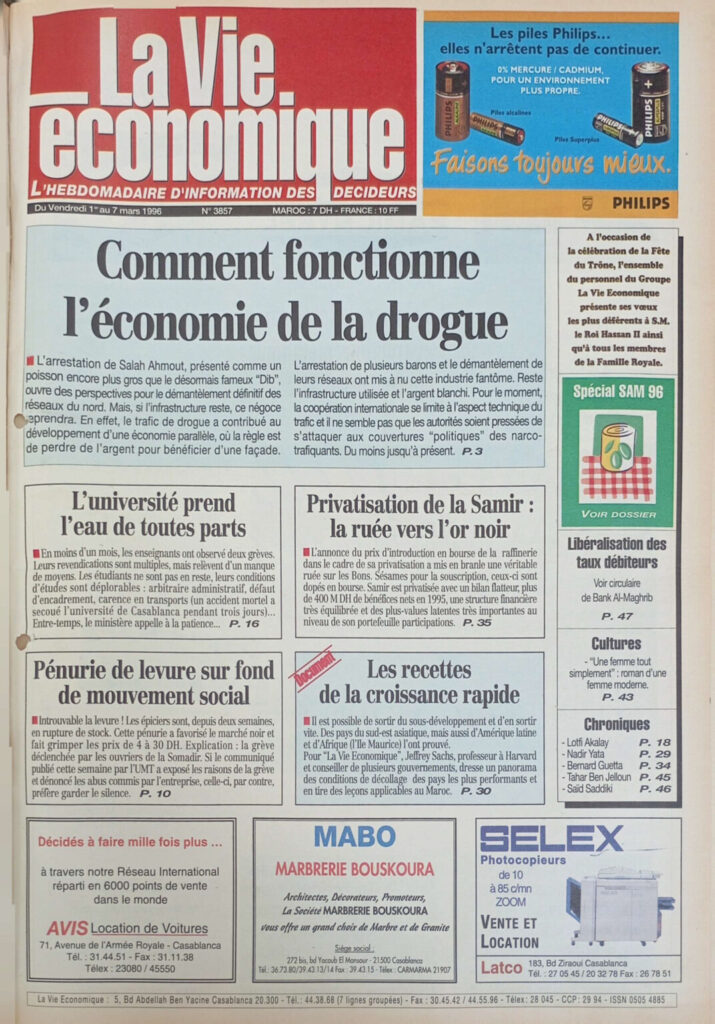
Archives 1996. Drug Economy: Instructions for Use
Thirty years ago, Morocco discovered—through the anti-drug crackdown—an entire economy built on dirty money and international connections.


“Between smuggling and drugs, I’m very much afraid that Morocco is currently being reduced—like Colombia or I don’t know what other Third-World banana republic—to the image of a mafia country.”
In Casablanca, the remarks of this industrialist, who wishes to remain anonymous, in fact reflect the whole problem underlying the clean-up campaign. It has been going on for far too long, the authorities say. But why wait so long before cracking down, public opinion wonders.
Hmidou Dib, El Yakhloufi, Derkaoui, Ahmout—among others, some of the most important drug traffickers—are today behind bars. The customs officers, police officers, authority agents, even the politicians who protected them, are not all there.
At least not yet. “Otherwise, there wouldn’t be many left to take care of citizens’ affairs—assuming that their work, up to now, has been to serve the public interest,” the man in the street jokes.
A phantom economy
In Tangier, but also in the other cities of the North, and even in the center of the country, “businesses” flourished for years in productive sectors, serving as a front for major dirty-money laundering operations.
Agricultural land was bought at a high price, always in cash, to house small-scale factories, so as not to arouse suspicion. In order to obtain the necessary permits, paid-for complicity became common practice.
The essential thing was to integrate into the commercial circuit, with all that implies—opening bank credit lines, allowing a “normal” circulation of “narco-dirhams.” Brickworks, garment factories, agricultural produce packing stations, and agri-food canneries were invested in by the “nabobs” of the narcotics trade.
But another objective was also being pursued: to “process” the drugs in complete peace of mind. According to certain information, companies with an established public presence in the center of the country served as filling centers for hashish coming from the Rif.
Quantities of chira were thus discovered in the folds of rolls of fabric, even in the linings of garment products intended for export.
In tin boxes supposedly containing olives intended for export, inspectors were able to discover carefully preserved slabs of hashish. And examples abound to the point of constituting a veritable raw material for feeding serial thrillers.
Moreover, these centers, concentrated along the Casablanca–Mohammédia and Salé–Kénitra corridors, provided excellent cover for traffickers to explain their personal enrichment.
In addition, operating in export-oriented sectors, these companies made it possible to offer a transit base to Latin American cocaine networks. International cooperation between Morocco and its foreign partners led to the arrest of many Spanish drug traffickers.
According to diplomatic sources, the number of Spaniards arrested in the Kingdom following the dismantling of national networks is close to 80. Several of them had already had run-ins with their country’s justice system in connection with Operation Piton conducted in 1990 by Judge Baltasar Garzón.
A report by the Drug Enforcement Agency (DEA) is said to have lifted the veil on these connections. But American diplomats posted in Rabat are not commenting on this information.
Cleaning up would therefore mean taking on these phantom industries. Cleaning up would also mean dealing with the godfathers. For who can still believe that this entire economy—with its networks and its infrastructure—could have flourished like this, right under the authorities’ very noses! “The time for protection is over,” we were told. Still, it has to be proven…
The problem of the northern regions remains. “Boosted” for years by drug money, they now find themselves in a difficult situation.
Indeed, many observers agree on the need for the state to pursue an immediate, proactive policy in these provinces. Unemployment and poverty are breeding grounds for every danger. Now that the clean-up operation has begun, it must be carried through to the end.
M.M. AND A.E.M.
CamScanner 23-02-2026 10.11