Business
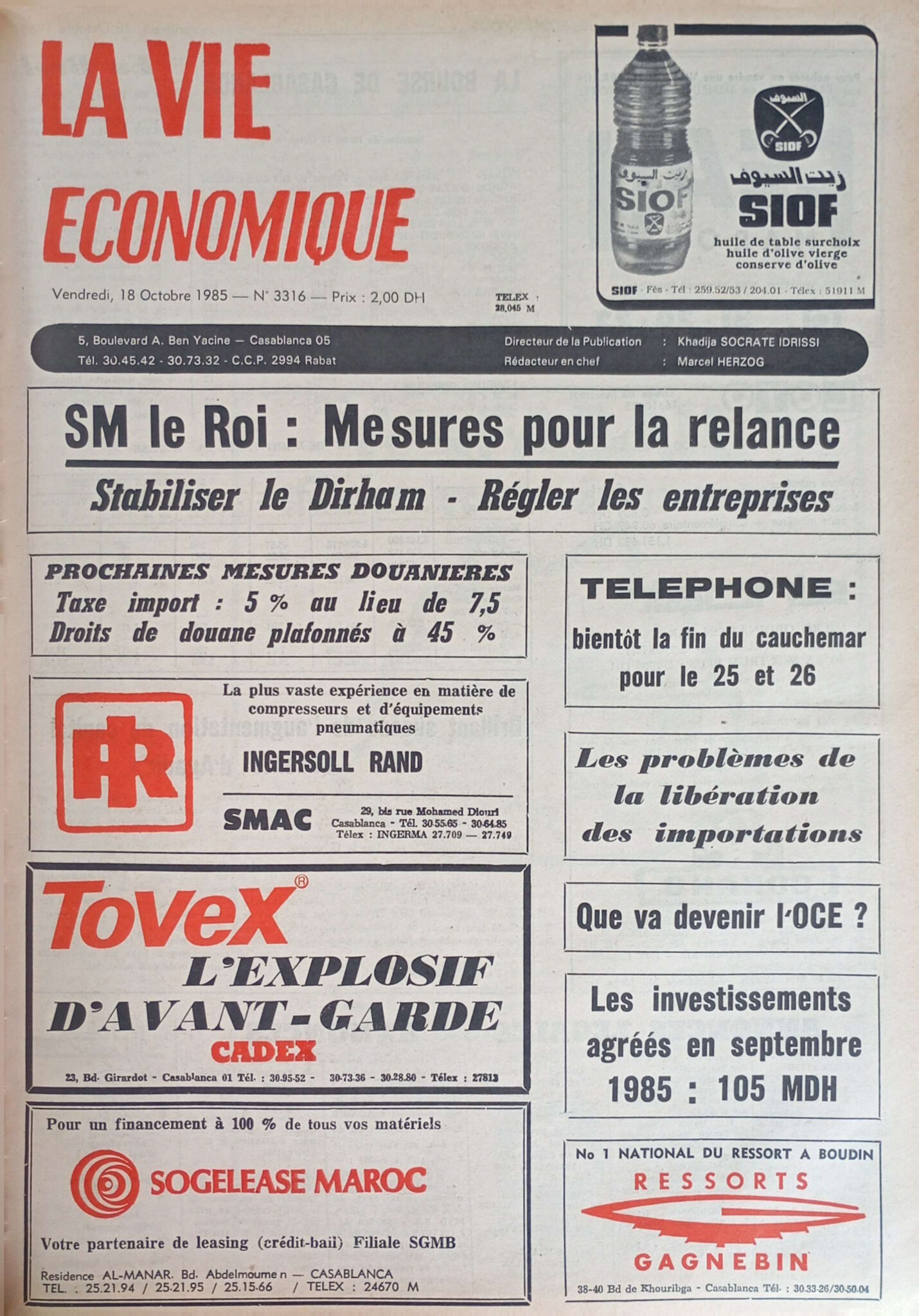
Archives 1985: Stabilizing the Dirham
Forty years ago, in the speech delivered at the opening of the autumn parliamentary session, the Sovereign outlined the measures to be implemented to revive the Moroccan economy.

The speech delivered by His Majesty Hassan II on October 11 during the opening of the autumn session of the House of Representatives gave, on the one hand, the signal for economic recovery, and on the other, announced Morocco’s temporary withdrawal from the peace process on the external front.
Recent events, indeed, and especially the bombing of Tunis, have dealt a possibly fatal blow to the peace initiatives that were being patiently woven.
His Majesty the King, with the high sense of duty he holds as acting president of the Arab Summit and his conscience entirely devoted to the pursuit of peace and justice, could only distance himself while awaiting a clarification of a situation where passions have overridden reason. But the problem of the Sahara remains.
The speech that the Sovereign was to deliver before the United Nations General Assembly will be read by the Prime Minister, Mohamed Karim Lamrani.
On the domestic front, the Sovereign gave his directives, which in fact constitute the signal for action aimed at ensuring the revival of the national economy within a framework clearly defined by His Majesty the King.
First, it is about “putting a definitive end to the depreciation of the dirham.” This depreciation has in fact exceeded 25%, whereas a margin of 15% was deemed sufficient.
The stabilization of the dirham is a necessity, as it determines the confidence of foreign investors and SMEs, particularly regarding the national loan, the scope of which will ultimately extend beyond the Sahara alone.
Indeed, it is about opening this loan to national and foreign legal entities. Regarding financial and monetary policy, His Majesty the King reaffirmed his confidence in international financial institutions, which, he said, have shown “flexibility and understanding” toward Morocco.
Morocco will assert its sovereignty, but it will not enter into conflict with the IMF and the World Bank.
Finally, His Majesty Hassan II included among the first measures to ensure economic recovery the payment by the State of its debts to companies and businessmen “so that, he emphasized, our country can, by the end of this year, take off with dynamism and enthusiasm.”
“All available funds will be used to finance construction and equipment work, but we will remain committed to austerity and to not impoverishing the citizens,” concluded His Majesty the King.
It is now to be hoped that Parliament will grasp the full scope of this message, which, in concrete terms, has charted the path to recovery.
This recovery involves in particular the reorganization of various sectors, starting with the tax sector.
The country expects its representatives to quickly examine the Tax Reform, taking into account the interests of the State and not selfish considerations.
In this speech, more particularly devoted to economic affairs, the Sovereign outlined the measures to be implemented, which are capable of creating the conditions for the revival of the national economy: maintaining relations with Morocco’s international creditor organizations, but with strict respect for its sovereignty, while explaining to them its real needs and the limits it cannot exceed.
Likewise, it is about settling as much as possible the debts contracted with companies, especially those that have served the State, so that factories can reintegrate all their employees and so that Morocco can pursue its development effort without delay or haste.
Also, the Sovereign insisted on the necessity of not letting the Moroccan currency depreciate. The royal speech called for the extension of the loan to legal entities.