Kingdom
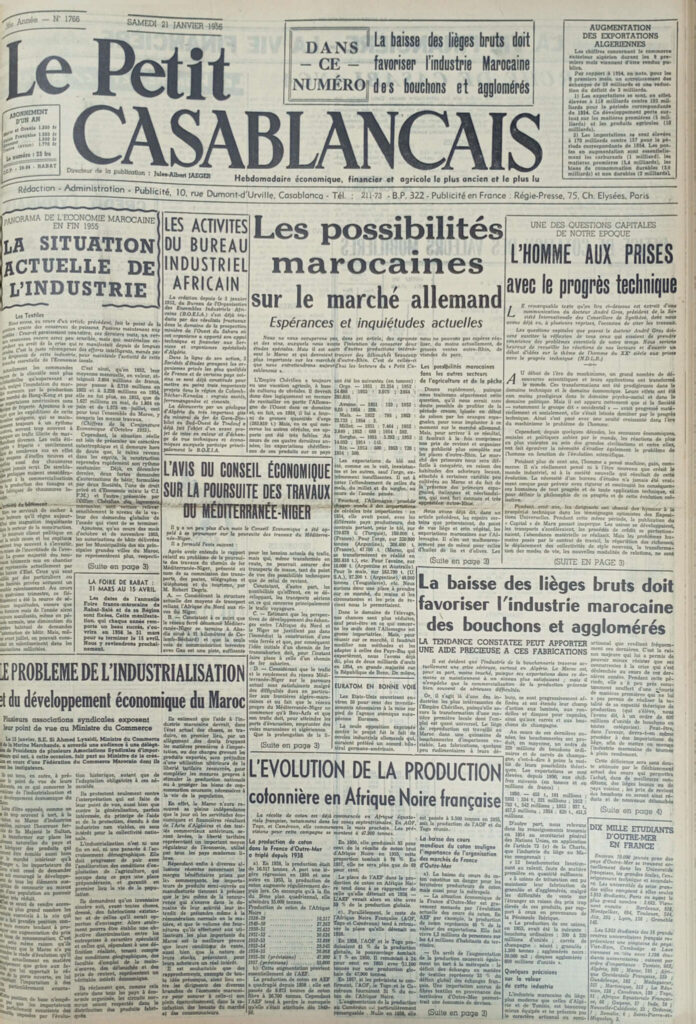
Archives 1956: The Problem of Industrialization
Seventy years ago, several trade union associations presented their views to the Minister of Trade. Imports, import substitution, purchasing power… were among the issues raised.


On January 12, Ahmed Lyazidi, Minister of Commerce and the Merchant Marine, granted an audience to a delegation of presidents from several importers’ trade unions. On this occasion, they informed the minister of the ongoing creation of a Moroccan trade federation, of which they are the instigators.
Furthermore, they wished to clarify their members’ viewpoint regarding the problem of industrialization and the economic development of Morocco.
Far from being opposed—as has too often been wrongly claimed—to the establishment in Morocco of industries capable, in the felicitous phrase of His Majesty the Sultan, “of transforming the country’s natural resources on-site and manufacturing products that can be marketed both domestically and abroad,” Morocco’s importers have continually called for the encouragement of all elements likely to contribute to the well-being of a population with very limited purchasing power.
It is this concern to make essential goods accessible to the greatest number that has led them to take a stance against any measure tending to provoke an increase in the price of consumer goods.
For this same reason, they consider that Morocco has only been able to reach its current stage of development in terms of equipment thanks to the facilities provided by the open-door policy, which allowed for imports at particularly advantageous prices.
This fundamental position does not prevent importers from being perfectly aware of the necessities imposed by historical evolution, as much as the obligatory adaptation to these necessities.
They protest only against the interpretation given to their viewpoint, as well as the generalization—sometimes self-interested—of the principle of aid and protection, extended to industries that are not viable or hold no interest for the national community.
Industrialization is neither an end in itself nor a panacea for demographic growth. It must progress in tandem with the improvement of conditions for agricultural exploitation, which occupies a preponderant place in this country and first and foremost guarantees the population’s livelihood.
They demand, above all, that a sincere inventory of existing manufactures and those it would be appropriate to consider be drawn up. Only then can an objective discrimination be established between enterprises of a speculative nature and those which, meeting a realistic definition that takes into account geographical conditions, labor employment capabilities, market outlets, and production costs, represent a genuine economic interest.
They demand that, as exists in all countries with an organized economy, normal channels be respected in the distribution of manufactured products.
They believe that aid to Moroccan industry should, in the present state of affairs, translate first and foremost into a reduction of duties levied on imported raw materials, or charges burdening exported products, without prejudice to a later use of the recovered tariff freedom to complete measures intended to stimulate national production or protect everyday consumer goods necessary for the population’s life.
Indeed, Morocco will only have recovered its full independence on the day when the economic and financial constraints resulting from the Act of Algeciras and prior commercial treaties are lifted, with tariff freedom representing an important regulatory tool for the economy, used by all free modern nations.
Finally, in response to various recent allusions concerning profit margins taken by merchants, importers of semi-finished or manufactured goods wish to specify that the very play of competition within their field of activity prevents them from claiming normal remuneration in this matter, and that the volume of supplies they provide to Morocco’s most important users is the best proof that their sales conditions, as well as the nature of their stocks, present a real interest for their buyers.
It is desirable that meetings, free from any preconceived ideas, take place between the leaders of the various branches of the Moroccan economy to ensure its full flourishing, in the satisfaction of market and consumer needs.
Le Petit Casablancais
CamScanner 12-01-2026 10.44