Kingdom
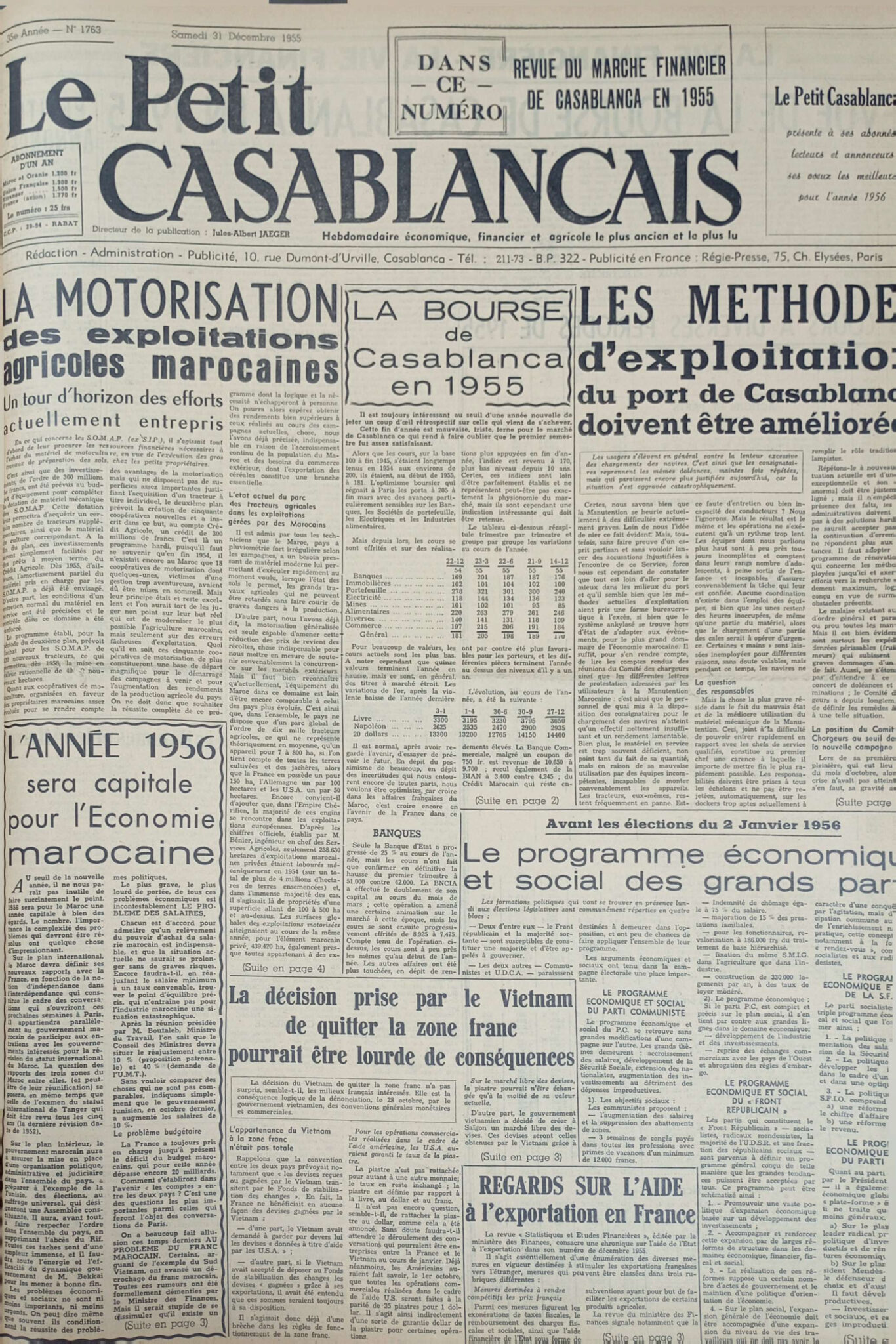
Archives 1956: A Pivotal Year for the Economy
Seventy years ago, between political adjustments and economic challenges, the agenda promised to be a heavy one. Overview.

At the threshold of the new year, it does not seem useless to us to briefly take stock. 1956 will be a pivotal year for Morocco in many respects. The number, importance, and complexity of the problems that will have to be resolved are somewhat impressive.
On the international level, Morocco will have to define its new relations with France, based on the concept of independence within interdependence, which constitutes the framework for the conversations that will open in Paris in the coming weeks.
Simultaneously, it will fall to the Moroccan government to participate in talks with the interested governments for the revision of Morocco’s international status.
The question of the relations between the three zones of Morocco (and perhaps their reunification) will arise, along with the review of the international status of Tangier, which must be revised every five years (the last revision dates from 1952).
On the domestic front, the Moroccan government will have to ensure the establishment of a political, administrative, and judicial organization throughout the country, and to prepare, following Tunisia’s example, elections by universal suffrage, which will designate a Constituent Assembly.
Above all, it will have to restore order throughout the country, by removing the abscess of the Rif.
All these tasks are immense in scope, and it will require all the energy and dynamic efficiency of Mr. Bekkai’s government to bring them to a successful conclusion.
The economic and social problems are neither less important nor less urgent. One can even say that often, they condition the success of the political problems.
The most serious, the most far-reaching of all these economic problems, is unquestionably the wage problem.
Everyone agrees that an increase in the purchasing power of the Moroccan wage earner is indispensable, and that the current situation cannot be prolonged without serious risks.
Yet, in readjusting the minimum wage to a suitable rate, the precise point of balance must be found, one that does not lead to a catastrophic situation for Moroccan industry.
After the meeting chaired by Mr. Boutaleb, the Minister of Labor, it is known that the Council of Ministers will have to place the readjustment between 10% (employers’ proposal) and 40% (demand of the UMT).
Without wishing to compare things that are not comparable, let us simply indicate that the Tunisian government, last October, increased wages by 10%.
The Budgetary Problem
France has always covered the deficit of the Moroccan budget up to now, which for this year still exceeds 20 billion. How will accounts be settled between the two countries in the future?
This is one of the most important questions among those that will be the subject of the Paris talks.
Much has been made recently of the problem of the Moroccan franc.
Some, citing the example of South Vietnam, have suggested a decoupling of the Moroccan franc. All these rumors have been formally denied by the Minister of Finance. But it would be foolish to conceal that there exists a movement, of external inspiration, working towards an abandonment of the franc zone.
If these chances do not appear very serious at the present time, a worsening of the economic situation would dangerously increase them.
We have only given a very summary overview of the main problems facing Morocco in 1956.
Many others could be cited, concerning agriculture, housing, industrial decentralization, the organization of exports, etc.
The new work to be accomplished requires an effort from the entire Franco-Moroccan community.
It offers everyone very fine prospects for success, provided that the basic conditions, that is to say solidarity and mutual understanding, are respected.
CamScanner 22-12-2025 09.57