Kingdom
Architects Redesigning Morocco
Unseen yet indispensable, Moroccan architects are drawing the lines of a Kingdom in transformation. At the crossroads of tradition and boldness, they design works that capture our gaze and spark our collective pride. Six of them are behind some of the most emblematic achievements. A discovery.

They do not cut the ribbons, nor lay the foundation stones, and their names fade from the site hoardings when they become inaugural plaques. They do not build walls; they draw visions. Without them, no building would come to life. But behind every monumental façade, every bold curve, lie their pencils and their creativity.
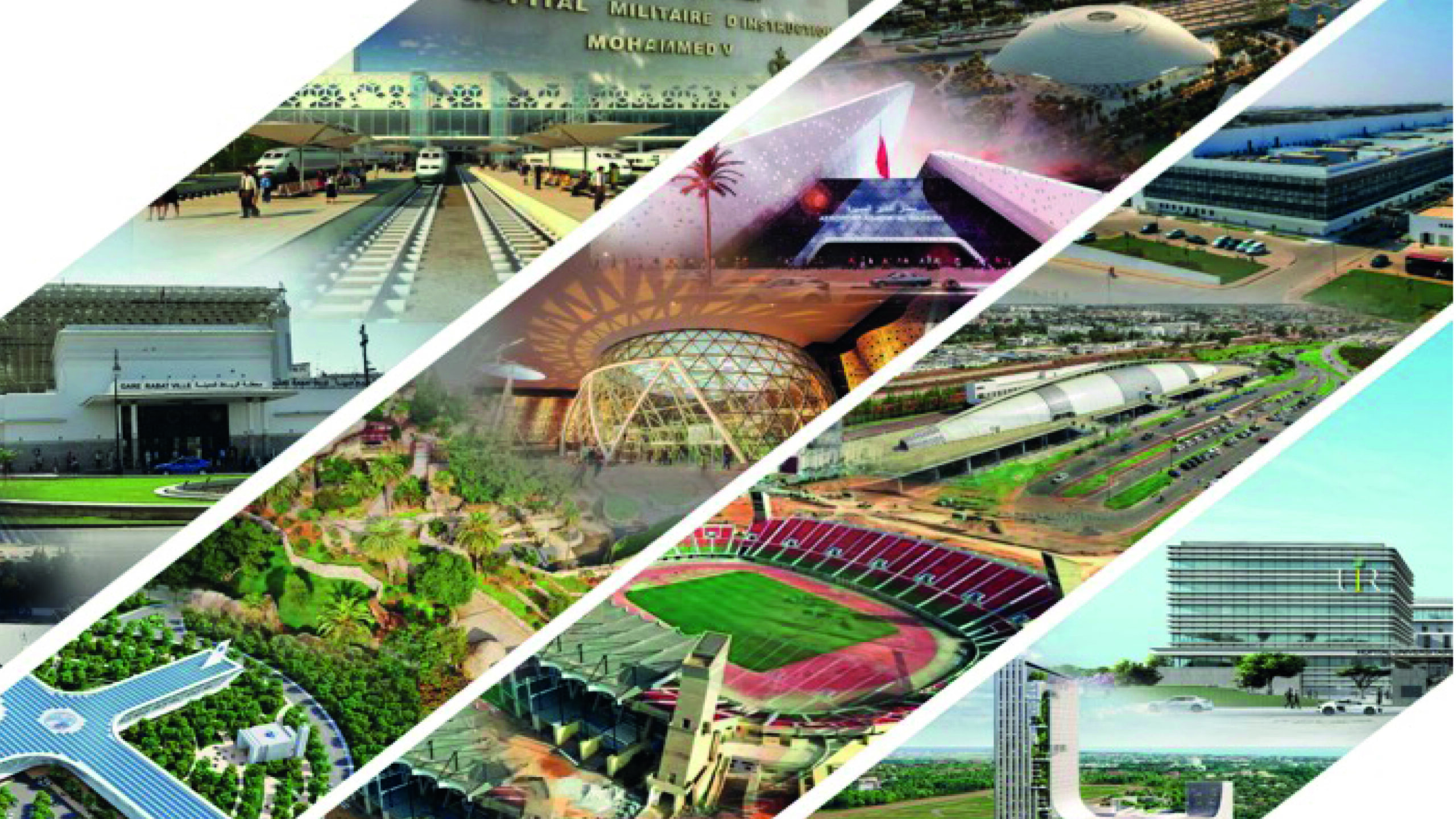
In the quiet of their studios, Moroccan architects are reinventing the contours of the Kingdom for the new millennium. From train stations to airports, through stadiums, hospitals, urban hubs, institutional headquarters, cultural complexes, and other public facilities, major projects abound.
From this substantial portfolio, we have selected a sample of 25 fairly representative projects, recently completed or underway, totaling a budget of 34.5 billion dirhams. Just that…
A review of the allocations for these major projects reveals a recurring presence of emblematic figures. Six of Morocco’s most prominent architects account for two-thirds of the 25 projects in our selection. Naturally, the investment volume of these public projects is proportional to the fees of the architects who secure the contracts.
Based on estimates using rates announced in public tender reports or the market average (4.5%, given that the regulatory range is between 4% and 6%), these masters of concrete amass 900 million dirhams in fees. And that’s only counting their share when the projects are completed in collaboration with other local or international firms.
Big Names, Big Fees
Nearly a third of this amount goes to Abdou Lahlou, whose signature appears on 7 projects totaling no less than 6.4 billion dirhams (see infographic).
Across the various construction sites he is set to deliver in the coming years (including airport terminals, stadiums, and university hospitals), his architecture firm is expected to bill around 267 million dirhams, not including the share that will go to his partner (Fouad Agharmine) on the Errachidia University Hospital project, scheduled for delivery in 2027.
For his part, Tarik Oualalou hit the jackpot: with just two major projects, the agency he founded with his partner is set to receive fees of 174 million dirhams.
Naturally, when you win the architectural competition for the largest stadium on the planet, announced in Benslimane (Hassan II Stadium – 115,000 seats), intended to host the opening match or final of the World Cup: a project awarded at 5 billion dirhams, with architectural services billed at the attractive rate of 5.7%.
A percentage that Oualalou will nonetheless share with the British firm Populous. This is not the case for his colleague Anouar Amaoui, who worked alone on the renovation of the Grand Stadium of Tangier: a 3.2 billion dirham contract that earned him around 144 million dirhams.
Another major name in Moroccan architecture, Abdelouahed Mountassir, secured two major projects: the future headquarters of the National Ports Agency, and especially the future Ibn Sina University Hospital. The tower overlooking the forest of embassies in Rabat boosts his firm’s income with fees of 142 million dirhams, assuming he shares half with the French agency AIA Life Designers.
Working with other firms is also the credo of Mohamed Fikri Benabdallah. He relies on his colleague Rachid Andaloussi as well as the French group Groupe-6 Architectes. Thus, his share in the cumulative projects amounts to 58.5 million dirhams.
Youssef Melehi ranks among the top 5 architects benefiting from major construction projects, including the renovation of Rabat-Ville station, the construction of the future Hay Riyad station, and the Laâyoune University Hospital, which will soon be delivered and for which he will receive fees estimated at 81 million dirhams if the project cost does not include equipment.
And the other distinguished master builders…
Beyond these big names, other Moroccan architects also stand out in the execution of strategic projects. This includes Zakaria Errafii, who designed the new terminal of Tetouan Airport (110 million dirhams), the firm Atelier d’Architecture Hajji & El Ouali, which delivered the Tangier University Hospital (2.3 billion dirhams), and Krim Younes, who outlined the renovation of the Moulay El Hassan Stadium (800 million dirhams) in Rabat with his firm My Group Architecture.
Or Mehdi Mejjati (Symbiose Architecture), who will design the National Museum of Archaeology and Earth Sciences in Rabat (200 million dirhams), in partnership with the Italian firm Nemesi Architects. Together, they total some 316 million dirhams in fees.
It is also worth noting that there are architectural consultancy contracts whose amounts do not reach 100 million dirhams. Examples include the tender launched in late September by the National Agency for Land Conservation, Cadastre, and Cartography (ANCFCC) for the design and supervision of construction of a land block in Had Soualem for 36 million dirhams.
In May, the same entity issued a similar tender for a land block in Nouaceur, budgeted at 31 million dirhams. These various public projects enrich the portfolios of architects. They serve as flagship offerings for projects led by private entities. In this regard, fees are highly variable, as the regulated fee scale does not apply to such contracts.
Hospitals, Stadiums, Stations, and Airports… Our Selection of Projects
With the new Mohammed VI University Hospital in Agadir, recently inaugurated, the new Ibn Sina Hospital in Rabat, as well as the future University Hospitals in Laâyoune, Errachidia, and Béni-Mellal, Amine Tehraoui’s department takes the lion’s share in our selection with 12.8 billion dirhams, representing 37% of the total budget.
For sports, nine major venues have been selected, totaling funding of 11.7 billion dirhams allocated in this portfolio. These include six football stadiums, four of which are already operational to host the exciting matches of the 2025 Africa Cup of Nations. Leaving the pitches, we land at Marrakech-Menara Airport, head to Agadir Massira, before stepping onto the tarmacs of Tangier Ibn Batouta and Tetouan Sania R’mel.
Four complexes expanding thanks to a 7.8 billion dirham investment by the National Airports Office (ONDA), as part of its “Airports 2030” airport modernization program. From the skies, we move to the rails, with stops at four stations. Budgeted at 1.4 billion dirhams, they hold a significant place in the locomotive of structuring projects by the National Railways Office (ONCF), in preparation for the 2030 World Cup.
The future headquarters of ONDA and the National Ports Agency (ANP), with a total investment of 428 million dirhams, are also on our list. As is the National Museum of Archaeology and Earth Sciences in Rabat (200 million dirhams).