Kingdom
Al Moutmir Bets on Agricultural Advice and Digital Tools to Strengthen Farmers’ Resilience
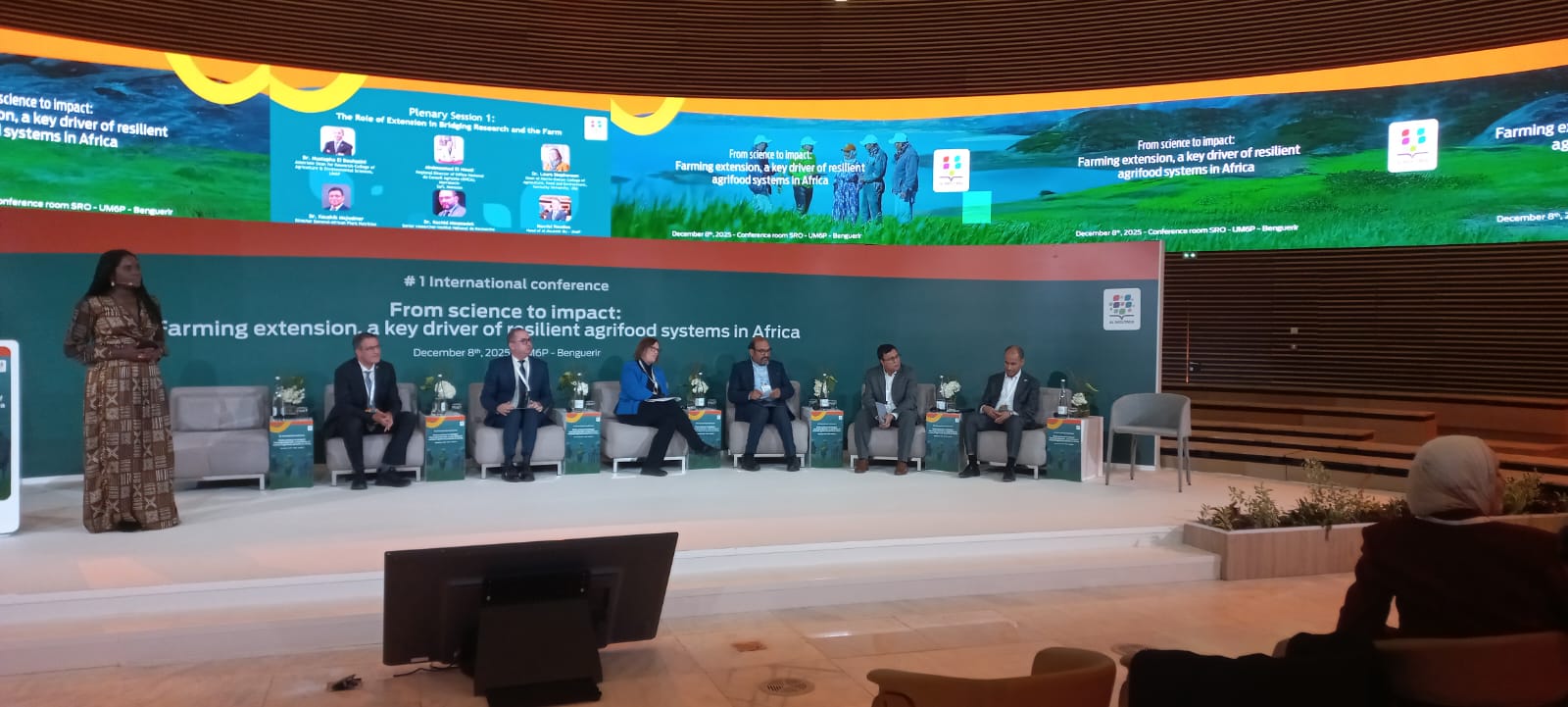
During an international conference organized on December 8 in Benguerir by the Al Moutmir initiative, Moroccan and international experts emphasized the crucial role of technology transfer and agricultural advice in building resilient and inclusive agri-food systems in Africa.

In the face of increasing impacts of climate change, it has become essential to provide farmers with innovative tools capable of strengthening their resilience and promoting sustainable agriculture.
It was around this crucial issue that the international conference dedicated to the role of agricultural advice and technology transfer in accelerating agricultural transformation in Africa was organized on December 8 at UM6P in Benguerir.
Initiated by Al Moutmir as part of the 19th edition of its Innovation Lab, this meeting brought together over 150 participants, including Moroccan and international experts, notably from Nigeria, the United States, and India.
Representatives from the National Office of Agricultural Advice (ONCA), the National Institute of Agronomic Research (INRA), industrial actors, researchers from the UM6P’s College of Agriculture & Environmental Sciences (CAES), as well as farmers, also took part in the discussions. Together, they explored how agricultural advice and technology transfer can bridge the gap between scientific innovation and its concrete application in the field.
Translating scientific advances into concrete solutions
The central theme, “From Science to Impact: Agricultural Extension, a Key Driver of Agri-food Systems Resilience in Africa,” had set the stage. It was explored through five plenary sessions, with the first dedicated to bridging the gap between research and agricultural practices through advice and technology transfer.
The second and third panels focused on innovation and technologies serving farmer-centered models, as well as on capacity building and the engagement of the entire agricultural ecosystem.
The fourth and fifth sessions, for their part, focused on inclusive innovation for women and youth, as well as on the personalization of approaches and the application of the 4R principles in fertilization management, illustrated by Al Moutmir’s experience in Morocco.
Throughout the presentations, experts emphasized the essential role played by technology transfer and agricultural advice at every stage of the value chain—from the laboratory to the farm. These levers not only allow for converting scientific advances into practical solutions but also for integrating technological innovations into production systems: climate-smart practices, digital tools, or rational fertilization strategies.
An agricultural advice model tailored to farmers
To succeed in this agricultural transformation, they insist on the necessity of creating spaces for debate and exchange to draw inspiration from the experiences of international partners and capitalize on their lessons.
It is equally crucial to interact directly with African farmers and the entire agricultural ecosystem in order to highlight local successes and foster the emergence of models adapted to on-the-ground realities. A collaborative approach that, according to them, is the key to building more resilient and inclusive agri-food systems.
“We have brought together all relevant stakeholders—national institutions, universities, African and international partners—to discuss a model of agricultural advice that is truly adapted to the needs of farmers and capable of supporting the transformation of their practices,” said Nawfel Roudies, Head of the Al Moutmir Business Unit.
“In the United States, this model is attached to universities; in India, another system was developed. The objective today is to confront, compare, and benchmark these different approaches in order to capitalize on these experiences and advance our agriculture,” he added.
A continental conference in 2026
According to him, agricultural advice plays the role of a true transmission belt between the world of research and that of farmers. This mechanism “enables a continuous exchange: on one hand, the integration of technological innovations among farmers; on the other, the feedback of field challenges to inform research and provide solutions for them,” clarified Roudies.
Alongside the plenary sessions, participants were also able to discover a selection of innovative agricultural solutions and technologies, developed by Moroccan startups and cooperatives, within the AGSHOWCASE exhibition space.
For Al Moutmir, this international conference thus lays the groundwork for a future large-scale continental event planned for 2026, which will bring together experts in agricultural advice and technology transfer. The goal: to exchange ideas on models suited for resilient and inclusive agriculture in Africa.