Kingdom
AI vs Creativity: “Augmented” Intelligence or Simply Automated?
Artificial intelligence is quietly making its way into creative professions, from music to screenwriting, including audiovisual translation. At the intersection of fascination and concern, it promises to democratize access to creation while redefining the role of humans in artistic production and transmission.

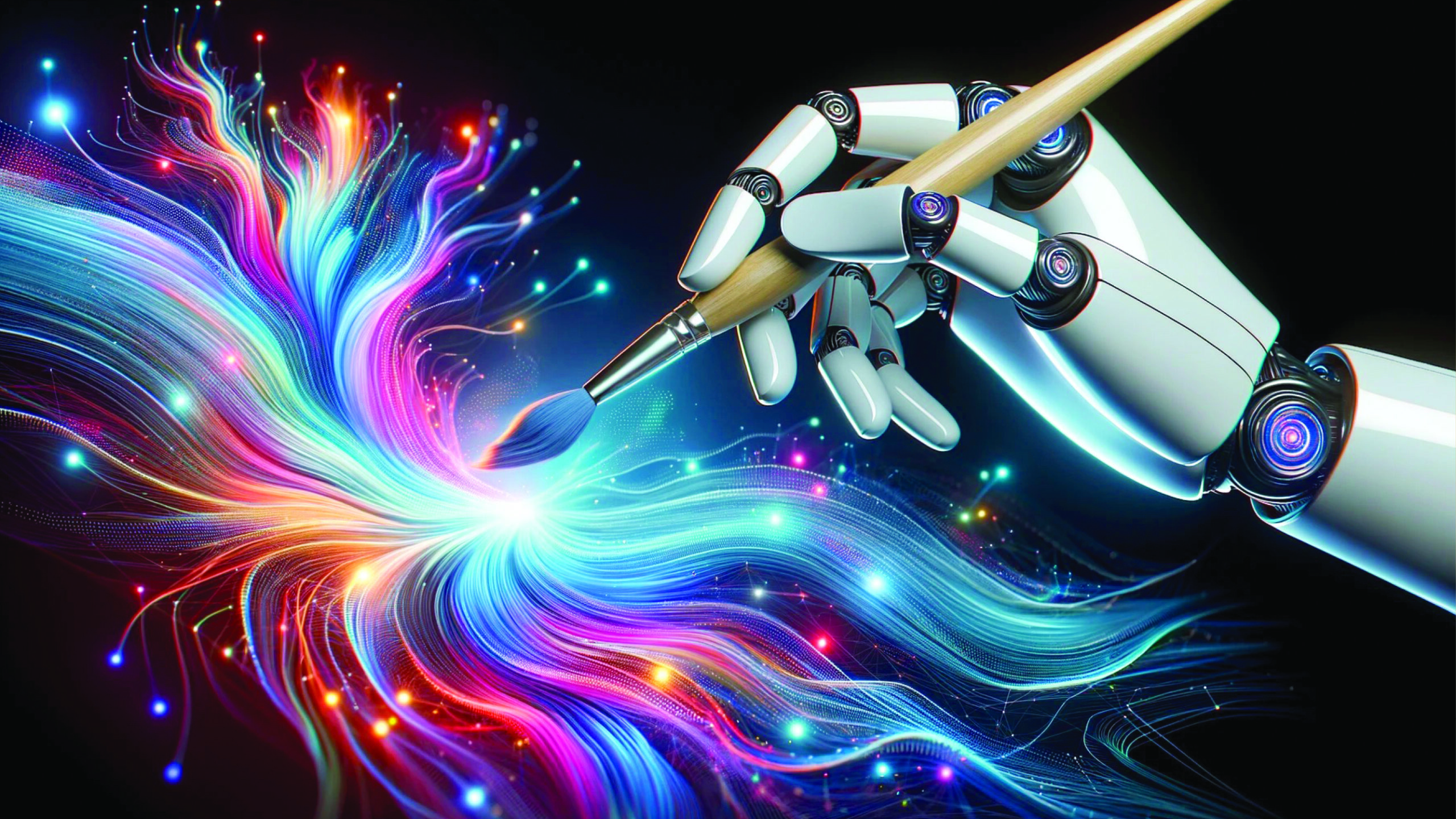
Artificial intelligence is no longer an abstract concept confined to research labs or futuristic talk. It has made its way into the heart of artistic practices—often quietly, sometimes through friction.
It is precisely this collision between creation and technology that Afric’Artech sought to stage, with its first edition opening under the theme “Augmented Humanity, Africa at the crossroads of Art and Technology”.
Conceived as a space for movement between disciplines, generations, and territories, the event lays claim to a clear ambition: to bring art, culture, and emerging technologies into dialogue—not as competing worlds, but as forces destined to be recomposed.
“It’s a meeting platform between technology, art, and culture. It’s a bridge between young project leaders and foundations precisely to create this platform for encounter and experimentation, but also for transmission,” explains Mounia Arezki Sayagh, founder of Afric’Artech.
The program, deliberately hybrid, blends academic conferences, masterclasses, artist talks, and collaborative projects—such as the hackathon organized with the School of Fine Arts and several Moroccan engineering schools specializing in artificial intelligence.
In 48 hours, mixed teams designed prototypes at the intersection of visual, algorithmic, and narrative languages, revealing as much enthusiasm as they did questions about the future of creative professions.
Saturation
Because behind the forward-looking momentum and the optimism on display, one specific moment in the opening ceremony came to crack the consensus. During the screening of a study devoted to artificial intelligence, a segment dedicated to AI-assisted music learning particularly caught our attention.
Not because the technology seemed hesitant, but because it already appeared operational, smooth, almost self-evident. AI-based software can now compose, analyze, and correct musical sequences, and simulate learning tailored to the student’s level.
This automation directly challenges the role of instructors and the place of humans in artistic transmission.
The full scope of this question becomes clear at the scale of the music industry. According to Deezer, nearly 28% of tracks uploaded each day to streaming platforms are now believed to be generated by artificial intelligence, feeding a continuous flow of songs that are hard to identify by listening.
Some bands followed by hundreds of thousands—or even more than a million—listeners, such as The Velvet Sundown, are suspected of being entirely the product of generative systems.
At a time when platforms are overflowing with assembly-line tracks, AI no longer merely composes: it gradually imposes aesthetic norms, formats, and standards that in turn shape learning itself.
When algorithms make the music and organize its transmission, the risk is no longer only pedagogical but cultural: that of creation reduced to the optimized reproduction of existing models, at the expense of error, deviation, and human experience.
The enthusiasm generated by these tools then takes on a new ambiguity. Platforms like AIVA or OpenAI MuseNet are already capable of composing pieces in varied styles, analyzing complex scores, and offering personalized learning exercises. For some, these technologies democratize access to artistic learning.
For others, they signal a standardization of forms, even a devaluation of the creative gesture and the master-student relationship. The question is not only whether AI can create, but whether it can transmit without impoverishing what makes an artistic path unique.
Precariousness
Music is, however, only one testing ground: this logic of algorithmic optimization is now spreading to other creative sectors, from screenwriting to audiovisual translation.
In Hollywood, the historic screenwriters’ strike in 2023, led by the Writers Guild of America, highlighted fears of a gradual marginalization of authors in the face of tools capable of generating synopses, dialogue, and narrative arcs in a matter of seconds.
The screenwriters were not only denouncing an abstract technological threat, but an economic reality: the use of generative AI to cut writing costs, weaken copyright, and turn creative work into mere supervision of machines.
The agreements reached at the end of the strike explicitly recognize that AI cannot be credited as an author and that its use must remain regulated—proof that the issue is no longer theoretical but contractual.
In the field of audiovisual translation, the shift is just as brutal. Long perceived as a stronghold of human expertise, translation is now being challenged by systems capable of producing synchronized multilingual subtitles in seconds, at a negligible cost.
Several professional studies, notably those cited by the International Federation of Translators, point to falling pay and increased deadline pressure, with translators increasingly confined to the role of post-editing machine-generated text. The promise of efficiency poorly conceals a gradual precarization, in which linguistic and cultural quality becomes a mere adjustment variable.
Tensions
This debate resonates particularly with some players in the cultural and creative industries, confronted with the rapid arrival of artificial intelligence in their daily practices.
Far from an outright rejection of technology, many instead advocate an approach known as “augmented intelligence”, in which the algorithmic tool remains subordinate to humans—their sensitivity and their decision-making capacity. A view that surfaced at Afric’Artech, not as the dominant discourse, but as one of the threads running through certain statements.
Present at the event, Othmane Cherif Alami, president of the Casablanca-Settat Regional Tourism Council and honorary president of Afric’Artech, thus emphasized the strategic use of AI in data collection and analysis, while underscoring the need for human oversight.
“Artificial intelligence augmented by humans will be at the heart of this system,” he states, referring in particular to the Regional Tourism Observatory and to the analysis of flows and perceptions linked to the Casablanca destination. An approach that, transposed to the cultural field, questions less technological performance than the governance of these new tools.
This emphasis on augmentation rather than substitution reveals an essential fault line. Artificial intelligence is no longer just a tool for creation: it is becoming a full-fledged economic actor, capable of reshaping value chains and power relations.
Where it is presented as support, it can also become a lever for rationalization—or even the gradual elimination of jobs. Artists, screenwriters, translators, and instructors are less opposed to the technology itself than to the deployment logics that accompany it, often decided without consultation, in the name of productivity and cost optimization.
Finally, Afric’Artech appears less as an answer than as a revelatory lens. The event above all made visible tensions already at work: the choices made today around AI will weigh heavily on the place granted to creators tomorrow, between the promise of emancipation and the risk of silent marginalization.
The question that remains—and that the segment on AI-assisted music learning made impossible to evade—is one of meaning. Creating, transmitting, translating, or writing is not only a matter of technical skill, but of situated experience, and of a relationship to the world and to others.
Artificial intelligence can reproduce some of these forms, sometimes with disconcerting effectiveness. It remains to be seen whether, through relentless optimization, it will end up eroding what gives art its unique value: its resistance to standardization.