Kingdom
Aeronautics: Safran Group Strengthens Its Industrial Foothold in Morocco
Only four months after the announcement of the establishment of a new aircraft-engine production line in Casablanca, the French group officially formalized the launch of its project for a landing-gear manufacturing plant in Nouaceur. A closer look at Safran’s industrial foothold in Morocco.

Morocco is slowly but surely building a broad aeronautics industry ecosystem, similar to that of the automotive sector (now the country’s leading export item, ahead of phosphates and their derivative products).
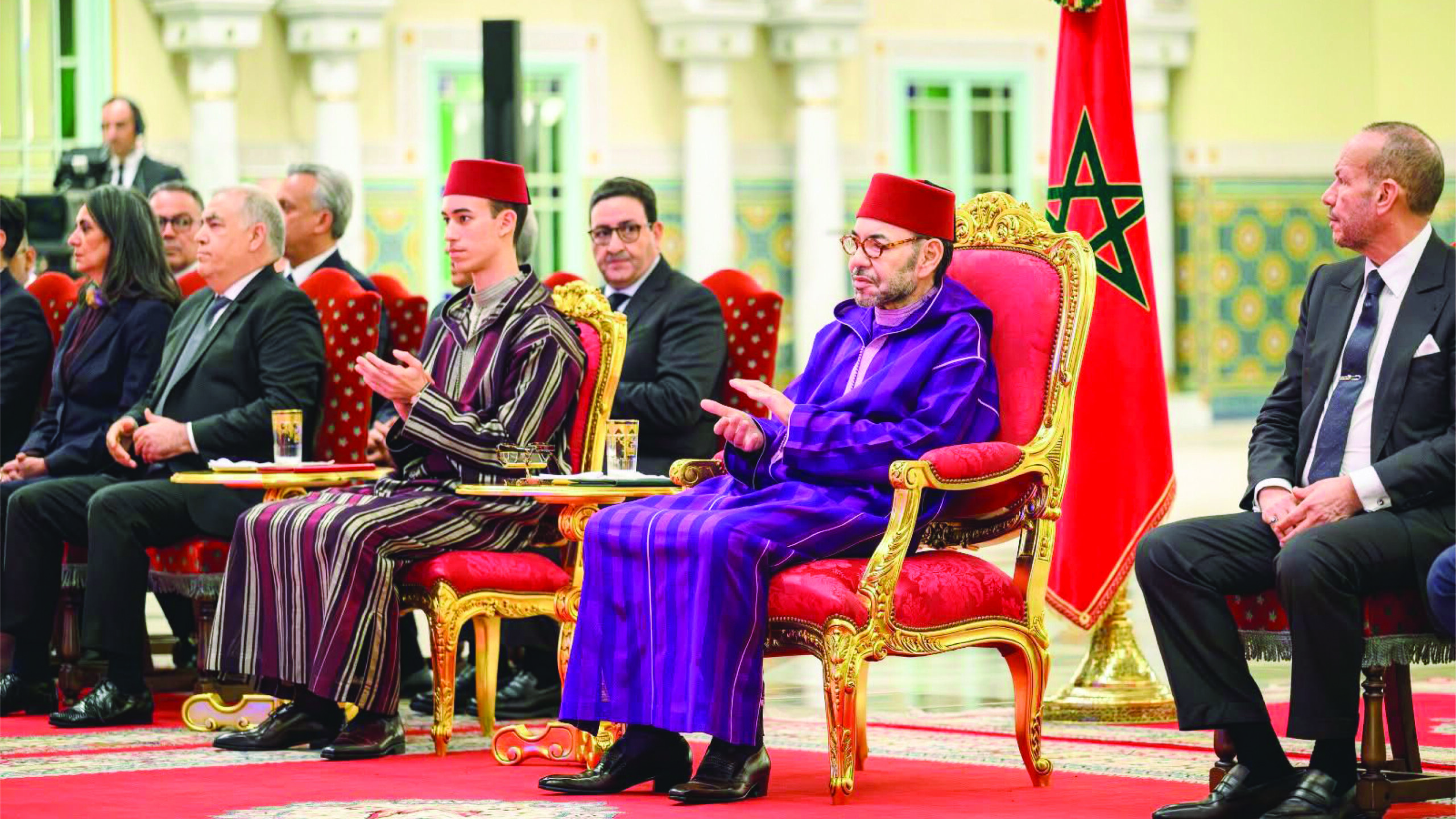
As proof, nearly four months after the launch of construction works for the maintenance and repair complex for the new-generation LEAP engines (October 2025) and the announcement of the establishment of a new aircraft-engine production line (LEAP-1A), the French group Safran formalized, during a ceremony chaired by His Majesty the King on February 13, 2026 in Casablanca, the launch of its project to build a landing-gear manufacturing plant in Nouaceur.
In short, these new projects by the world leader and number one manufacturer of short- and medium-haul aircraft engines enable the Kingdom to reach a new industrial and technological milestone.
It should be recalled that, until now, the national aeronautics industry has produced only engine nacelles. Added to this is the fact that the assembly trades for aeronautical sub-assemblies and onboard electrical systems (i.e., wiring activities) are what drive exports, which peaked at MAD 29 billion in 2025, representing annual growth of 10%.
This shows the highly critical nature of the aforementioned new projects for the country’s growing aeronautics ecosystem, whose objective is to move higher up the value chain.
A €280 million project
Mobilizing an investment effort of €280 million, and ultimately creating 500 jobs, the project to build the landing-gear manufacturing plant of the world’s third-largest aeronautics player (excluding airframers) will provide the Kingdom with a highly specialized industrial segment.
In this regard, it should be specified that it includes precision machining, high-technology assembly, testing, certification, and advanced maintenance. As part of one of Safran Landing Systems’ largest landing-system manufacturing centers in the world, the future industrial unit in Nouaceur (supplied 100% with decarbonized energy), dedicated to the Airbus A320, will be built on a land parcel of more than 7 hectares.
Designed to host high-tech processes and key expertise, the plant is strategically significant for the French group, as it will support the ramp-up in production rates of the Airbus A320 family and prepare for the next generation of short- and medium-haul aircraft.
This major ambition undeniably confirms the importance of Morocco for Safran, which is clearly determined to continue with the country the technological journey involving the production of particularly critical onboard aircraft systems—landing gear.
Moreover, the new project will be a catalyst for the emergence of a resilient and agile industrial setup (and, above all, one with shorter industrial routes for Safran), since the plant will be located close to the group’s current assembly sites and to Airbus’s European assembly lines.
As for the local aeronautics fabric, it should be noted that the future landing-gear production unit of the aerospace giant, present in Morocco for 26 years, will play a pivotal role within the Moroccan ecosystem. In doing so, it should bring new suppliers in its wake, which will be conducive to increasing the number of aeronautics companies (150) operating in the country.
Mastery of complex technologies
The manufacture of landing-gear systems in Morocco strengthens the country’s stature as one of the most dynamic emerging destinations in the aeronautics industry.
It also attests to the Kingdom’s mastery of complex technologies and represents a major step toward consolidating industrial integration within global aeronautics value chains.
As a reminder, the Kingdom has achieved the feat of integrating key aeronautics programs, including those of the Airbus A320, the Boeing 737, the A350, and the A330.
Better still, for certain parts, the national aeronautics platform—supported by more than 25,000 well-trained talents—is single-source. By way of illustration, one can cite the A320 cockpit parts, manufactured exclusively by the Airbus Atlantic Maroc Composites plant, one of the European airframer’s two Moroccan factories.
This configuration largely reflects the strong confidence Morocco inspires among major international prime contractors, who are extremely demanding when it comes to technological know-how, delivery lead times, standards, and rigorous certifications.
That said, after more than two decades of progress, facilitated by a combination of favorable factors (competitive production costs, state support, a skilled workforce, a dedicated strategy, etc.), the Kingdom has become an essential stronghold for global aeronautics. Moreover, according to the Ministry of Industry, every airplane flying in the world contains at least one part made in Morocco.
In another vein, the multiple high-technology projects launched by Safran (including an aircraft-engine production plant with a capacity of 350 units per year), coupled with investments amounting to several billion dirhams made by global heavyweights over the past three years (Pratt & Whitney, Collins Aerospace, Embraer, etc.), place the aeronautics sector in a good position to reach the objectives set for 2030.
As a reminder, the Minister of Industry, Ryad Mezzour, expects that over the next four years revenues will double to MAD 60 billion and jobs will reach around 50,000 positions.
More than 4,800 employees in Morocco
Present in the Kingdom since 1999, the Safran group—today claiming the creation of more than 4,800 jobs, knowing that the newly launched projects will ultimately generate several hundred more—locally embodies a development trajectory similar to that of the national aeronautics sector.
The latter has steadily moved upmarket over the past twenty years. In its early days in Morocco, Safran’s activity was limited solely to the maintenance of Royal Air Maroc aircraft engines. Shortly thereafter, the French group expanded its activity in the Kingdom into the production of electrical harnesses.
It was only in 2006 that Safran Nacelles Morocco began producing composite materials and assembling nacelles and their sub-assemblies.
The year 2015 marks the start of production by Safran Electronics & Defense Morocco of electromechanical equipment for several aeronautics manufacturers (Airbus, Boeing, Honeywell, Agusta, etc.).
It should be added that the aerospace giant also has a site located in the Tiflet industrial zone. It specializes in the assembly, adjustment, and testing of electronic and mechanical equipment for fuel-management systems.