Business
A Decisive Year For Social Development
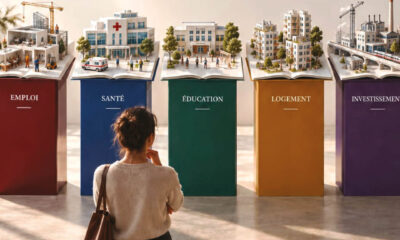
With 140 billion dirhams dedicated to Health and Education, the 2026 Finance Bill marks a new milestone in the country’s social policy. Modernization of hospital infrastructure, reform of public schools, and expansion of vocational training… The year is set to be a turning point for Morocco’s human capital.


The 2026 Finance Bill emphasizes a major focus: strengthening the education and health sectors, a priority consistent with the government’s direction over the past four years.
The total budget allocated to these two sectors amounts to 140 billion dirhams, an increase of 21 billion compared to 2025.
It should be noted that a overhaul of the national health system has been underway since 2022, which has ensured universal access to care and developed a robust health system.
This effort is continued with a budget allocated to the sector under this Finance Bill of 42.4 billion dirhams (BHD), compared to 32.6 BHD the previous year, an increase of 30%, considering that the allocation for the period in 2021 was 19.5 BHD.
The government thus plans to continue the construction of university hospitals (CHUs), with a budget of 5.3 BHD, notably those in Béni-Mellal, Guelmim, and Errachidia.
The Ibn Sina CHU in Rabat is expected to be operational in 2026. “This year will see the commissioning of two CHUs, in Agadir and Laâyoune,” specified Nadia Fettah Alaoui, Minister of Economy and Finance, during the presentation of the Finance Bill to Parliament.
In any case, the expansion of this hospital capacity will increase bed capacity by more than 3,800 beds.
Simultaneously, 2.5 BHD will be dedicated to continuing and launching the construction works for provincial and regional hospital centers, as well as psychiatric, specialty, and local hospitals.
Note that this program has already completed 22 projects during the 2022-2025 period, with a bed capacity of 2,433 beds.
Furthermore, to improve the quality of health services and strengthen reception and treatment conditions within hospital facilities, the government is allocating 3.32 BHD for the upgrading and renovation of 90 hospitals requiring rehabilitation across all regions of the Kingdom.
Another key project is the “launch of the second phase of rehabilitating primary healthcare facilities, which aims to renovate the remaining 1,600 centers over a three-year period, at an estimated total cost of 6.9 billion dirhams.
This phase complements the first, still underway, which involves approximately 1,400 centers at a total cost of 6.4 billion dirhams,” emphasized the minister.
The government is also continuing the implementation of the Moroccan Agency for Medicines and Health Products, the Moroccan Agency for Blood and its Derivatives, as well as the gradual establishment of territorial health groups following the operationalization of the pilot region Tangier-Tetouan-Al Hoceima’s GST, starting October 1, 2025.
Quality Public School
Education, the second most important social component, continues its transformation, driven by the strategic plan for the reform of the education system: the “2022–2026 Roadmap for a Quality Public School for All.”
Thus, with a budget of 99 billion dirhams (BHD), the Executive’s efforts will focus primarily on the widespread adoption of the pioneering school model, through a gradual rollout aimed at full coverage by 2027–2028, with 2,000 new units and 500 pioneering middle schools for the 2026–2027 school year.
It will also involve granting a one-time annual performance bonus of 10,000 dirhams to the staff of these institutions to enhance educational quality and innovation.
Strengthening the school supply, continuing efforts in social support, and expanding preschool education are also among the priority areas of the education system reform.
Higher education is not left out, as the Ministry plans to continue professionalizing the training offerings and adapting them to labor market needs.
An allocation of 17.3 BHD is dedicated to the sector, emphasizing in particular the continuation of the program to increase the density of healthcare personnel by 2030, through the upcoming launch of two faculties of medicine and pharmacy in Errachidia and Béni-Mellal.
Strengthening digital talents by 2027 within public universities is also a focus, through developing students’ skills in digital and technology fields, by continuing the establishment of “Code 212” centers.
As for the teacher training program for primary and secondary education by 2025, progress has been marked by the continued construction and equipping of 6 higher schools of education and training in Kénitra, Oujda, Agadir, Berrechid, El Jadida, and Béni-Mellal.
10 Operational Skills Cities
The vocational training sector continues its sustained development momentum. Infrastructure has been significantly strengthened through the creation of 27 new institutes, including 21 under the OFPPT, bringing the public training institution network to 798, of which 510 depend on this Office.
This offering will be further enriched with the commissioning of three new Skills Cities (CMC) in the regions of Dakhla-Oued Eddahab, Marrakech-Safi, and Guelmim-Oued Noun, bringing the total number of operational CMCs to ten, while two others are nearing completion.
Additionally, the training offering has also been consolidated. The Office has thus established 400 streams as part of the new training offerings.
Employment Promotion Underway
Employment remains the focal point of the government, which has developed a roadmap structured around a set of complementary initiatives, with the goal of creating 1.45 million jobs by 2030, accompanied by a 9% reduction in the unemployment rate.
These include, among others, the implementation of support mechanisms for SMEs, strengthening the inclusion of active employment programs (Tahfiz, Idmaj, and Taehil), and reducing job losses in the agricultural sector through apprenticeship training.
The government also plans to continue consolidating vocational guidance and optimizing intermediation through enhanced coordination between the OFPPT, Anapec, and universities, as well as improving training quality by expanding the apprenticeship training system.
In summary, the 2026 Finance Bill sets the tone for a pivotal year for the Kingdom’s social policies, which represent the pillars of a development model based on equity, quality, and sustainability.
Public Service: Nearly 37,000 Positions to Be Filled
The number of budgeted positions proposed by the 2026 Finance Bill is 36,895. More than one-third are allocated to the Ministry of the Interior (13,000), followed directly by Health, which plans to create 8,000 jobs, and the Ministry of Economy and Finance with 2,600 positions. Nearly 400 positions are to be filled at the Ministry of Education.
It should be noted that an additional 19,000 positions are proposed for the Regional Education and Training Academies, intended for the recruitment of new teachers. In summary, the education and health sectors account for 70% of new job opportunities, totaling 27,000 positions to be filled.