Kingdom
50 Projects That Changed the Sahara (4/5)
For half a century, the Kingdom has been massively investing in its Southern Provinces to equip them with all kinds of infrastructure to provide the population with the conditions for a dignified life. Industry, culture, agriculture, transport, fishing, sports… a multitude of projects have turned the mirage of development into reality. A selection.

31- The Moussem of Tan-Tan or the gallop of traditions
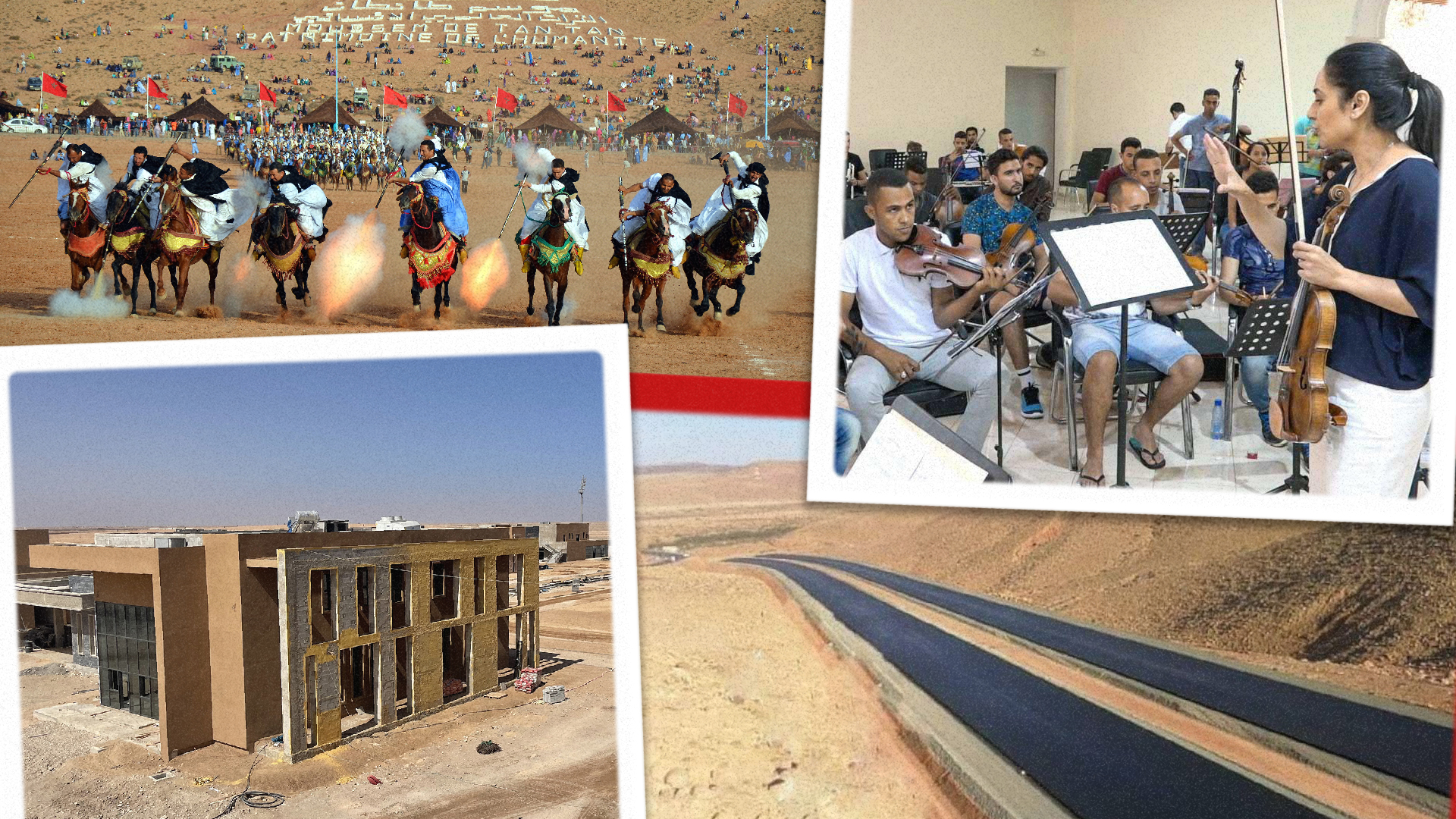
Under the High Patronage of His Majesty King Mohammed VI, the Moussem of Tan-Tan, inscribed on UNESCO’s Intangible Cultural Heritage list since 2008, brings together each year more than thirty nomadic tribes of the Sahara in an explosion of traditions and brotherhood. This agropastoral gathering, born in 1963, is held at the end of August in Tan-Tan, an oasis in southwestern Morocco, attracting a million visitors. The program includes: a grand equestrian fantasia, where thousands of riders in white djellabas charge at a gallop, rifles in the air, in a ballet of dust and cries. Camel races, Gnaoua performances, and Hassanian dances animate the Bedouin tents, while the fair displays handicrafts, livestock, and local products. It is a cultural kaleidoscope: discreet diplomatic exchanges between tribes, markets where camels and carpets are negotiated, and moments of spiritual reflection around campfires.
The Moussem transcends folklore; it is an economic pillar for the region, generating seasonal jobs and boosting Saharan tourism. This year, eco-responsible editions have integrated workshops on oasis preservation. International delegations see it as a model of tribal cohesion. Tan-Tan, the gateway to the desert, relives its nomadic soul for a week. The Moussem is not just an event: it is the pulse of Saharan Morocco, where millennia-old traditions dialogue with the modern world, reminding us that in the sand, human bonds are eternal.
32- Major brands set up shop in the South
A city in full development is also recognized by the many commercial brands that set up there, whether national or international. Laayoune is a textbook case from this point of view. Booming, the city has seen several establishments in recent years, contributing to the economic and social development dynamic the region is experiencing. As early as 2017, the first McDonald’s restaurant opened its doors in the capital of the Southern Provinces. More recently, it was the Moroccan distribution giant, Marjane, which inaugurated its first hypermarket on an area of 12,500 m². BIM is not left behind. The Turkish hard discount brand has also set its sights on Laayoune by opening two stores there. Even better: in early 2025, Mazeej Mall, the new generation retail park from Marjane Group, opened its doors on Mohammed V Avenue. The result of a 250 million dirham investment, Mazeej Mall spans 60,000 m2, with 30,000 m2 of covered area. The commercial offering of Mazeej Mall brings together local, national, and international brands, such as Electroplanet, Kounouz, Marwa, Celio, Yves Rocher, Alain Afflelou, Lee Cooper, and many others. Result: the creation of 1,000 direct jobs. Finally, last April, the multi-brand sports goods store chain Planet Sport inaugurated its first premium store, also in Laayoune.
33- A route opened towards the Sahel
At the end of September, the Minister of Equipment announced the imminent opening of the new Smara-Bir Moghrein road axis, in Mauritania, passing through Amgala. Morocco and Mauritania are thus strengthening their land border interconnection with the opening of the Amgala post, the second after El Guerguerat. The 93 km project, which mobilized a total amount of 49.72 million dirhams, consists of four sections. This second land corridor between the two countries has a strategic dimension as it falls within the framework of the Atlantic Initiative for the Sahel countries. An initiative launched by the Sovereign and which has seen the adherence of the four concerned countries, in addition to Mauritania, and has been praised by several influential states, the latest being Russia. This route, whose construction work was launched in February 2024, is of particular importance for regional integration. It will offer new logistic access to Mauritania and, beyond, to Mali, reinforcing Morocco’s vocation to position its Southern Provinces as platforms for exchange with the Sahel. It also connects the iron deposits of Zouerate, near Bir Moghrein, to the new port of Dakhla Atlantic, as well as to the planned green steel production project in the Southern Provinces.
34- A center to weave the future of traditional art
In the bustling heart of Laayoune, the Center for Professional Qualification in Traditional Arts (CQPAT) stands as a living bastion of Sahrawi heritage. This public center welcomes young people aged 15 to 30 seeking qualifying training. Founded to preserve and transmit ancestral know-how, it offers programs in weaving, embroidery, basketry, and leatherwork, inspired by the nomadic motifs of the Sahara. Each year, about a hundred apprentices acquire not only technical skills but also a recognized diploma, opening the doors to artisanal entrepreneurship.
In November 2024, it merged its efforts with the newly opened Specialized Institute of Traditional Arts, under the patronage of His Majesty the King, to expand its offering to intensive residential training. These initiatives aim to counter cultural desertification by promoting craftsmanship as an economic lever. The workshops buzz with vibrant colors: carpets with hypnotic geometries, silver jewelry evoking the caravans of yesteryear. The trainers, often master artisans from Hassanian tribes, transmit an undiminished passion. Beyond technique, the Center promotes professional integration. Partnerships with local cooperatives allow graduates to market their creations in the markets of Tan-Tan or Dakhla. Laayoune thus affirms its role as guardian of Saharan traditions, inviting every visitor to touch the soul of the desert.
35- Laprophan: A branch to serve as a hub for Africa
The laboratory inaugurated its branch in Laayoune in December 2022. This establishment came naturally, as the pharmaceutical manufacturer has always aimed to accompany the evolution of the country’s medicine needs, on one hand, and on the other hand, it is convinced of Laayoune’s potential as a true hub for Africa. This investment aims to contribute to public health and the ongoing socio-economic dynamic in the Southern Provinces. Furthermore, this opening also falls within the framework of South-South cooperation. A cooperation that also covers preclinical and clinical biomedical research. Two agreements were signed with the Ibn Zohr Faculty and the Faculty of Medicine of Laayoune to develop scientific innovation. The opening of this subsidiary, which is part of a 750 million dirham external investment program launched by Laprophan, will strengthen Morocco’s leadership in building the health sovereignty of the African continent.
36- A music conservatory to follow the rhythm of the wind
Where the Atlantic winds carry the echoes of the Sahara, the Regional Conservatory of Music and Choreographic Arts of Dakhla stands as a laboratory of Hassani sounds. Inaugurated in 2024, this cultural bastion extends over 2,060 m2, for an investment of 14.4 million dirhams (MDH). Nestled on El Walae Avenue, it fuses modernity and tradition, with soundproofed rooms, a 200-seat auditorium, and studios dedicated to dance. Open to all, from 6 to 30 years old, the conservatory offers a rich curriculum: initiation to the oud, guembri, and bendir for nomadic rhythms; classes in classical, modern, and Hassani dance. Modules on Andalusian and Amazigh music enrich the offering, while collective workshops form youth orchestras. Its first class of 150 students shone during an inaugural gala, blending Saharan-jazz fusions and contemporary choreographies on the lagoon. This place is not just a school, it is the sonic soul of Dakhla. Here, music weaves the Moroccan identity of the South, against the oblivion of the singing caravans.
37- The fishing port of Laayoune in full expansion
Larger, more efficient, and more accessible: the fishing port of Laayoune, the most important maritime fishing port in the Kingdom, has been undergoing major expansion work since November 2024. With an amount of 210 million dirhams, this project, managed by the National Ports Agency (ANP), aims to significantly increase the port’s reception capacity and boost the development of coastal and artisanal fishing activities. The expansion also aims to improve and streamline the traffic of various fishing vessels, while offering better safety conditions for fishermen, thus contributing to strengthening the socio-economic role of this vital infrastructure in the region. The work currently underway includes the construction of a new fishing quay 350 meters long and 5 meters deep and a quay return 100 meters long. The installation of 112-meter access gangways is also on the program. The completion of the work is scheduled for summer 2026.
38- Aerodrome to connect Es-Smara to civil aviation
The Es-Smara aerodrome should soon welcome its first commercial flights. Since last year, the National Airports Office (ONDA) has launched several projects to modernize and expand this site based in the Laayoune-Sakia El Hamra region. The work had reached a 50% completion rate in September, according to local authorities. One of the flagship projects is the construction of a control tower for a total investment of 8.4 million dirhams (MDH). Major works were also launched last summer, including the construction of a 115 m² Royal Gendarmerie control post for 350,000 dirhams, over a period of three months. The airport platform will also be connected to the liquid sanitation network as part of an 800,000 dirham environmental project, carried out in partnership with the National Office of Electricity and Drinking Water (ONEE). A set of infrastructures that will consolidate and diversify the local economy, promote tourism activity, and generate new jobs.
39- Federal football center: Nursery for new talents
The capital of the Moroccan Sahara will soon house an emblematic sports infrastructure: a federal football training center. Built on 12 hectares, with a built-up area of approximately 7,000 m2, the structure is expected to be officially inaugurated soon. This gem, whose construction required an envelope of 160 million dirhams (MDH), is equipped with numerous facilities that will delight football enthusiasts. Starting with the six football pitches. The 120 trainees (including 40 girls) who will stay there will also have at their disposal a wing dedicated to health and sports, and another to teaching and training. More than just a site dedicated to physical training, the Federal Football Training Center aims to be a true nursery for the region’s future talents, who will further contribute to the radiance of Moroccan football. The infrastructure adds to the 90 local grass pitches, five municipal swimming pools, and one Olympic swimming pool already operational in Laayoune.
40- ISMAC Dakhla: A creative lighthouse for audiovisual and cinema
On the edge of the infinite waves of the Atlantic, the Dakhla branch of the Higher Institute of Audiovisual and Cinema Professions (ISMAC) emerges as a creative lighthouse in the Moroccan Sahara. Inaugurated in February, this regional structure marks a turning point for training in the professions of the 7th art in the Southern Provinces. With its high-tech rooms and immersive studios, it trains 200 apprentices per year, a youth eager to tell Saharan stories on screen. ISMAC Dakhla offers a three-year program in production, directing, sound, image, and post-production, adapted to local realities. The students, selected through a rigorous competition, explore nomadic storytelling, arid landscapes, and the multilingual voices of the Sahara. Modules on ethnographic documentary or environmental cinema highlight the region’s climate challenges, such as coastal desertification. The professors, drawn from the Moroccan and international scene, collaborate with festivals like Marrakech for exclusive masterclasses. This year, the first short films produced by the students were awarded at the Fameck Arab Film Festival, proving the narrative potential of the South.