Kingdom
50 Projects That Changed the Sahara (3/5)
For half a century, the Kingdom has been massively investing in its Southern Provinces to equip them with all kinds of infrastructure to provide the population with the conditions for a dignified life. Industry, culture, agriculture, transport, fishing, sports… a multitude of projects have turned the mirage of development into reality. A selection.

21- Foum El Oued: The technopole that transforms the South
Located 20 km from Laayoune, the Foum El Oued technopole, launched in 2016, constitutes a major project of the Integrated Development Plan for the Southern Provinces. Extending over 600 hectares, it mobilizes a total investment of 2 billion dirhams. Managed by the Phosboucraa Foundation, a subsidiary of the OCP group, the technopole combines an educational and research hub with Mohammed VI Polytechnic University and a high school of excellence, a business hub with an incubator to support entrepreneurship, and a cultural hub integrating a museum, a commercial village, and social infrastructure. Designed with a bioclimatic approach, it draws inspiration from local dunes, promotes natural ventilation, and integrates sustainable solutions, such as solar energy, water recycling, and organic waste recovery. Today, the technopole creates an emerging ecosystem of research and innovation, strengthening higher education, supporting entrepreneurship, and offering prospects for skilled employment, while diversifying the economy and consolidating the attractiveness of the Southern Provinces.
22- A market gardening hub that exports a billion dirhams
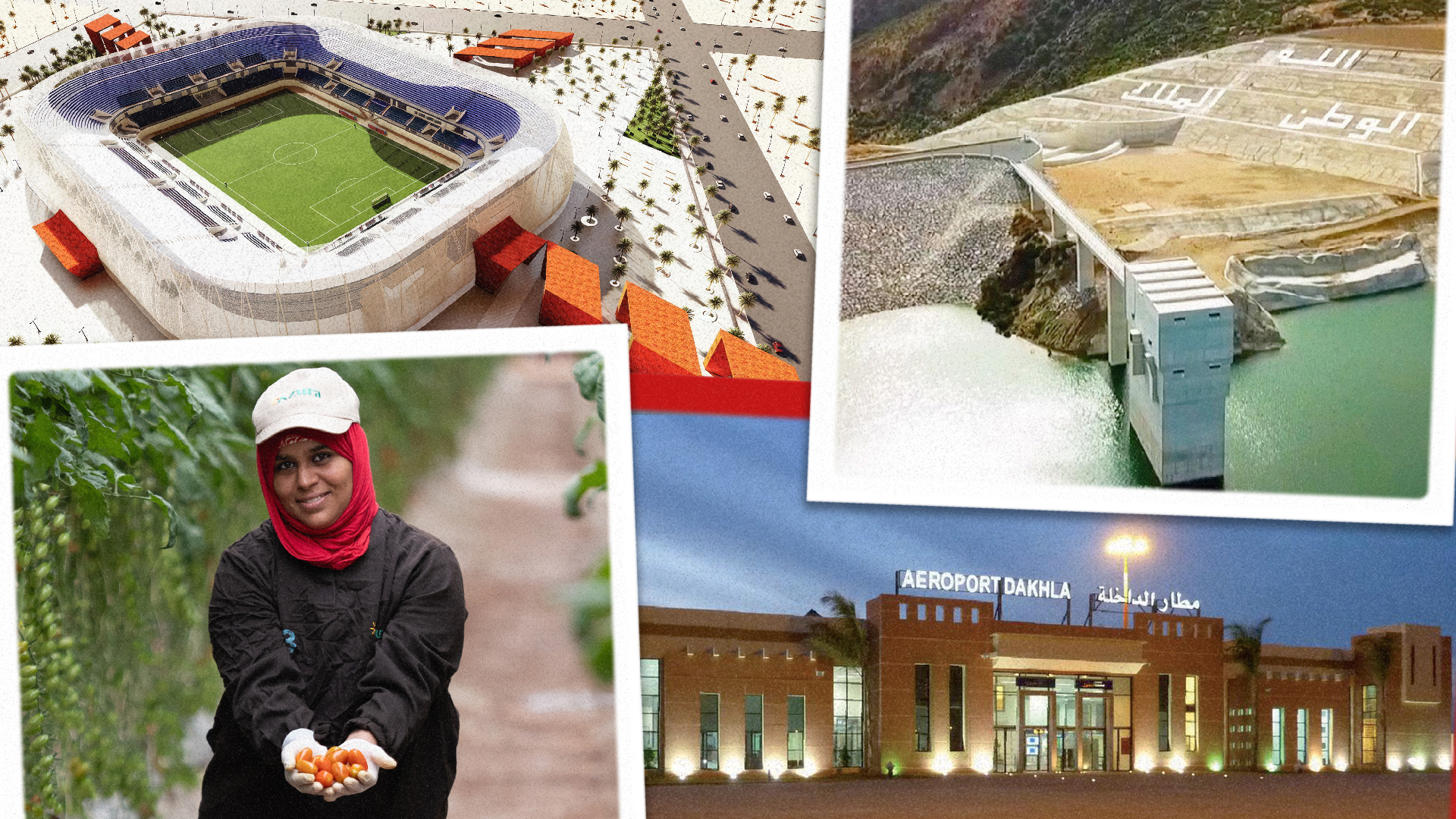
Dakhla has risen in a few years to become a new market gardening hub in Morocco, specializing in the production of round and cherry tomatoes. Since the 2000s, four major producer-exporter groups have been established there, namely Domaines Agricoles, the Soprofel Idyl group through Tawarta agricultural production and Mijk agricultural estate. The Maraîchage du Sahara group, a subsidiary of the Derham group, as well as the Maraissa company of the Azura group are also part of it. The production, estimated at nearly 50,000 tonnes, is primarily destined for export to several destinations, including Europe, Russia, and the Gulf countries. Currently established on an area of approximately 1,100 ha, tomato cultivation is expected to make a quantum leap with the development of 5,200 ha irrigated by seawater desalination. Nearly 70% of this area will be dedicated to market gardening, mainly tomatoes, resulting in a production of over 400,000 tonnes, added value of over one billion dirhams, and 10,000 permanent jobs.
23- The Sakia El Hamra dam to strengthen local water resilience
The Sakia El Hamra dam in Laayoune has this particularity: it is being completely rebuilt. Built in 1995, the hydraulic structure had suffered serious damage due to the 2016 floods. Thus, after various technical assessments, there was no room for patchwork! The decision was made to rebuild it. And the first groundbreaking took place in April 2018. Last October, the Ministry of Equipment and Water reported a work progress rate of 87%. With a storage capacity of 113 million cubic meters, the structure is expected to play a strategic role in supplying drinking water to the population, but will also be a major contribution to agricultural irrigation in the region as a whole. Similarly, this dam, for which an investment envelope of 650 million dirhams was mobilized, should serve as a bulwark for flood protection, while strengthening local water resilience. It should be noted that the structure, according to forecasts from the Department of Equipment and Water, is scheduled for delivery in July 2026. However, given the sustained pace of the work, it is entirely possible that this deadline could be reduced.
24- An integrated industrial complex for phosphates
Laayoune-Sakia El Hamra is a key player on the national chessboard of the phosphate and fertilizer ecosystem. Indeed, the region hosts the industrial value chain of Phosboucraa (a subsidiary of the OCP group), which is distinguished by its integration thanks to a 102 km conveyor (the longest in the world) linking the Boucraâ mine to the industrial units in Laayoune. The Boucraâ mine, located in the Laayoune-Sakia El Hamra region, represents 8% of the total phosphate rock production. This rock, transported via this conveyor to the processing plant and the Laayoune Wharf, is then exported to the international market. The integrated industrial complex is designed to have, among other things, an annual production of half a million tonnes of phosphoric acid and one million tonnes of fertilizer. It houses several industrial components: a fertilizer production platform, a phosphate washing and flotation plant, a unit for drying phosphates destined for export, a storage park… For the record, the establishment of this OCP group value chain in the region was made possible by an investment of nearly 17 billion dirhams (MMDH).
25- The longest road viaduct in the Kingdom over Sakia El Hamra
The viaduct under construction over the Sakia El Hamra wadi will be one of the largest road engineering structures ever built in Morocco and notably the longest road viaduct in the Kingdom. With a length of 1,648 meters and a width of 21.4 meters, at an estimated cost of 1.38 billion dirhams, this impressive engineering structure is scheduled for delivery in 2027. It consists of two separate roads, each with two lanes, as well as a pedestrian walkway, all resting on 216 foundations, some reaching depths of up to 50 meters. The expected benefits are multiple. As an integral part of the royal project for the Tiznit-Dakhla expressway, and more precisely the Laayoune bypass, the viaduct will allow transit traffic to bypass the city center and smooth traffic to and from the Southern Provinces. It will also remedy the problem of traffic disruptions during the unpredictable floods of the Sakia El Hamra wadi. The viaduct is indeed designed to withstand floods, strong winds, and corrosion related to salinity. It symbolizes the state’s commitment to modernizing infrastructure in the Southern Provinces.
26- A business aviation terminal to boost tourism
Since February 8, 2023, Dakhla Airport has housed a terminal entirely dedicated to business and private aviation. Designed according to the FBO “Fixed Base Operator” concept, this infrastructure, financed to the tune of 10 million dirhams (MDH) and extending over an area of 424 m², is distinguished by its modern architectural style. The VIP space, with a capacity to handle 19 passengers simultaneously, is designed to offer the best conditions of comfort and security. The terminal has its own facilities, completely independent of the commercial terminal, including a landside access, a parking lot with a capacity of 20 vehicles, and an airside drop-off to transport passengers to and from the FBO.
Beyond strengthening airport facilities, this terminal will boost tourism activity, particularly the business and private aviation segment, in a region highly prized by tourists, well-served by Royal Air Maroc (RAM), and which continues to attract numerous airlines. In the first quarter of 2025, the airport welcomed over 70,000 passengers, an increase of 14% compared to the same period in 2024. Last year, traffic showed over 228,000 passengers. A dynamic that is expected to continue.
27- EST Dakhla: The new talent pool
The network of Higher Schools of Technology (EST) is expanding, and Dakhla now has its own den of tech and innovation: EST Dakhla, inaugurated in July 2021 under the auspices of Ibn Zohr University. With a capacity for about 1,000 students and a budget flirting with 40 million dirhams (MDH) (including 12 million from the Regional Council), the school extends over more than 12,840 m² and shines with its modern infrastructure: amphitheater, state-of-the-art labs, high-tech classrooms… and even sports facilities to unwind between projects. On the training side, it’s serious business: computer science, management techniques, and electrical engineering, disciplines tailored to meet the tech and economic challenges of the South… and beyond. But EST is not limited to school benches: it also aims to become a true hub for research and open to innovation.
And this is just the beginning! Since March 2023, the school has been expanding with a 1,640 m² extension for nearly 9.74 million dirhams (MDH), in order to welcome even more students and boost its equipment. The goal is clear: to make EST Dakhla the essential engine of higher education in the south of Morocco.
28- Dar Al Moukawil to boost entrepreneurship in the heart of the Sahara
Inaugurated on November 5, 2021, on the occasion of the 46th anniversary of the Green March, the Dar Al Moukawil Center of Attijariwafa bank in Laayoune is the 16th in the national network. This free and integrated system supports very small enterprises (VSEs), self-employed entrepreneurs, and project holders, whether they are bank customers or not. It offers personalized support through daily training sessions, meetings with experts, tailored advice, and business networking.
This center is part of a partnership dynamic with the Wilaya of Laayoune-Sakia El Hamra, the Chamber of Commerce, Industry and Services (CCIS), and the Digital Development Agency (ADD). It aims to strengthen the local entrepreneurial ecosystem, particularly for youth and women, by providing them with the necessary tools to create and develop their businesses. To date, the Dar Al Moukawil Centers have supported over 365,000 entrepreneurs and small businesses across Morocco. This opening reinforces Attijariwafa bank’s commitment to the economic and social development of the southern regions of Morocco.
29- A structuring hydro-agricultural project for Boujdour
A large-scale project started in Boujdour in the rural commune of Jrifia in 2016. It is a hydro-agricultural development project that falls under the New Development Model for the Southern Provinces and the Green Generation 2020-2030 strategy. The project will enable the irrigation of 1,000 hectares of agricultural land, through the drilling and equipping of about ten boreholes with depths ranging from 1,400 to 1,800 meters. It also consists of establishing water storage and treatment structures, supply pipelines, irrigation networks and tracks, internal drip irrigation equipment, and demineralization units. With a budget of 465 million dirhams (MDH), this project is expected to increase milk production to 1,750 tonnes, red meat production to 600 tonnes, and market garden production to 50,000 tonnes. Generating an added value of 115 million dirhams, this project will create 1,000 permanent jobs. The first phase of this project, covering 250 hectares, was inaugurated in 2023, while the second phase, covering the same area, was launched in October 2024.
30- Dakhla Grand Stadium to international standards
The pearl of the Southern Provinces will also have a brand new modern stadium, meeting the highest international standards. Work on this important sports infrastructure has already begun following the award, in early 2025, of the main construction contract to a Moroccan company for an amount of 265 million dirhams. The Dakhla Grand Stadium will be built within 36 months, on an area of 50 hectares housing, in addition to the playing field, several important facilities and amenities. With a capacity of 15,000 seats, 5,000 of which are covered, it is located northeast of the city of Dakhla, at the intersection between National Road N1 and the provincial road leading to the peninsula. Much more than just a sports facility, the future arena is part of a global vision for the territorial development of the region, at the intersection of sports, tourism, and infrastructure. It will indeed integrate into the city’s urban development plan, close to new road axes and the future Dakhla Atlantic Port, and will contribute to strengthening its sports and tourist attractiveness. Already the world capital of kitesurfing, Dakhla could thus become a multidisciplinary sports center, hosting national and international competitions, as well as cultural events and concerts.