Kingdom
50 Projects That Changed the Sahara (2/5)
For half a century, the Kingdom has been massively investing in its Southern Provinces to equip them with all kinds of infrastructure to provide the population with the conditions for a dignified life. Industry, culture, agriculture, transport, fishing, sports… a multitude of projects have turned the mirage of development into reality. A selection.

11- Training at the service of Saharan tourism
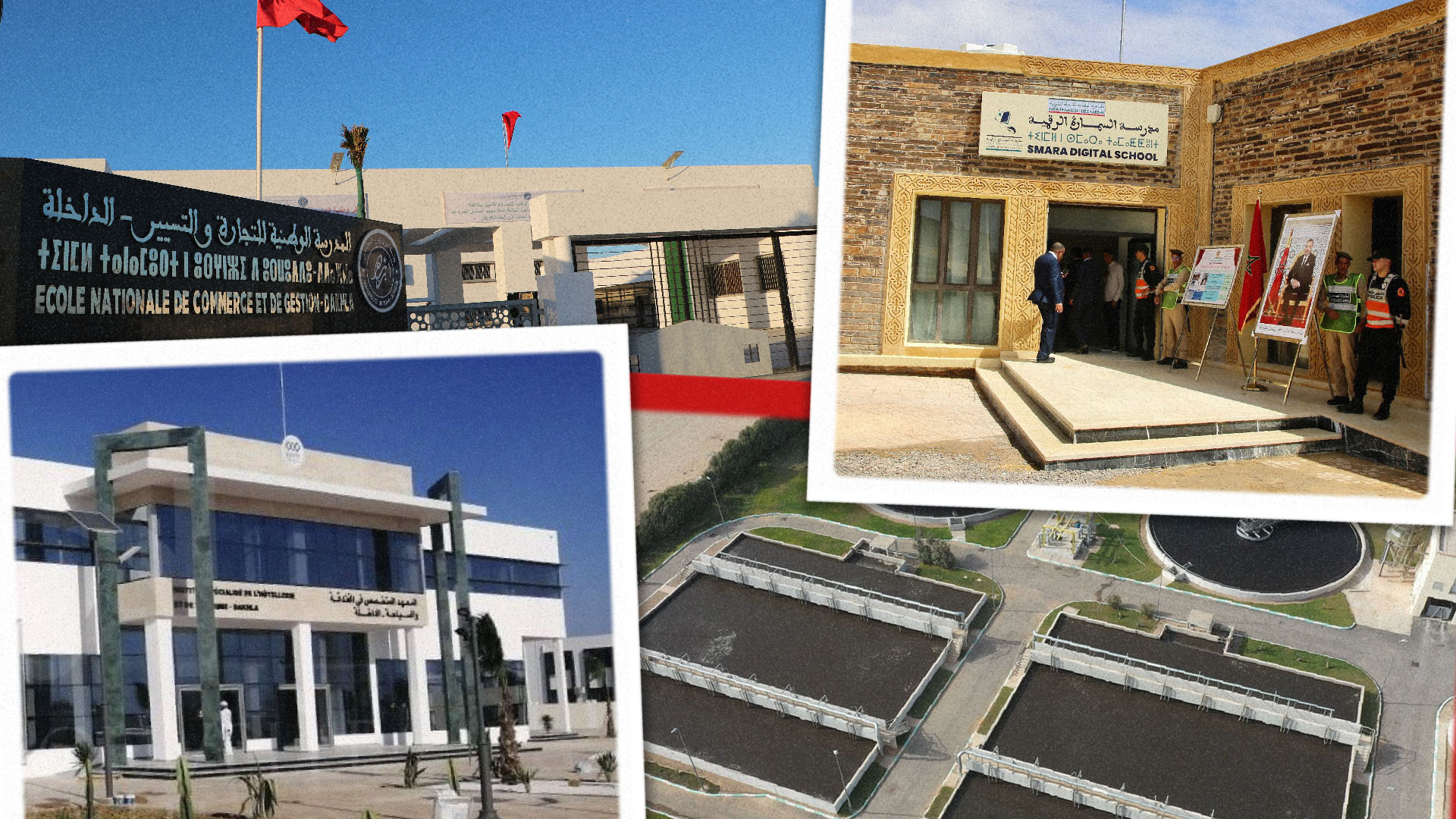
Inaugurated on December 18, 2020, the Specialized Institute of Hospitality and Tourism (ISHT) of Dakhla embodies the Kingdom’s will to make vocational training a central lever for the development of the Southern Provinces. Built on an area of 20,000 m², with 3,850 m² built, this institution of the OFPPT network required an investment of 42.5 million dirhams. Designed as a modern application school, the ISHT has 14 educational workshops, language laboratories, and a training hotel allowing trainees to work in a real professional environment. Each year, it welcomes up to 1,100 learners across 11 fields, ranging from hotel management to catering, including culinary arts, service, and reception. This hands-on teaching model directly meets the local market’s need for skilled labor, in a region where tourism is a strategic pillar. A true talent incubator, the ISHT now enhances the region’s attractiveness by offering sector operators a locally trained and immediately operational workforce.
12- Thriving integrated aquaculture sector
The city of Dakhla is a pioneer in the development of the aquaculture sector in Morocco. The Azura group, through Azura Atlantic, has been established there since 2016 and specializes in clam production. Mobilizing an investment of 300 million dirhams (MDH), the group has installed a fully integrated sector, from the hatchery to marketing. Other companies have set up there, such as Unimer through a joint venture with the Moroccan-Catalan Aquaculture Company (SMCA) where oysters, clams, and mussels are developed, or Gold Sea Australia, specializing in the farming and export of shellfish and clams. To date, 11 farms are active in Dakhla and 2,400 ha have been allocated to 214 shellfish and algae projects for a projected production of 78,000 tonnes with the creation of 2,500 jobs. Dakhla-Oued Eddahab was even selected as a pilot region for the overhaul of regional aquaculture development and management plans, a project initiated by the National Agency for Aquaculture Development (ANDA), requiring a budget of 4.7 million dirhams. Dakhla also hosts the first aquaculture station of the regional center of the National Institute of Fisheries Research (INRH), the first of its kind in North Africa with an area of 8,000 m2 and requiring an investment of 65 million dirhams.
13- West Africa Free Zone sets the bar high
The West Africa Free Zone logistics zone is an integral part of the future large industrial and logistics zone, associated with the Dakhla Atlantic port, which is expected to be operational by 2029. The logistics zone project, located in the commune of El Argoub and extending over 45 ha, reflects the country’s ambition to make Dakhla a central pivot for trade between Morocco and West Africa.
Concretely, the free zone will be a platform for logistics consolidation (destined for the continent), transshipment, and world-class logistics service, capable of offering a high level of competitiveness to commercial operators. Among the comparative advantages of the West Africa Free Zone are its privileged positioning on the major shipping lines to West Africa as well as its large storage capacities.
In terms of investment, more than 150 million dirhams (MDH) must be mobilized for the development of the logistics zone, which will contribute to improving regional integration in the long term.
In short, the West Africa Free Zone logistics zone will have all the assets to establish itself as a strategic hub for the African Continental Free Trade Area (AfCFTA), of which the Kingdom is a prominent member.
14- UM6SS Dakhla: A hub of excellence in health
Inaugurated on September 23, 2024, the campus of the Mohammed VI University of Health Sciences (UM6SS) in Dakhla illustrates the Kingdom’s vision of making the southern regions a hub of excellence in health and medical training. Carried by the Mohammed VI Foundation of Health Sciences, this project is part of a dynamic of decentralizing higher education and anchoring skills territorially. The goal is clear: bring medical training closer to the regions, respond to the specific needs of the territory, and open a continental gateway through the African Academy of Health Sciences.
On a site spanning several hectares, the campus houses the Mohammed VI Faculty of Medicine, the Faculty of Nursing and Health Professions, as well as a graduate school of health sciences engineering. Conceived as a crossroads of African knowledge, the African Academy aims to welcome up to 3,000 students from across the continent. The campus includes a residential quarter, a conference center, and university residences totaling nearly 600 beds, a framework designed to foster exchange, research, and student life.
Ultimately, the system will be complemented by the Mohammed VI University Hospital Complex of Dakhla, a future pillar of the regional health system. Equipped with 300 beds, including 58 for intensive care, this hospital will serve as both a care center and a clinical training ground for students.
15- Millions of dirhams for liquid sanitation
With an investment envelope of 245 million dirhams, the city of Dakhla was equipped with a major liquid sanitation project in 2016. This project involved the construction of a wastewater treatment plant with a treatment capacity of 150,000 population equivalent and a daily flow of 10,000 m3. Additionally, the project consisted of laying 21 kilometers of wastewater collectors, establishing five pumping stations, and constructing structures for transferring treated water for reuse purposes. It is worth recalling that this project completed a first liquid sanitation project commissioned in 2008, which had mobilized an investment of 62 million dirhams. It had involved the rehabilitation and extension of sanitation networks over a length of 67 kilometers, the completion of 3,750 private connections, and the construction of two pumping stations. And given the urban development the city is experiencing, it was necessary for the reinforcement of various infrastructures to follow. Especially since it was crucial to provide sustainable responses to the challenges of urbanization, while considering the imperative of strengthening the destination’s tourist attractiveness.
16- ENCG Dakhla to train versatile managers
Established in 2016, the National School of Commerce and Management (ENCG) of Dakhla, the tenth component of the national ENCG network, falls under Ibn Zohr University. Built on an area of 16,428 m², it is part of the dynamic of expanding higher education into the Southern Provinces. The school’s mission is to train versatile managers in the fields of commerce, management, and finance. The curriculum, structured according to the LMD system (Bachelor-Master-PhD), combines academic teaching with professional immersion through internships, associative projects, and thematic seminars. ENCG Dakhla also organizes the International Congress on Desert Economy, which has become a space for scientific exchange around sustainability issues in arid zones. The impact of this school extends beyond the academic field. It facilitates the integration of young graduates into the regional economic fabric, strengthens local managerial skills, and encourages Saharan entrepreneurship. In 2024, an envelope of 8.2 million dirhams was mobilized by the Regional Council to improve learning conditions and support these sustainable projects, thus confirming its structuring role in the development of the Dakhla-Oued Eddahab region.
17- Guelmim: The dam aiming to irrigate 10,000 hectares
Falling within the framework of implementing the integrated development program for the Guelmim-Oued Noun region, signed in 2016, the construction work for the Fask Dam was completed in 2024. This hydraulic structure, which extends over an area of 628 hectares, has a storage capacity of nearly 79 million cubic meters. With the underlying objective of irrigating no less than 10,000 hectares. This signifies that the agricultural sector in the region will greatly benefit. Furthermore, this dam not only contributes to replenishing the groundwater downstream but also enables the supply of drinking water to the city of Guelmim and neighboring centers, and provides protection against floods. Subsequently, this hydraulic infrastructure, which mobilized an investment of 1.5 billion dirhams, is expected to participate in the creation of a diversified agricultural ecosystem and attract new investments. However, observing the overall dynamism of Guelmim-Oued Noun, it goes without saying that the Fask Dam will play a driving role in the socio-economic development of the entire region.
18- Port Dakhla Atlantique: Future giant of the oceans
It is one of the most ambitious projects ever launched in Morocco. A titanic infrastructure, the project of all superlatives. Nestled in the commune of Ntireft, 40 km north of the city, this megaproject is the result of an agreement signed in 2016, during a tour by the Sovereign in the Southern Provinces. Nine years later, the giant silhouette is slowly emerging from the waters. Last July, the work was 40% complete and the future 1.3 km marine bridge was 85% finalized. This multifunctional port, with a total investment of 12.5 billion dirhams (MMDH), will notably include a commercial basin with an oil terminal, a coastal and deep-sea fishing basin, and a naval repair basin. It will also be connected to National Road No. 1 (RN1), particularly the Tiznit-Dakhla expressway, another major project whose work is almost complete. With an annual traffic of 35 million tonnes, distributed between bulk, containers, naval repair, and fishing-related activities, Dakhla Atlantique will ultimately be one of the largest ports in the Kingdom. Backed by the Royal Initiative for the Atlantic, the port infrastructure, which is expected to be operational in 2029, will be an important lever to stimulate intra-African trade.
19- Smara connects through the new digital school
Inaugurated on September 9, 2025, the Es-Semara Digital School presents itself as a targeted response to the employability challenge in the province of Es-Semara. Financed by the Provincial Human Development Committee (CPDH) to the tune of over one million dirhams, this establishment immediately welcomes 70 young people and operates in partnership with the Anapec, the Es-Semara Foundation, and the technical operator Web4Jobs. Conceived as a practical learning platform, the Digital School offers short tracks in coding, digital skills, soft skills, and language reinforcement, articulating technical training and support towards integration or self-entrepreneurship.
Operational from its opening, the school aims to reduce the local digital divide by equipping young people with skills sought after by companies and startups, while laying the foundations for a provincial digital ecosystem. In the short term, it aims for the professional integration of the first graduating classes. In the medium term, it aims to contribute to the creation of digital micro-enterprises and the diversification of economic opportunities in the province. A modest scheme in terms of its budget, but targeted in its pedagogy and partnerships, the Es-Semara Digital School illustrates how focused local investments can amplify employability and socio-economic inclusion in isolated territories.
20- A custom-built police school in Laayoune
In September 2019, the city of Laayoune witnessed a first for the southern provinces of the Kingdom. A police school was inaugurated there. On September 17, the 400 trainee peacekeepers joined the training benches, the General Directorate of National Security (DGSN) announced at the time. The school in question has a pedagogical unit that provides theoretical and practical training in the various police professions, including public security, general intelligence, and judicial police. On the operational side, the training includes physical education courses as well as rules for maintaining public order. Behind this training unit, which is equipped with all modern facilities to ensure better training in accordance with the policy pursued by the DGSN, is the aim to promote and perfect the human resources of the General Directorate of National Security so that they can carry out their duty under the best conditions.