Kingdom
50 Projects That Changed the Sahara (1/5)
For half a century, the Kingdom has been massively investing in its Southern Provinces to equip them with all kinds of infrastructure to provide the population with the conditions for a dignified life. Industry, culture, agriculture, transport, fishing, sports… a multitude of projects have turned the mirage of development into reality. A selection.

1- Expressway to improve mobility
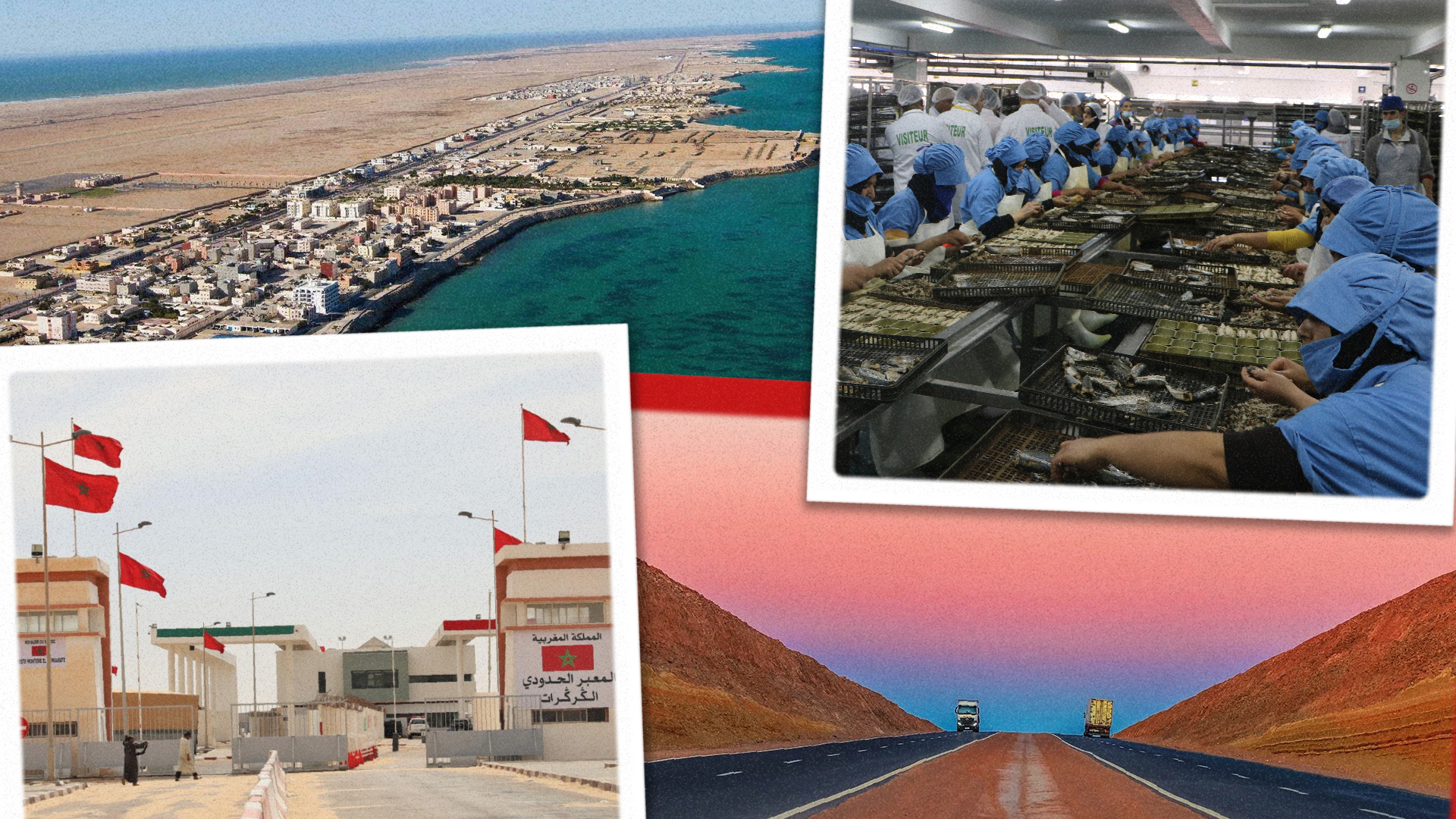
This is one of the largest structuring projects carried out in the Kingdom in recent years, both in terms of the scale of its technical challenge and its strategic importance. Almost completed after several years of work, this titanic project is set to stimulate the economic and social development of the southern provinces for decades to come, while anchoring Morocco in its African depth. A cornerstone of the New Development Model for the Southern Provinces, launched in 2015 by His Majesty the King, this expressway is considered the backbone of the development of the Moroccan Sahara. Extending over 1,050 kilometers and dotted with around fifteen engineering structures, the project includes the construction of a highway between Tiznit and Laayoune, over a length of 550 kilometers, as well as the widening of National Road No. 1 between Laayoune and Dakhla to nine meters, over 500 kilometers. In addition to its stimulating effects on economic activity, the expressway improves mobility between the north and south of the Kingdom. Furthermore, by reducing the distance for light vehicles, trucks, and heavy goods vehicles, it facilitates the fluidity of goods transport and reduces logistics costs, thus reinforcing Morocco’s position as a logistics hub for the region. For the Southern Provinces, there will truly be a before and after the expressway.
2- University Hospitals to open up healthcare in the South
The University Hospital Center (CHU) of Laayoune is a strategic hospital and university project for the southern provinces of the Kingdom. Initiated as part of the New Development Model, it aims to strengthen healthcare provision, improve access to specialized care, and support medical training in the region. Covering an area of 180,000 m2, with 95,000 m² built, the CHU required an estimated budget of 1.2 billion dirhams invested in its construction and equipment.
The 500 beds it will have are distributed across several specialized activity centers. The goal is to reduce patient travel to other major cities for specialized care by offering medical services adapted to the local population. This CHU should also serve as a regional health reference center, particularly for the Southern regions, both for the local population and potentially for South-South medical cooperation with other countries. Furthermore, this center will also provide a practical training framework for students and health professionals from the Faculty of Medicine and Pharmacy of Laayoune. The inauguration of this CHU is scheduled for the end of 2025.
3- El Guerguerat: More than just a border post!
The wind of infrastructure modernization blowing across the various regions of the Kingdom is clearly felt in the commune of Bir Gandouz, more precisely at the El Guerguerat border post. A nerve center for trade between Europe and West African countries, the border post has been transformed in recent years thanks to a cluster of high socio-economic impact infrastructure projects. Nearly 30 million dirhams (MDH) were invested in the construction of a desalination plant, with a capacity of 432 m3/day. This modern infrastructure is accompanied by other water installations (borehole, reservoir) to optimize the water supply for the populations. The area, expected to become more urbanized in the coming years, hosts, among other things, a bank agency (Barid Bank), a hotel unit, and a mosque. On the sports infrastructure side, in February 2023, the Infrastructure Commission of the Royal Moroccan Football Federation (FRMF) launched construction work on a competitive football pitch (with synthetic turf, meeting FIFA standards) in El Guerguerat. There is also the future 30-hectare distribution and logistics zone which will contribute to accelerating the socio-economic development and urbanization of this area of the Moroccan South.
4- When the South gets into sports
From hot sand to synthetic turf, the Southern Provinces are changing their scenery! In Laayoune, Dakhla, Smara, or even El Guerguerat, local sports fields are flourishing and becoming the new headquarters for the youth. We are talking about more than a hundred sports infrastructures that have been created or renovated, for a total investment of 250 million dirhams (MDH), benefiting over 30,000 young people. These ultra-functional mini-stadiums, driven by the National Human Development Initiative (INDH) and local authorities, are bringing neighborhoods back to life and creating a real sense of community spirit. Sport becomes a pretext for building connections, strengthening cohesion, and perhaps spotting future champions.
In Laayoune, several sports complexes have sprung up like mushrooms, offering young people a framework worthy of major teams. Dakhla, for its part, is betting on the winning duo of sport & tourism, attracting both football enthusiasts and fans of kitesurfing and gliding sports.
Further south, in El Guerguerat and Bir Gandouz, two large FIFA-standard synthetic football pitches are under construction. A first for these booming areas. Highly mobilized local associations are multiplying tournaments, training courses, and activities to supervise the youth and channel their positive energy. A sporting and social dynamic that is gradually transforming the Southern Provinces into true lands of play and conviviality.
5- Connection to the national electricity grid
Since February 2021, the city of Dakhla has been connected to the national electricity grid, contributing to enhancing and strengthening the region’s economic potential. A major axis of the development model for the Southern Provinces, this large-scale project effectively strengthens the energy security of the Saharan regions, particularly Laayoune, Boujdour, Smara, and Dakhla, while promoting the integration into the national grid of the renewable energies produced there in large quantities. It also supports the socio-economic boom of these provinces as well as the major projects being developed there, such as the Dakhla Atlantic port, industrial zones, and desalination plants. Managed by the National Office for Electricity and Drinking Water (ONEE), this titanic project involves 1,000 km of high-voltage power lines (225 kV and 400 kV), for a total estimated investment of 2.5 billion dirhams (MMDH). It also required the construction of several new electrical substations and the installation of very high voltage (VHV) lines crossing difficult desert areas. Ultimately, the project will facilitate the realization of new interconnections with neighboring countries, notably Mauritania, thereby contributing to the strengthening of regional integration.
6- Cities of Trades and Skills for the talents of the future
Conceived in the major overhaul of vocational training launched in 2019, the national strategy for Cities of Trades and Skills (CMC) bets on a simple but ambitious idea: to give each region of Morocco its own talent hub. In the Southern Provinces, the project takes on a strategic turn. In Laayoune-Sakia El Hamra, the CMC has been in full swing since the 2021-2022 academic year. Between state-of-the-art technical workshops, innovation labs, and coworking spaces, everything is designed to train the professionals of tomorrow in the sectors that drive the region: maritime fishing, renewable energies, logistics, agriculture, construction and public works (BTP), tourism, and services. With a capacity for over 2,000 trainees, the place breathes future. And it’s not over: the CMC of Dakhla-Oued Eddahab is already on the horizon, ready to open its doors in the coming months according to the schedule of the Office of Vocational Training and Labor Promotion (OFPPT). Together, these CMCs strengthen an already solid vocational training ecosystem in the South, which includes 16 establishments, 16 sectors, and over 20,600 training places. A real ramp-up to prepare the skills that will build the future of the Moroccan Sahara.
7- Nerve center of the canned fish industry
Dakhla now stands as a nerve center of the national fishing industry, particularly in the canned fish sector. The city boasts no less than six fully operational canned fish units, including Unimer Dakhla, Rio de Oro, Damsa, and Scandimar. The most recent establishment required an investment of 120 million dirhams and will ultimately create 950 direct jobs. In total, the sector has mobilized a budget envelope exceeding one billion dirhams and employs around 2,500 people. Two others are reportedly in the process of being established and would strengthen the industrial fabric. The annual production of all these processing units is around 400 million cans, a figure set to increase with the expansion projects of some of these factories. In any case, the products from these canneries are destined for both the national market and export, particularly to Europe, West Africa, and Asia.
8- Dakhla: An exceptional desalination plant
25,000 permanent jobs, 37 million m3 of water per year, and the creation of a new 5,200-hectare irrigated perimeter. These are the expected benefits of the Dakhla desalination plant, located 130 km north of the city. Launched in December 2022, the work has reached a completion rate of over 60%. This project is the first of its kind to be 100% powered by wind energy, as it relies on a 60 MW wind farm to guarantee a sustainable energy supply, and will thus help preserve the water table. It is being carried out under a public-private partnership and mobilizes an investment of 2.6 billion dirhams. The annual production will be strategically distributed: 30 million m3 of water will be used for irrigation, while the remaining 7 million m3 will be dedicated to supplying drinking water to the city and the future Atlantic Port. Another advantage of this large-scale project: it will enable the equipping of 219 farms, 100 of which are allocated to young farmers.
9- Two logistics zones to transform Oued Eddahab
Among the high socio-economic impact structuring projects in the Dakhla-Oued Eddahab region are the future distribution and commercial zones at the El Guerguerat border post and in Bir Gandouz. These two projects, involving several key players (Regional Council, French Chamber of Commerce and Industry in Morocco, the State, etc.), are meant to further consolidate the region’s stature as a strategic hub for trade relations between Morocco and Africa.
Built each on an area of 30 hectares, the two complementary projects are expected to mobilize nearly 160 million dirhams (MDH), with the advantage of strengthening the infrastructure fabric as well as the regional attractiveness for national and international investors and companies operating, among others, in the transport and logistics value chain. The two zones, designed to host more than 70 investment projects (with land plots ranging from 1,000 m2 to 10,000 m2), are already attracting the interest of several companies. The marketing and management of the two logistics parks have been entrusted to the French Chamber of Commerce and Industry in Morocco, renowned for its expertise in this area.
10- Healthcare invested by the private sector
Inaugurated on November 6, 2024, by the Akdital Group, the Dakhla International Clinic marks a major advance in healthcare provision for the Dakhla Oued Eddahab region. The result of a 269 million dirham investment, this modern facility offers comprehensive, multidisciplinary care. With a capacity of 113 hospital beds, it integrates state-of-the-art equipment in various medical and surgical fields.
The clinic boasts, among other things, an intensive care unit, a day hospital for chemotherapy, a radiotherapy unit, a maternity unit, and also eight operating rooms designed according to international standards. The Dakhla International Clinic has had a definite social impact at the regional level as it has created more than 150 direct jobs and has strengthened the local hospital infrastructure to decentralize care and reduce regional inequalities in health.