Influences
Hypnotic Brass Ensemble : «Where Roots Refuse to Compete»
Twenty minutes after leaving the stage with Mehdi Nassouli, the Hypnotic Brass Ensemble is still carried by the concert. The Chicago collective speaks to us about Africa, polyrhythms, qraqeb, and a conviction that their music and Mehdi Nassouli’s music have always spoken the same language.

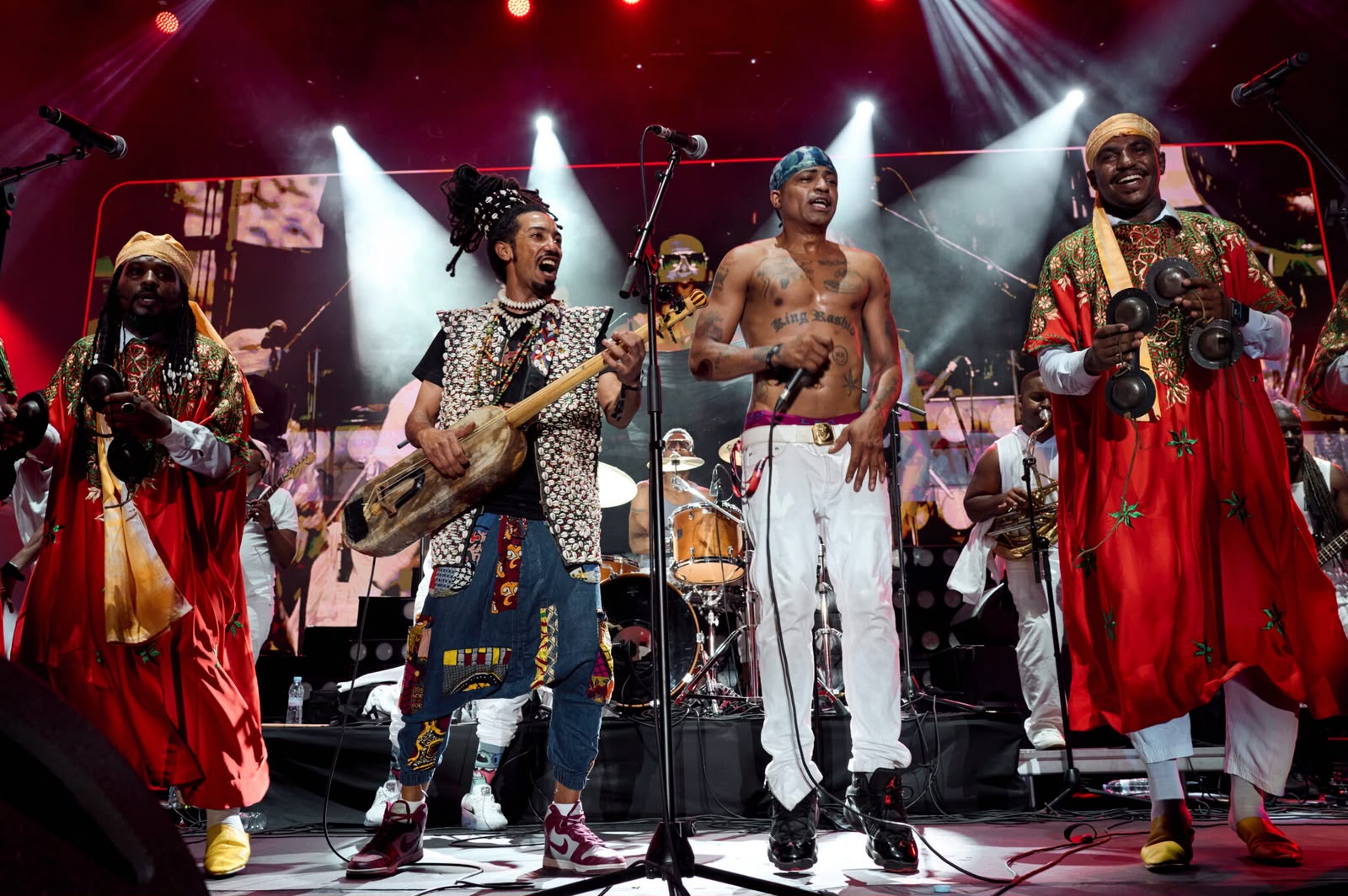
The most beautiful musical encounters are not always aesthetic shocks. Sometimes they resemble a memory that no one knew how to share. On stage, facing Mehdi Nassouli, the Hypnotic Brass Ensemble did not seem to be discovering Gnawa music, but rather rediscovering a rhythm buried somewhere in its own history.
As if Chicago and Essaouira, Marrakech, Taroudant… had always been speaking to each other without knowing it. Twenty minutes after the concert, the brass instruments are still burning hot, the hands still remember the qraqeb, and the conversation naturally drifts toward Africa, heritage, polyrhythms, and the idea that some music crosses oceans without ever losing its language.
How did your musical world meet Mehdi Nassouli’s? When did you realize your music could converse with his?
We already knew gnawa music. Our father passed on to us jazz, but also music from around the world. He used to tell us that jazz is an African-American creation whose roots sink into the history of Africa and its diaspora. We grew up with that awareness. In our home, music was not just an art; it was a way of inhabiting the world.
When the meeting with Mehdi Nassouli presented itself, we did not feel like we were discovering a foreign universe. We immediately recognized a familiar language. Some of our compositions were already sharing the same harmonic colors as his.
Deep down, our musics are born from the same roots. We simply found a common trunk. From there, everything became obvious. That freedom comes precisely from those shared foundations. When you speak the same musical language, each person can go very far without ever losing the other.
And there is also the human dimension. We come from the street… Well, this is a brotherhood. Mehdi and the musicians around him carry an energy that resembles ours. We would probably have gotten along even without the music. Deep down, the language of the street and that of music obey the same codes.
A way of being, more than just a way of playing?
Exactly. It is a way of life!
The Gnawa rhythm, with its famous “quarter time,” seems to offer great freedom of exchange. Is that where the key to this encounter lies?
Yes, because everything begins with rhythm.
In part of modern jazz, especially in John Coltrane, rhythm can sometimes fade away in favor of a more abstract search. Our approach is different. We learned to be creative within a framework: that of rhythm, sound, and form.
When we discovered Gnawa music, we found that same philosophy again. An ancestral tradition, but built on principles that were already familiar to us.
When we went on stage together, no one needed to impose anything. Each person could guide the other, listen, respond, and restart. That is how a true musical conversation is born. This is no ego because we all come from the street (smile).
Some artists seek above all to tell a story, others to make people travel. With Mehdi, we pursue another ambition: to create a shared emotion.
He nourishes his music with each of his encounters around the world. We do exactly the same thing. It is this curiosity that brings us together.
What the audience heard tonight is not a simple collaboration. It is the extension of an ancient tradition that continues to invent its future. We inherit from our fathers and grandfathers, but this heritage only makes sense if it continues to live.
Don’t rhythms already speak a universal language, beyond traditions?
Absolutely. That is the whole principle of polyrhythms: several rhythms crossing, answering each other, and finally forming a single language.
When Mehdi explained the structures of Gnawa music to us, we realized that we were already working according to a very similar logic. In our piece Balicky Bon, for example, the brass intertwine exactly like Gnawa rhythms.
It is this rhythmic architecture that fascinates us. It gives everyone room for expression while maintaining collective coherence.
Today, we can naturally enter into their rhythms, clap our hands, play with them. We are still learning, but we already speak this common language.
By the way, remind me of the name of those instruments…
The qraqeb?
Honestly, we could very well add one to our group (laughs).
It is an extraordinary instrument. The brass instruments draw the melodic lines; the qraqeb occupy the spaces, reveal times that we do not always perceive, and give the body an immediate desire to move.
This music is deeply physical.
During this journey, we also rediscovered flamenco. Hearing it here, we realized how much some of its rhythmic colors are close to those of North Africa. The further back one goes toward the origins, the more these links become obvious. It is fascinating!
Is there a question that no journalist ever asks you, but that you would like to hear?
Yes. We would like to be asked what the rest of the world really thinks of African Americans, and more specifically of those from Chicago.
Everyone associates us with crime, gangs… Yet at home, instead of having a gun, we have a trumpet, a trombone, etc.
We are musicians, but we also feel that we are ambassadors of a community.
Our father introduced us to music at a very young age in order to fight stereotypes. He wanted to show that young African Americans could be educated, disciplined, curious, capable of excelling just as much in classical music as in jazz. That is what we want to convey everywhere we play.
That makes me think of the World Cup. Everyone said Morocco would be eliminated early, no one believed this team was capable of upsetting the established order…
And yet, you won (laughs). You managed it because you had something that predictions never measure: absolute faith in your own ability.
That is also why there is a question that is especially close to our hearts: the fact that we are not outsiders. In fact, we would like to know what Moroccans think of African Americans. Not only of what our music — hip-hop, jazz, or soul — has brought to the world, but of our history, our culture, our heritage, and what we represent today.
Because, in the end, this goes far beyond music. It touches our identity. And for us, it is just as essential as the songs themselves.