Kingdom
Drone warfare: Towards a new grammar of combat
From the Donbas to the Gulf, drones are redefining military and strategic balances. The real battle is no longer technological; it is industrial, doctrinal, and human. For the Royal Armed Forces, preparing for this shift is not an option — it is a necessity.

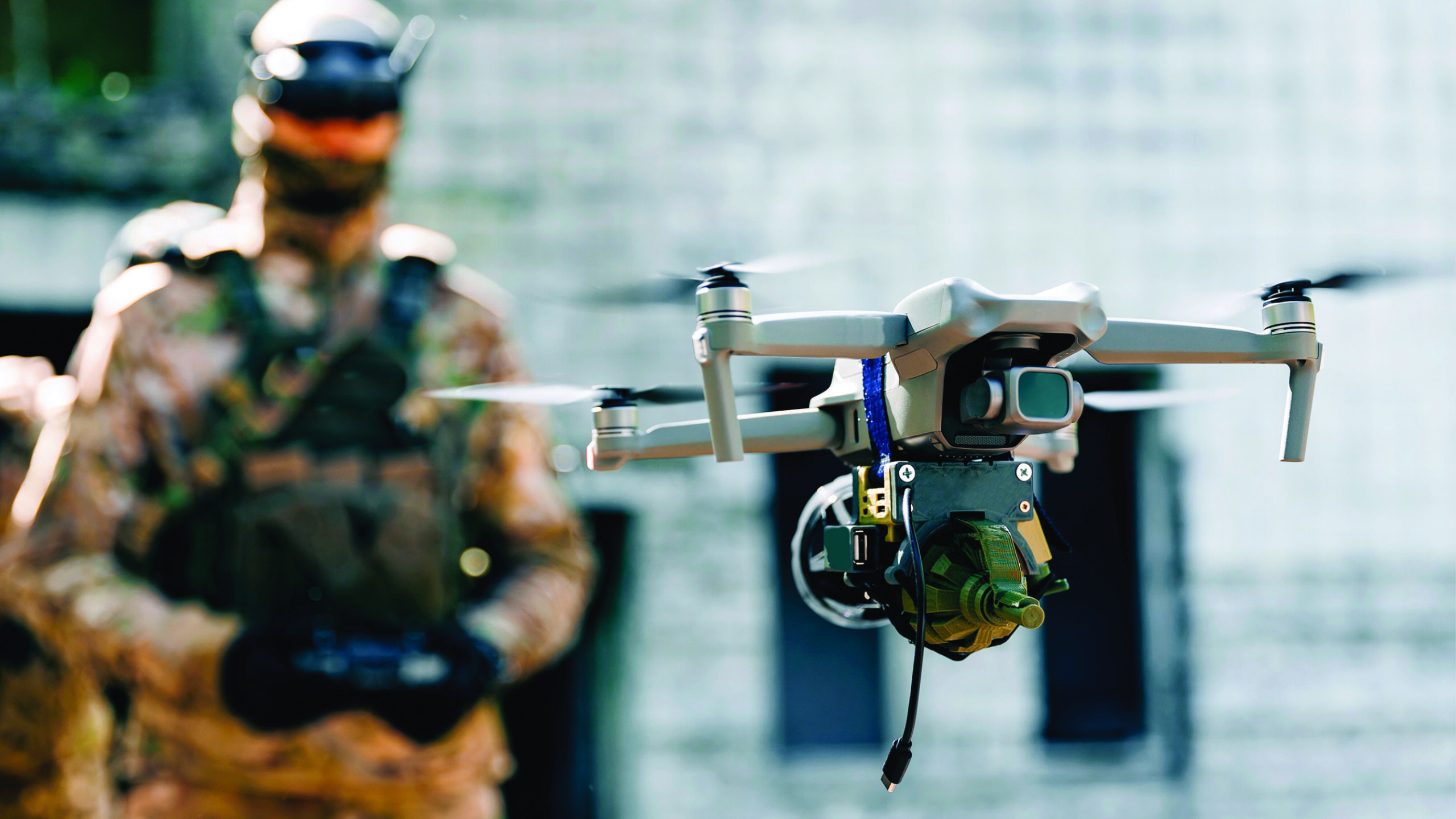
Somewhere in Baghdad, within the perimeter of the international airport that hosts one of the most heavily protected U.S. bases in Iraq, a drone assembled for a few thousand dollars and operated by a pro‑Iranian militia calmly enters restricted airspace. It flies over the site. It inspects and films in real time.
It selects its target. Then it crashes into a fortified building, while a second drone coldly documents the attack. No alarm is triggered, and no interception system is activated.
The most sophisticated defence systems on the planet—acquired at a cost of billions from the largest American defence contractors—have just been bypassed by a makeshift device. Iran’s foreign minister mocked the incident, referring to an “American security umbrella riddled with holes.”
Thousands of kilometres away, along the battered roads of the Donbas, Ukrainian soldiers are stringing up metal nets along dozens of kilometres of supply routes. Not to trap enemy armoured vehicles, but to protect themselves from drones. Machines costing 500 dollars which, in certain sectors of the front, account for 70 to 80 per cent of material losses.
Devices of disarming simplicity, so numerous and so cheap that they have forced one of Europe’s most battle‑hardened armies to turn its supply routes into makeshift tunnels. This is the reality of modern warfare. And it is unsettling, because it contradicts two decades of military certainties.
The drone is no longer what it was just five years ago. At the time, it represented a decisive advantage reserved for the most advanced armed forces—a technological joker that only first movers, those pioneer actors able to convert innovation into operational superiority, could afford and master. It has become something far more destabilising: a mass‑accessible, proliferating, and asymmetric weapon.
For 21st‑century armies, it plays the role that gunpowder once did for medieval warriors—a factor X, a disruptive element that gives no warning before breaching defences deemed impregnable, overturning established balances of power, and rendering obsolete systems on which great nations have built their strength for decades.
This factor X does not merely change the nature of weapons. It also transforms how war is conceived, how threats are detected, and how operations are conducted. It forces military staffs around the world, from the sands of the Sahel to the plains of Ukraine, to redefine their priorities: how to prepare to fight—and above all to endure—within this new grammar of war?
For the Royal Armed Forces, as for all armies that seek to remain credible, this question is not rhetorical. It is operational. And it is urgent.
A silent but irreversible rupture
For decades, military superiority was displayed at arms fairs: the stealthiest aircraft, the best‑armoured tank, the most precise missile. Power was measured in billions of dollars invested and years of research and development undertaken by the giants of the global defence industry.
This was the era of the dominant platform—where sophistication guaranteed victory. That certainty is collapsing on the battlefields of the 21st century. The Ukrainian experience leaves no ambiguity: according to several military reports, the drone has become the primary vector of destruction on the battlefield, overtaking conventional artillery.
It has forced Russia to rethink the deployment of its armoured units and has transformed ISR (intelligence, surveillance, and reconnaissance) from a capability reserved for major powers into a tool accessible at battalion level.
Above all, it has introduced a new temporality into warfare: permanent adaptation, where a drone model becomes obsolete in three weeks and is immediately replaced by an improved version. Adnane Kaab, former senior officer of the Royal Air Force and defence and strategy analyst, offers this diagnosis:
“What strikes first is not the appearance of the drone, but the reversal of the cost ratio it introduces. A very low‑cost system can now constrain, divert, or neutralise a much more expensive one. This is not a tactical adjustment. It is the end of an illusion. Cost no longer guarantees superiority.”
Aerial warfare, he adds, “can no longer be conceived solely in terms of technological superiority and air dominance, but in terms of the economic sustainability of the war effort.” A rupture that reshapes not only arsenals, but the very conception of victory.
Iran: When saturation defeats sophistication
If Ukraine has been the laboratory of this new grammar of combat, Iran has written its industrial manual—demonstrating that 21st‑century military power can be built under embargo and with limited means, provided the right strategic choices are made.
Under international sanctions and denied access to Western technologies, Iran has, since the 1990s, developed a mass drone‑production capability that now allows it to exert military influence simultaneously across four theatres: Yemen, Gaza, Iraq, and Ukraine via Russia, through the Shahed‑136.
Produced in series in dedicated factories and sold to Moscow for a few tens of thousands of dollars per unit, this drone has saturated Ukrainian and European air defences to the point of triggering an unprecedented interceptor missile stockpile crisis in NATO’s recent history.
For Kaab, the usual reading of the Iranian case is misleading:
“It is often interpreted through the prism of technology, whereas it is first and foremost the result of a constrained strategic choice. Deprived of access to certain advanced technologies, Iran prioritised a logic of volume, robustness, and reproducibility. This choice is not a renunciation—it is a coherent adaptation to its resources and its environment.”
This adaptation aligns with a long‑standing strategic tradition rarely invoked in debates on drones. Kaab recalls it by citing Alexander Svechin, an early‑20th‑century Soviet military theorist, who insisted on aligning available means with the nature and duration of the conflict, favouring a strategy of endurance over one of annihilation.
Iran has done exactly that. It did not attempt to compete with the United States on technological terrain. Instead, it built a capability sustainable over time, capable of exerting pressure through repetition and attrition.
The lesson is universal: “Power no longer comes from the technological object itself, but from the ability to produce it, adapt it, and renew it over time,” Kaab summarises. And it is precisely this lesson that major Western powers have taken years to internalise—some still have not.
Morocco: An indispensable strategic adaptation
The Kingdom operates in a threat environment that combines, across three simultaneous fronts, southern asymmetry, conventional threats to the east, and chronic instability in the Sahel—a very real triptych that demands responses equal to the challenge.
In response, since 2020 the Royal Armed Forces (FAR) have undertaken an unprecedented qualitative modernisation: Bayraktar TB2, Akinci, Patriot PAC‑3, AH‑64E Apache helicopters, Koral electronic warfare systems, and HIMARS rocket launchers.
This arsenal reflects a coherent strategic vision and an ability to anticipate technological ruptures. The creation of the Eastern Military Zone in January 2022, in direct response to growing hostility from the Algerian regime, also confirms that the FAR have undergone a profound doctrinal transformation.
But having the tools is not enough. The former senior FAR officer states it plainly:
“Morocco knows how to mobilise in times of crisis. But producing in wartime is another requirement entirely—it implies transforming a reactive capability into one of continuous production.”
The logistical resilience demonstrated during Covid—through the Royal Gendarmerie’s industrial conversion to large‑scale mask production—and during the Al‑Haouz earthquake—through the FAR’s deployment to near‑inaccessible areas in under 24 hours—is a real strategic asset. But, as Kaab clarifies, “without a genuinely engaged industrial conversion, this resilience remains a situational asset, not a lasting strategic advantage.”
These challenges appear to have been fully grasped by Morocco. Rather than waiting, it is positioning itself. The first African country to acquire the Bayraktar TB2, it is now preparing to take a further step by hosting, on the sidelines of the African Lion 2026 exercise (from 20 April to 8 May), the first U.S. regional drone training centre in Africa.
Announced by General Christopher Donahue, Commander of U.S. forces in Europe and Africa, this initiative confirms the Kingdom’s ambition: to establish itself as a continental reference power in drone warfare—not only through the acquisition of the most advanced systems, but through operational mastery of weapons whose effectiveness ultimately depends on the quality of those who operate them.
Today, Morocco possesses the vision, the strategic alliances, and a developing industrial and aeronautical base to meet these challenges. The question is no longer whether it can move forward, but at what speed it chooses to do so.
Because in drone warfare, tempo is not an operational detail. It is, as Kaab reminds us, “another requirement”—the one that separates armies that endure conflicts from those that anticipate them.