Kingdom
The Lalla Mimouna Museum, an Exceptional Art Gallery
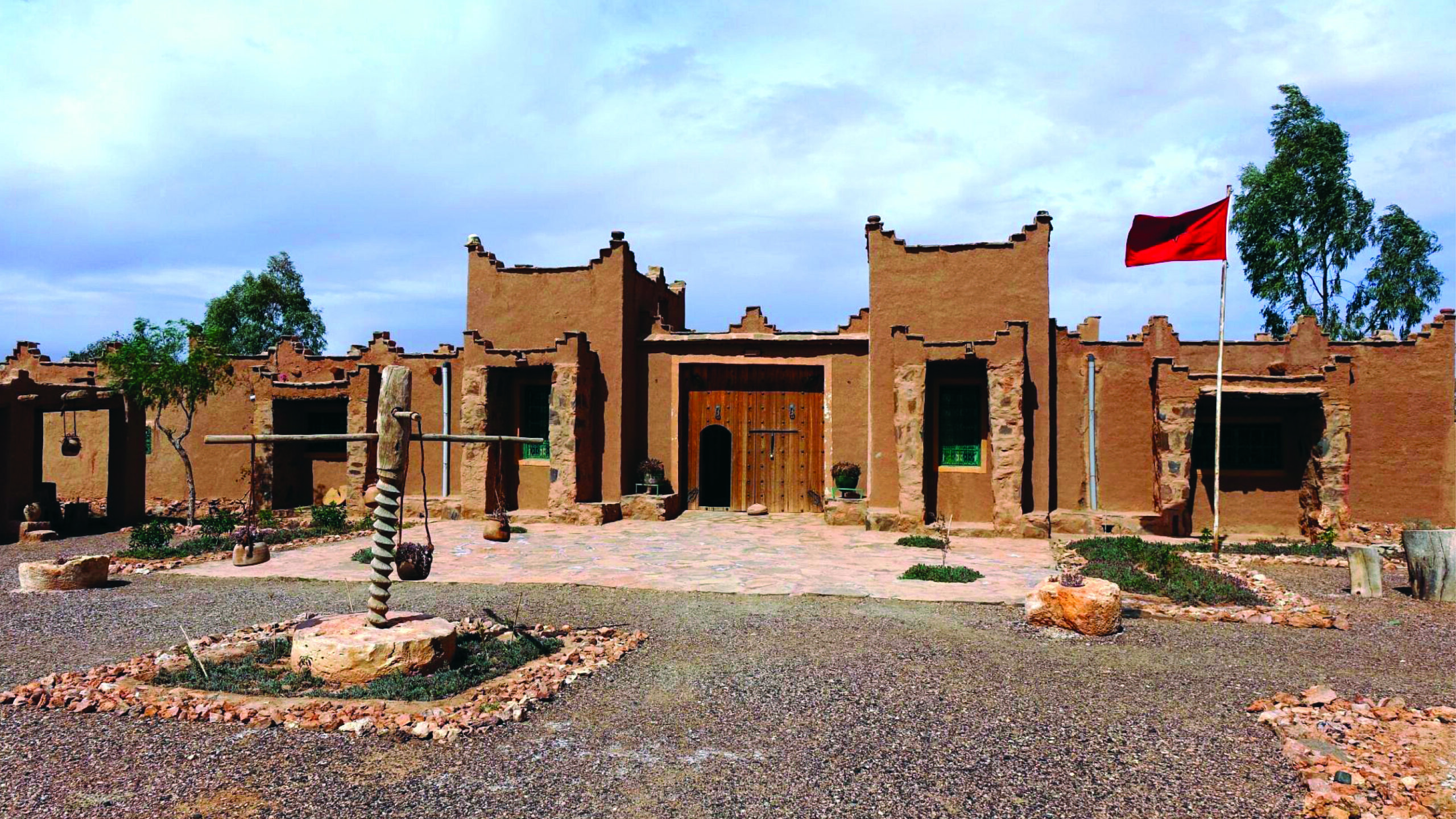
Just a short distance from Erfoud, Tinjdad is home to an exceptional art gallery: the Lalla Mimouna Springs Museum. Founded by Zaid Abbou, an outstanding collector, it displays—through rare objects—an entire facet of Berber cultural heritage.

It’s not only in Rabat, Casablanca, or Marrakech that you’ll find a museum of real artistic value. Along the national road from Tinghir to Rissani, the gateway to the desert, lies Tinjdad.
A small town in the Drâa-Tafilalt region, seemingly of little interest, crossed daily by travelers heading to discover the dunes of Merzouga. And yet, this locality hides a small artistic and sociocultural treasure of which its inhabitants are very proud.
Two kilometers before reaching it, a sign points the way: the Lalla Mimouna Springs Museum. Don’t hesitate—step in and visit this exceptional site, the result of nearly forty years of tireless work by Zaid Abbou, a passionate lover of art and calligraphy.
Zaid is a true native of Tinjdad. A polyglot, passionate about art and calligraphy, and an incurable collector of antique objects, he returned to Morocco in 1975 after completing higher studies at the Institute of Foreign Languages in Germany.
Before founding this museum, he traveled extensively as an international tour guide—a rich career both financially and culturally. It brought him comfortable income and a villa in Agadir, which he transformed into a small museum through his choice of décor and the art objects he collected: antique carpets, century-old copper and silver jewelry, calligraphic paintings of his own creation…
One day, his passion for art took over. Zaid gave up his professional career and its privileges to devote himself fully to what he loved most: calligraphy, antiques, and art in general.
“A crazy idea with unpredictable consequences,” he admits, without regret. He returned to his roots—his hometown—to first establish the “Galerie Chez Zaid” in 1990, in Tinjdad itself, and a few years later, the “Lalla Mimouna Springs Museum,” a larger and better-stocked site than the first.
He set it up on a three-hectare plot belonging to the municipality, where a natural spring is located—an object of great desire in a pre-desert region where water, more than anywhere else, is a source of life and prosperity.
However, laboratory analysis revealed that the water, besides being brackish, was too polluted. Nevertheless, Zaid fought with local authorities to acquire the land and establish his museum project there.
It is located along the paved road and is therefore easily accessible to visitors. In 2007, construction was completed, and his new gallery was ready to welcome its first visitors, after transferring his long-collected treasures from Agadir.
The result: a masterpiece worthy of major international art museums. Zaid, whom we find bent over his papers (a future collection he is preparing on Arabic writing and calligraphy), rises from his chair to welcome us.
The man is a mine of knowledge about art and cultural heritage—Amazigh heritage in particular—and visitors cannot help but be amazed, even more so when the museologist takes them by the hand to discover his collections.
Several museums in one
Listed in several travel guides, websites, and online platforms—including TripAdvisor, Le Petit Futé, and Le Routard—his gallery is beginning to gain national and international recognition, and praise for the museum is pouring in.
“It is certainly the place that best symbolizes the Morocco of tomorrow, not to be missed under any circumstances,” one guide advises in one of its editions. Its undeniable strength lies in the variety and richness of the objects on display, and in how they are presented—original, functional, and educational.
In reality, it is several museums in one, each reflecting a story, an era, a culture, and ancestral traditions. But it is the Berber heritage of southern Morocco that is most prominently highlighted.
For example, the water museum: here you find all the tools used for digging wells and channeling water, through the “khattara” system that once had its heyday.
You can also see the traditional water vendor, the “guerrab,” with his goatskin water bag slung over his shoulder, holding in his hands the yellow copper cups from which he serves his customers.
This is Zaid’s way of staging the water of the Lalla Mimouna Springs while preserving its sacred character. Another example is the Berber wedding museum: it displays the bride’s jewelry, beauty products, caftans, and even some marriage contracts dating back to the 17th and 18th centuries, written by Muslim adouls and Jewish rabbis, which our collector discovered during his travels across the Kingdom.
The writing museum, the “qalam,” features ancient pens and the ink once used to write on “louhas” (wooden tablets). Beside them, a less pleasant but contextually fitting sight: the ever-present stick used for “falaqa,” a form of corporal punishment meant to discipline unruly students.
Other small pavilions follow, showcasing additional facets of Morocco’s Arab-Berber-Hebrew cultural and artistic heritage: cuisine, masonry, carpentry, blacksmithing, currency, pottery… One entire pavilion is dedicated to agriculture, another to nomadic life.
The Lalla Mimouna Springs Museum in Tinjdad is an artistic wonder of inestimable value that deserves to be better known. “It is in the interest of the Ministry of Culture to help make it known to foreign tourists heading to Merzouga—it is an essential detour.
Moroccans themselves hardly ever stop here,” laments the collector. Zaid acknowledges having been invited to several exhibitions, including one held at the Mohammed V Theater when Hassan Maâouni was Secretary of State for Handicrafts.
That department, it should be recalled, played an important role in promoting Morocco’s cultural and artistic heritage. He was also invited by the French agency France Arts et Vie, which specializes in cultural travel, to exhibit in Aix-en-Provence, where he met renowned calligraphers.
The most recent exhibition, in 2022, took place during a cultural and artistic event under the leadership of the current minister Mehdi Bensaid, held at Ksar El-Fida in Rissani. It allowed him to display some of his calligraphic works, and he did so again a year later at Bab El-Kébir (Kasbah of the Oudayas) in Rabat.
As for the supervising ministry, he reproaches it for having made no effort to support the museum—“neither financially, nor morally, nor in terms of promotion. I am not asking for money, but at least that the Moroccan public be made aware of this museum’s existence, remote as it may be from major cities.”
The only personality to make the trip from Rabat, he recalls, was the late Touria Jabrane, when she was Minister of Culture. In 2023, the museum narrowly escaped disaster, having been severely hit by floods that affected the entire region.
It took several weeks to save its heritage from near-certain loss. “If not for the local authorities who mobilized to lend a hand, this artistic treasure would have been buried forever,” he says with relief.