International
Middle East Conflict: From Morocco’s Position to Potential Macroeconomic Impacts
The regional flare-up in the Middle East, which prompted an immediate and unequivocal reaction from the Kingdom condemning the Iranian attacks, could eventually affect the national economy, which until now had been surrounded by favorable prospects. Analysis.

The armed conflict shaking the Middle East, triggered by Iran’s armed attacks, as retaliation, against several Gulf countries (the United Arab Emirates, Bahrain, Saudi Arabia, Qatar, etc.), constitutes a clear source of instability for the global economy and international relations. Moreover, Morocco’s reaction was immediate and did not take long to appear.
As early as Saturday, February 28, His Majesty the King reaffirmed his support and full backing for the Gulf countries that had been targeted by Iranian attacks.
The Sovereign, who spoke by telephone with the heads of state of the targeted countries, reaffirmed “Morocco’s support for all legitimate measures that these states deem appropriate to preserve their security and the tranquility of their citizens.”
Even more telling, regarding the fraternal ties and constant solidarity that unite Morocco with these Gulf states, His Majesty the King stressed that “the security and stability of the Arab Gulf countries are an integral part of the security and stability of Morocco.”
And that “any infringement upon their security constitutes a serious and unacceptable aggression and a direct threat to the stability of the region.”
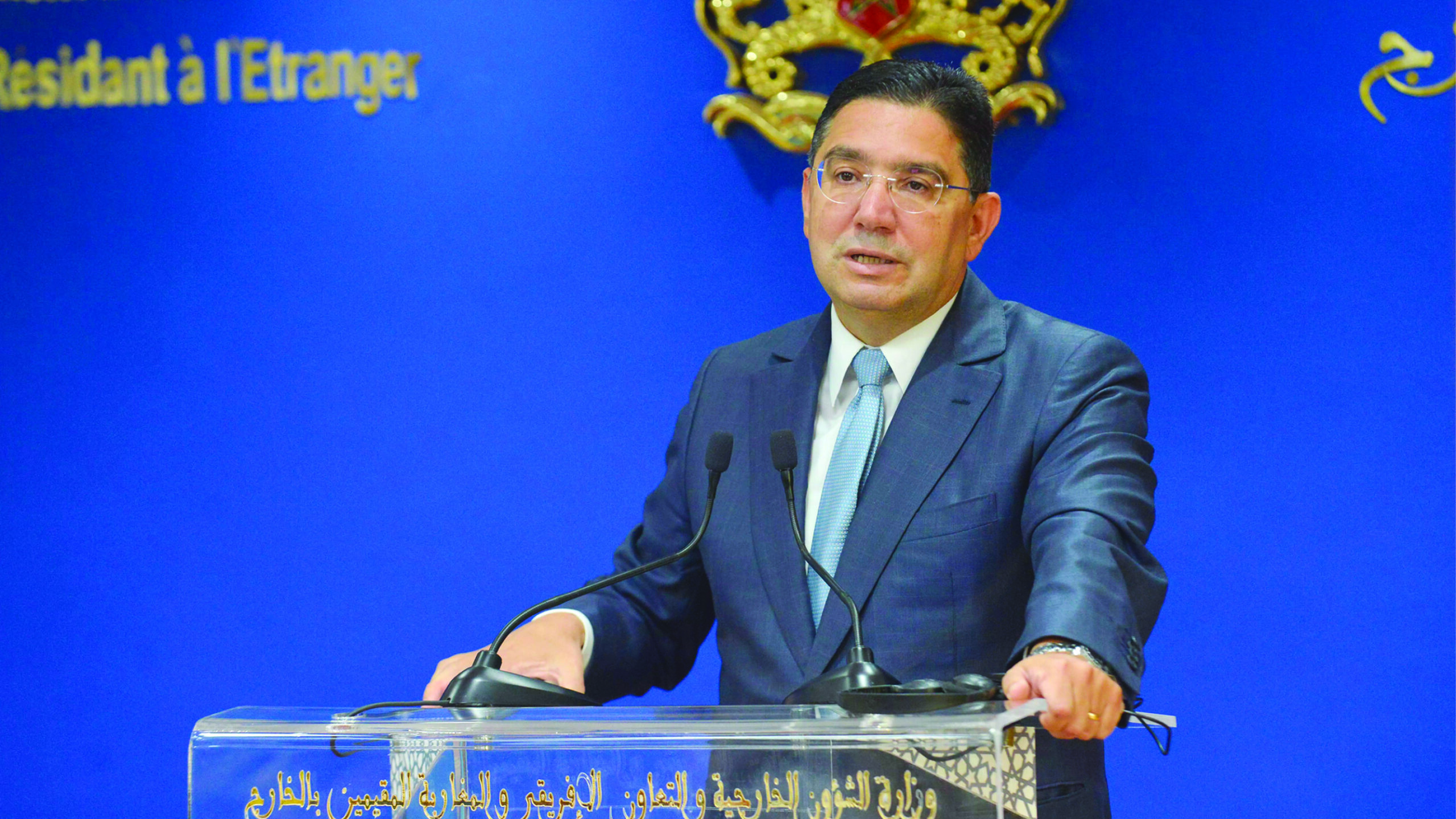
In the same vein, the Ministry of Foreign Affairs, African Cooperation and Moroccans Living Abroad stated that “Morocco condemns in the strongest terms the despicable Iranian missile attack that violated the integrity and security of the brotherly Arab states,” namely Saudi Arabia, the United Arab Emirates, Bahrain, Qatar, Kuwait, and Jordan.
Beyond the clear and firm position of Moroccan diplomacy, the escalation of tensions in the Middle East in recent days represents a threat to the global economy. This situation of uncertainty, against a backdrop of intense armed conflict, could ultimately affect Morocco’s economy, a country that is a net importer of energy.
The multiple consequences of a prolonged conflict
The ongoing regional flare-up has already compromised maritime transport through the Strait of Hormuz, through which no less than 20% of global oil consumption passes.
This harmful situation has caused the price of Brent crude (the international oil benchmark) to surge beyond 80 dollars (at the time of writing this article), with the threshold of 85 dollars approaching. It must be acknowledged that this outlook contrasts sharply with the beginning of 2026, a period during which the price of a barrel of crude oil stood at around 61 dollars.
Clearly, a prolonged paralysis of the Strait of Hormuz, a crucial artery for global energy transport, could push Brent prices toward 100 dollars.
Such an increase would undoubtedly have a strong impact on the Kingdom’s energy bill and its trade balance. It should be recalled that 2025 was nevertheless marked by a decline in the energy bill (-5.5%), to 107.5 billion dirhams. This downward trend resulted from a contraction in diesel and fuel supplies by 9.7%, driven by a 14.5% drop in prices, despite the increase in imported quantities.
Regarding the trade balance, Morocco’s deficit had already widened to around 353.15 billion dirhams, an increase of 15.8% compared with 2024. Obviously, a sustained upward trajectory in Brent prices during 2026 would increase pressure on the country’s trade balance, which has been structurally in deficit for several years.
Still in terms of macroeconomic risks, a prolonged surge in oil prices, due to the ongoing tensions in the Middle East, could push the state to activate cushioning mechanisms in order to support household purchasing power and the competitiveness of Moroccan companies.
Moreover, Nadia Fettah, Minister of Economy and Finance, recently indicated that the government is ready to face the impacts induced by the conflict on the national economy.
In any case, public support measures will not be without consequences for public finances, which the government has cleaned up over the past few years. As evidence, the Kingdom’s budget deficit was reduced to 3.5% of GDP in 2025 (compared with 4% of GDP in 2024).
Beware of the inflationary spiral!
Another macroeconomic consequence that cannot be ruled out if the rise in Brent prices persists significantly in 2026 is the abrupt break in the disinflationary trend that characterized prices in Morocco during the past year, with an average annual inflation rate of below 1% (0.8%).
At this stage, it is worth recalling that in 2022 Morocco recorded an average annual inflation rate of 6.6%, the highest in the country’s economic history since 1991. This was due to the increase in food and fuel prices following Russia’s invasion of Ukraine.
In short, the year 2022 confirms the strong inflationary tendency of petroleum products for both the Moroccan and global economies. It also marks a period during which central banks froze their monetary easing cycles, resulting, among other things, in less favorable credit access conditions (higher interest rates, banks’ reluctance, etc.).
Overall, for a country like Morocco, a global economy shaped by oil prices above 100 dollars per barrel generates a set of factors that are unfavorable to economic growth. Moreover, the Casablanca Stock Exchange has already felt the effects of the conflict currently shaking the Middle East (a 10% drop in two sessions).
It should be recalled that several listed companies are highly dependent on energy inputs. Therefore, a sharp increase in the prices of energy products and maritime freight could have a mechanically negative impact on the margins of these listed companies.
It is clear that a prolonged conflict in the Middle East carries risks for the national economy, which until now—thanks to the positive outlook for the agricultural season (due to abundant rainfall)—has been on a particularly dynamic trajectory.
A potentially benefiting sector
The instability prevailing in the Arab countries targeted by Iran’s armed attacks is fundamentally harmful to the tourism activity of well-known destinations in the Gulf.
The regional flare-up could durably dampen the enthusiasm of Western tourists for major destinations such as Qatar and Dubai, which recorded 19.5 million international visitors in 2025. This could benefit countries on the northern shore (Spain, Portugal, Greece) and the southern shore of the Mediterranean, including Morocco, which enjoys internationally recognized stability.
Indeed, the Kingdom continues to break records in terms of tourism attractiveness (the leading destination in Africa ahead of Egypt, with nearly 20 million tourists in 2025).