Kingdom
Expo: Unveiling the Secrets of the St. Laurent
Yves Saint Laurent: Before dressing the street and the runways, he learned to dress the stage. In Marrakech, the museum dedicated to the designer sheds its usual focus on fashion to explore his foundational and spectacular work for the theater, ballet, and the music hall.

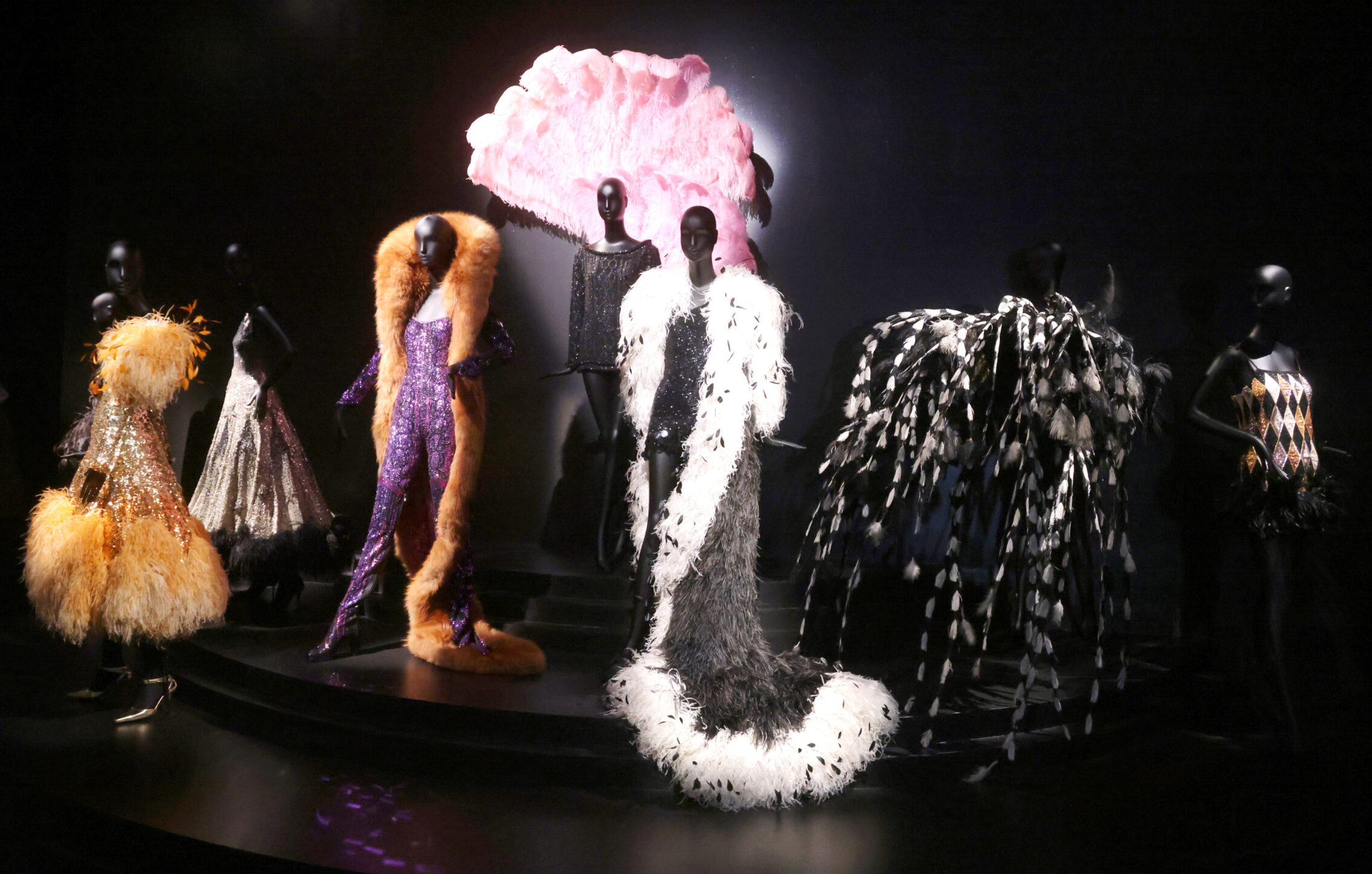
At the Yves Saint Laurent Museum in Marrakesh, this is not about adding another layer of celebration to an already well-established myth. With ‘Yves Saint Laurent on Stage’, on view until January 5, 2027, the museum is making a more subtle yet far more fruitful shift: removing the couturier from the showcase of fashion and re-placing him within the theatrical space—where clothing ceases to be an end in itself and becomes a tool. This curatorial gesture, both rare and quietly political, challenges the long-held perception of Saint Laurent’s work through the sole prism of high fashion, thereby reclaiming the essential part of his work: a constant dialogue with the performing arts.
This choice, embraced by the museum, marks a clear break from previous exhibitions. As its director, Alexis Sornin, points out, this is the first time since the museum’s opening in 2017 that an exhibition is not directly about fashion or ready-to-wear. Instead, it examines Yves Saint Laurent’s working relationships with theatre, ballet, and music-hall. This change in focus allows for the discovery of a less familiar Yves Saint Laurent, perhaps less spectacular but far more revealing: the artist who understood from the start that a costume is not about embellishing the stage, but about making it possible.
The exhibition opens logically with the designer’s youth in Oran. In 1950, a thirteen-year-old Yves Mathieu-Saint-Laurent attends a performance of Molière’s ‘L’École des Femmes’ (The School for Wives) directed by Louis Jouvet with sets and costumes by Christian Bérard. This moment, often recounted but rarely given such physical presence, is presented as a true turning point. It was a foundational, profoundly emotional aesthetic shock for Saint Laurent, a mystical encounter with a stage capable of transforming reality and opening a space for escape and wonder.
This fascination took shape during his adolescence in the models of his “Illustre Théâtre”: miniature sets, cut-out figures dressed in makeshift fabrics, and staged domestic performances. Far from a simple child’s game, these experiments reveal a precocious grasp of perspective, movement, and the psychological role of costume. Drawing was already central, with precise lines and meticulously detailed garments, sometimes highlighted with silver powder. For Saint Laurent, even then, costume was inseparable from the body that wore it and the stage that gave it context.
The exhibition traces this intimate chronology, showing how the future designer learned to distinguish between two crafts. For the stage, Saint Laurent had to forget immediate allure. The costume is not there to flatter but to build a character, support a movement, and serve a voice. This rigour, this refusal of chance, is perhaps why he was able to create some of the most daring costumes for theatre, ballet, and music hall of his time, all without falling into gratuitous decoration.
As the exhibition progresses, the stage becomes a life-sized laboratory. From the first collaboration with Roland Petit for ‘Cyrano de Bergerac’ (1959) to productions at the Paris Opera and the work of Jean-Louis Barrault or Marguerite Dumas, Yves Saint Laurent imposed a unique vision for stage costume. He sought movement over line, freedom over form, and psychological truth over elegance. Major pieces, on loan from the Fondation Pierre Bergé – Yves Saint Laurent and other major institutions, make this constant demand tangible.
This constant dialogue with the performing arts sheds new light on his entire body of work. The exhibition reveals how the creations for the stage, in turn, nourished his fashion collections. The influence of Léon Bakst, a tutelary figure of the Ballets Russes, can be traced through both ballet costumes and emblematic runway shows, including the famous 1976 ‘Ballets Russes’ collection. The boundary between stage and city blurs: fashion becomes a portable theatre, and the theatre becomes an inexhaustible source of formal renewal.
This reading, however, would not have its full impact without the important curatorial work of Jasmine Eusebi and Stephan Janson. The exhibition design, avoiding a static presentation, creates a fluid dialogue between drawings, fabrics, photographs, videos and archives. The scenography itself, conceived as a theatrical set, uses light, volume and spatial flow to give the objects a narrative depth, reminding us that theatre, like an exhibition, is conceived in three dimensions.
‘Yves Saint Laurent on Stage’ reveals the portrait of a creator more complex—and more fragile—than the frozen icon of fashion. We understand better how this discreet man could dress figures as diverse as Arletty, Edwige Feuillère, Maria Callas, Zizi Jeanmaire, Sylvie Vartan, or Johnny Hallyday: he understood intimately the vertigo of the stage, its artifice and its necessities. Far from reducing Saint Laurent to his genius as a couturier, the exhibition restores him in his creative humanity: an artist for whom costume was always a dramatic act, even before being an object of desire.