Powers
CDT: The early signs of a wind of modernization are taking shape
Since December 14, the Democratic Confederation of Labour, one of the country’s three leading trade union forces, has had a new leadership team. Largely rejuvenated. A renewal that marks a new trajectory within a trade union landscape undergoing change.

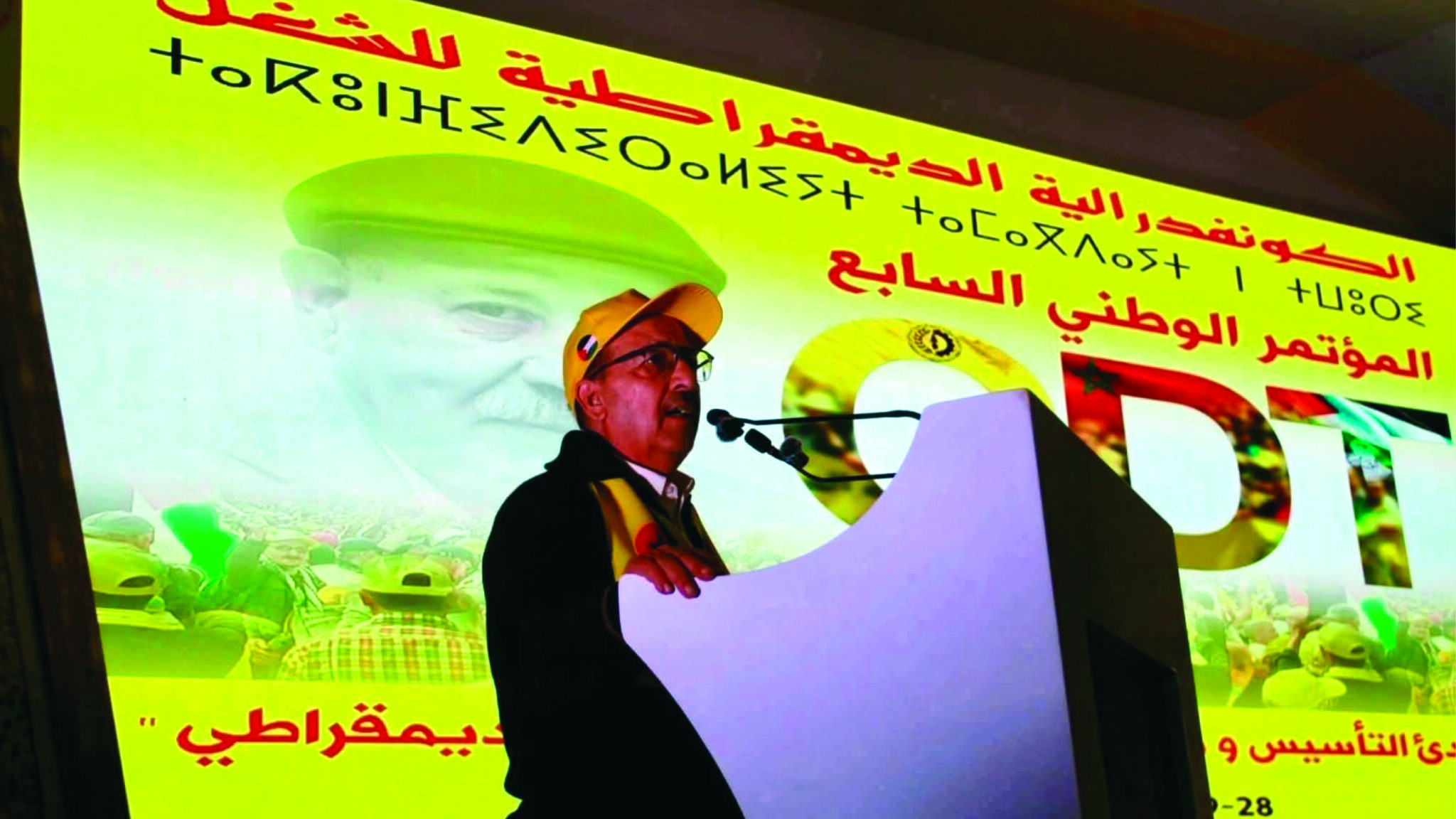
The observation is self-evident: the Democratic Confederation of Labour (CDT), the country’s second-largest trade union force after the UMT, had been showing the face of an “aging” trade union center, particularly at the level of its governing bodies. From the top of the pyramid down to its decision-making organ.
Since its creation in 1978, the center has reportedly known only two secretaries-general. Namely Noubir Amaoui, who remained at the helm until 2018, before handing over the baton to Abdelkader Zaër.
Two former leaders, stemming from a certain era, who were surrounded by sectoral officials walking in their shadow with “reflexes” that sanctified the “zaïm”. The latter has just handed over the reins to his former deputy, Khalid Alami Houir, who was elected following the CDT’s 7th national congress.
And it goes without saying that Khalid Alami Houir finds himself facing “a reality that calls for renewal capable of injecting a new organizational dynamic” into the heart of the CDT. All the more so as he has set himself the goal of “consolidating the positioning of the center on the Moroccan trade union chessboard”.
With another no less important objective, which consists of ensuring that it can be in tune with the transformations taking place in the Moroccan social and societal field. However, such momentum could not have the desired effects without rejuvenation at the level of the trade union center’s decision-making apparatus. This, moreover, observers believe, is what emerges from the composition of the executive bureau.
Indeed, the governing body, unlike its predecessors, has seen the arrival of several new profiles, at a time when former figures, who used to make the weather, have been “sidelined”.
Concretely, barely a third of the outgoing bureau has been renewed. And among the two-thirds who are “leaving,” there are indeed heavyweights who had ruled for years as “sectoral officials”. What is more, they were known for their “maximalist positions” on many issues.
Co-construction under way…
It follows that the renewal thus enacted marks, according to observers, a new inflection that is taking shape in the narrative of a union that blew out its 47th candle last November.
Moreover, when one takes into account the developments shaping the general environment in which the trade union center operates, it goes without saying that the arrival of new young profiles is a necessity to accompany the ongoing transformation.
A context marked in particular by the new legal arsenal governing recourse to work stoppages, with the promulgation of the organic law relating to the exercise of the right to strike. What is more, it opens the way to new forms of demands expression.
Knowing that systematic tug-of-war tactics can no longer remain the norm, tools are changing in line with fluctuations in the general environment of trade union practice. Times are changing, and so are modes of activism.
All the more so since, in light of developments, negotiations are increasingly taking on the appearance of a field where it is more and more a matter of coming forward with solution proposals, instead of remaining hostage to a confrontational approach, where the famous phrase “all or nothing” is brandished.
Indeed, already, co-construction with the various social partners is becoming an unavoidable reference point. Even an imperative to seek and find answers to the expectations of those whom any trade union center is supposed to defend, an analyst tells us.
Because, ultimately, trade union action is now conjugated in the time of tangible results that have an impact. And this, “in a certain form of productive pragmatism,” adds our analyst.
Proof lies in the results obtained—since the Akhannouch government took office—from the various rounds of social dialogue. Indeed, within the framework of implementing the outcomes of this social dialogue, numerous achievements have been recorded.
With immediate effects that employees and civil servants have seen on their pay slips and, consequently, in their daily lives and purchasing power. The climate of trust thus established can only be strengthened. And it will continue to strengthen.
Moreover, in recent years, one has noted the multiplication of collective agreement signings in several companies. This contributes, as will be understood, to strengthening social peace within the Moroccan productive fabric.
Better still, and beyond monetary aspects, thanks to the convergence of the wills of the social partners, it has been possible, after several decades of waiting and tug-of-war and after long discussions and negotiations, to establish a climate of trust between the social partners. This stems from the virtues of consultation.
Other files are in the pipeline, including that of pension system reform. Here again, discussions are in full swing among the social partners. In this context, the technical commission in charge of the file is multiplying meetings.
And each of the parties involved is working to contribute its stone to the building under construction in order to emerge from a tunnel that was thought interminable. This is to say that we are faced with a new state of mind capable of reassuring operators, and even constituting a lever to strengthen investment attractiveness.
Rearview mirror…
Since its founding in 1978, the Center, which was considered the trade union arm of the Socialist Union of Popular Forces until the party of the rose’s 6th national congress, has reportedly known, to date, only three secretaries-general.
At the very beginning, and until 2018, there was first Noubir Amaoui who, due to health problems, handed over the baton in November of that same year to his longtime companion, Abdelkader Zaër. And it is now his former deputy, Khalid Alami Houir, who is at the helm.
This former secretary-general of the National Union of Phosphate Workers, who joined the CDT in the early 1990s, arrives with a new state of mind in a trade union environment undergoing change.