Business
Morocco Plugs Into its Sovereignty
Between strategic infrastructure, strengthened cyber protection, and a push into artificial intelligence, the Kingdom is asserting its trajectory at Gitex Africa Morocco 2026 in a global reshaping where data becomes power, networks become territories, and innovation serves as a lever of influence.

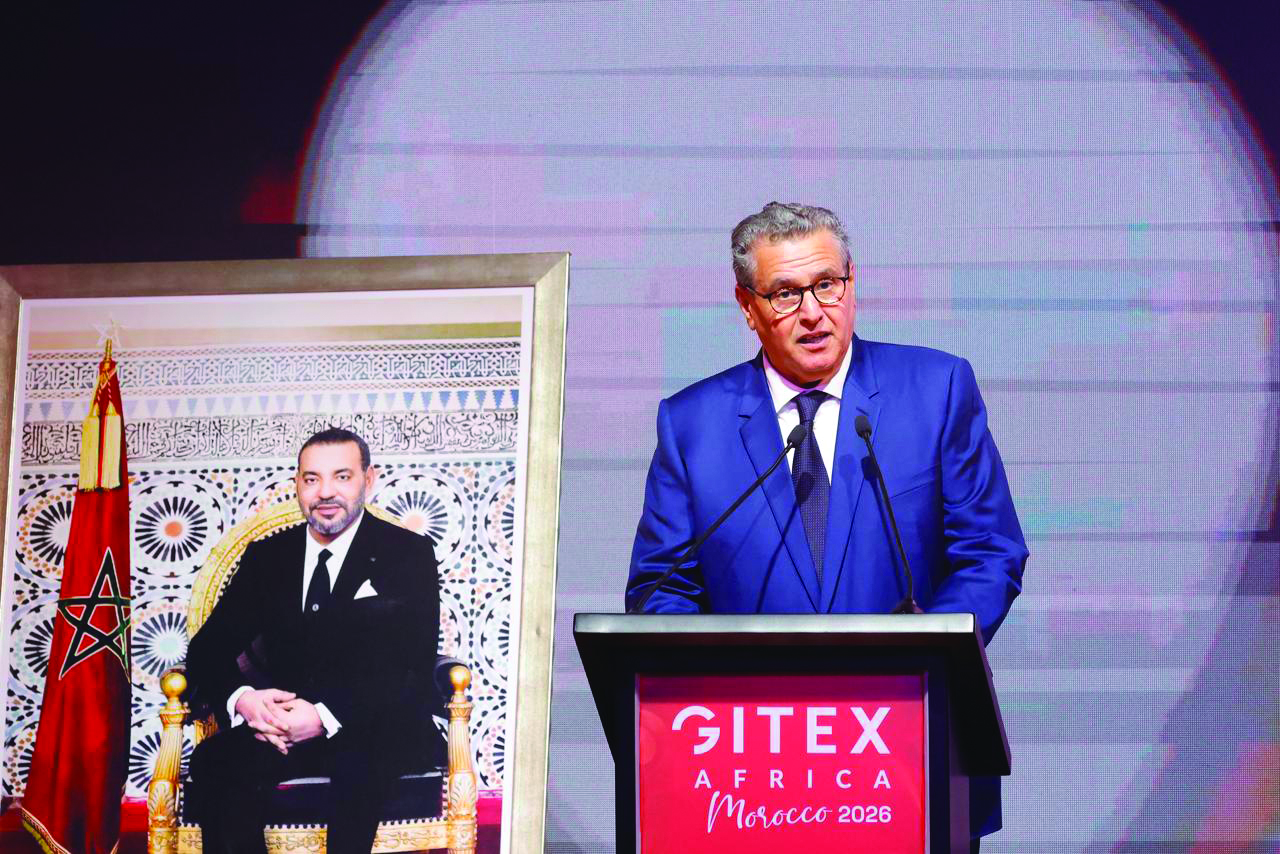
Under the white tents of Gitex Africa Morocco 2026—which, seen from above, almost resemble the layout of a network map—50,000 participants, 1,450 exhibitors, and 130 countries are no longer talking about technological catch-up, but about power. Asserted sovereignty. Data, infrastructure, and artificial intelligence elevated to strategic levers in a global reshaping where those who control AI and data flows no longer merely follow—they set the pace.
Aziz Akhannouch sets the tone from the outset. The Head of Government does not deliver a technical speech; he lays out a trajectory. He recalls that in 2021, for the first time, a ministerial department entirely dedicated to digital affairs was created—a clear political signal. Behind this choice lies a deliberate scaling-up. “Between 2021 and 2024, the investment budget for this sector rose from 11 million dirhams (MDH) to more than 1.7 billion dirhams (MMDH). This embodies the qualitative shift the government is seeking.”
The line is clear: structure, accelerate, industrialize. In September 2024, the Kingdom launched “Morocco Digital 2030,” with a simple idea that the Head of Government repeats almost as a principle: “Digitalization only makes sense if it improves the daily lives of Moroccans and strengthens the competitiveness of our economy.”
Behind this statement lies a mechanism: a digital state serving citizens, and a digital economy designed as a lever for value creation. The figures follow.
148,500 jobs in offshoring and digital exports by the end of 2024, more than 26 billion dirhams in exports, with a stated target of 270,000 jobs and nearly 40 billion dirhams by 2030.
But the core of the speech lies elsewhere, in an assertion that goes beyond indicators: “Morocco has chosen (…) a strategic approach based on mastering the artificial intelligence revolution rather than submitting to it, guided by the principle of technological sovereignty and non-dependence.”
Sovereignty here takes the form of infrastructure: 5G, with a target of covering 45% of the population by the end of 2026 and 85% by 2030; fiber optics, currently being generalized, with more than 1.4 million subscriptions expected; a program targeting 1,800 additional rural municipalities; and above all, Morocco’s entry into the cloud arena, with the establishment of a research and development center in Casablanca that has already generated more than 700 jobs.
Sovereign ambition
Before investors, the message becomes almost incantatory: Morocco is ready. Ready through its institutional stability, its skills, and its infrastructure. And when he broadens the scope, Akhannouch places the event within a wider political dimension: “Gitex Africa was born from an essential idea: to give Africa a platform to speak for itself.” In that sentence, everything is said.
For her part, Amal El Fallah Seghrouchni, Minister Delegate for Digital Transition and Administrative Reform, pushes the logic further. Where Akhannouch structures, she conceptualizes. Where he speaks of trajectory, she speaks of a model.
She outlines a new model of sovereignty based on digital governance strengthened by artificial intelligence, and above all a singular ambition: that of a technological power built not on domination, but on the ability to unite, connect, and enable flows.
She draws an almost doctrinal line: “Morocco’s technological bet is to demonstrate that it is possible to build technological power (…) through its capacity to bring people together and to place innovation at the service of development and the common good.”
She then anchors this vision in concrete terms: Dakhla. “The Kingdom is committed to a sovereign infrastructure (…) with the construction of Igoudar, the largest data center in Africa.”
The project matches the ambition: 500 megawatts by 2030; infrastructure entirely powered by renewable energy and cooled by Atlantic water; a “data embassy” on the edge of the Sahel, conceived as a sovereign digital territory. Behind the image lies a strategy: to produce, store, and process data on the continent, and no longer see it flow elsewhere.
The minister also emphasizes the ethical dimension: responsible artificial intelligence, respectful of ethics and based on algorithmic transparency, serving development, improving public services, and modernizing the economy.
Strategic shift
Faced with this rise in power, Europe is not standing still.
France’s Minister for Artificial Intelligence and Digital Affairs, Anne Le Hénanff, acknowledges a strategic convergence. She highlights the need to reduce dependencies in critical sectors such as cloud computing, cybersecurity, and artificial intelligence, while advocating for ethical, human-centered technology.
On the African side, the tone shifts—more direct, more blunt. Mark-Alexandre Doumba, Gabon’s Minister of Digital Economy, brings the debate back to a reality often overlooked in technological discourse: “Access to sufficient and competitively priced energy is the most critical component for developing a true AI economy.” Without energy, no digital sovereignty. Without kilowatts, no algorithms.
In the aisles of the exhibition, this tension is palpable—between promise and constraint, between ambition and material reality.
Morocco is advancing on multiple fronts simultaneously: startup financing, with up to 2.5 billion dirhams mobilized; training, with the number of digital graduates rising from 11,000 to 22,000; ecosystem acceleration, with a stated goal of fostering 3,000 startups and training 100,000 talents per year. Everything is aligning.
Amid the controlled euphoria of announcements and projections, a question emerges without ever fully imposing itself: Morocco is entering an arena where infrastructure defines power, and where ambition only matters if it translates into industrial capacity. It remains to embody this over time.
In Marrakech, at the start of April, the answer is not spoken—it is beginning to take shape. Morocco is moving forward. Fast. Strong. And with a clear idea: no longer depend—and finally, to count.