Kingdom
Apprenticeship Training: The Private Sector Commits
The Minister of Economic Inclusion, Small Business, Employment and Skills, Younes Sekkouri, presented this Friday at the CGEM in Casablanca the main axes of the program “Tadaroj,” encouraging companies to set up apprenticeship training centers aimed at thousands of unqualified young people.

Training 100,000 trainees per year by 2030 in sectors with high employment potential such as crafts, agriculture, fishing, tourism, industry, and services is the objective assigned to the Ministry of Economic Inclusion, Small Business, Employment and Skills. Hence the signing of program contracts with supervising ministries. But this challenge will be difficult to meet without private sector involvement.
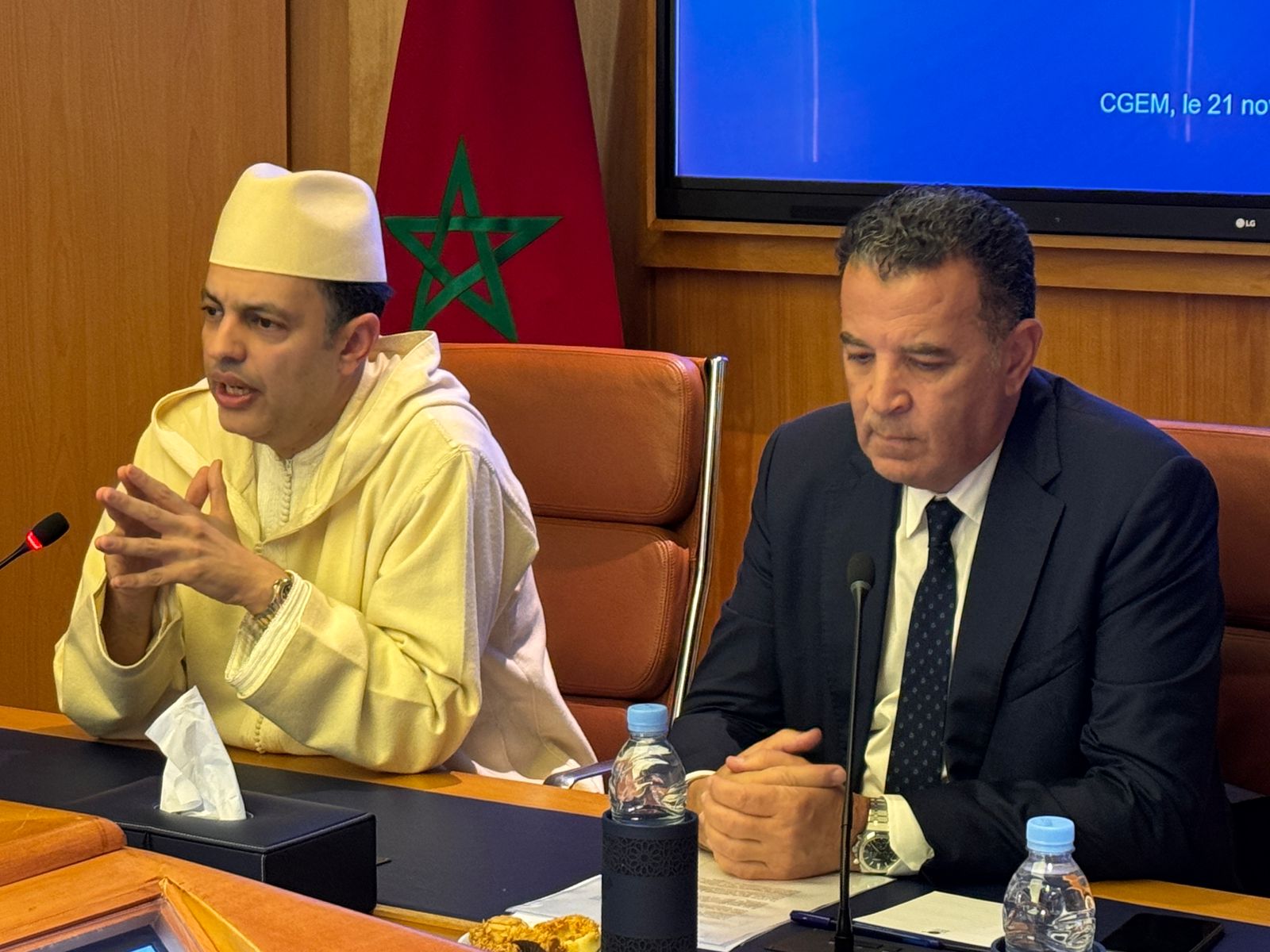
Younes Sekkouri understood this and multiplied initiatives in this direction. Most recently, he held a working meeting this Friday afternoon with several officials from the General Confederation of Moroccan Enterprises (CGEM), at the employers’ headquarters.
For almost two hours, he and his staff presented the main axes of the apprenticeship training program “Tadaroj”, launched last October 28, encouraging private companies to establish intra-company apprenticeship training centers (CFA-IE) to train thousands of unqualified young people.
According to Naima Sabri, head of the studies division at the Department of Vocational Training, more than 10,000 young people are currently being trained in 56 CFA-IE centers (out of 237 existing ones) for the period 2024-2027, mainly in trades related to the automotive industry, tourism, hospitality, textiles, crafts, and aeronautics.
This figure is indeed higher than the 8,400 apprentices in training between 2023 and 2024, but it remains insufficient according to her. The same observation was made by Chakib Alj, president of the CGEM.
Training skills in line with business needs
Through the future training centers, Sekkouri’s department aims to qualify young people and integrate them into the labor market, through a practical training model consisting of 80% of the total duration in companies or operations, and 20% in CFAs providing general and technological training.
“The objective is, on the one hand, to help companies gradually structure the recruitment of their employees and develop skills in line with their needs and, on the other hand, to promote the socio-professional integration of young people, but also the competitiveness of the company. A win-win system”, explained Naima Sabri, head of the studies division at the Department of Vocational Training.
To reassure her interlocutors further, she specified that the establishment of CFAs is governed by Law 12.00 regulating apprenticeship training, which authorizes public and private companies to have them within the framework of an agreement concluded with the administration responsible for vocational training.
Free and accredited training
To support the private sector and encourage youth participation, a subsidy of 5,000 dirhams per apprentice was set up, accompanied by a 20% increase in support for apprenticeship training centers.
Trainer allowances were also increased to 300 dirhams per trainee, to ensure quality training in a professional environment. The Ministry of Employment also assists in covering costs related to insurance, office supplies, as well as program management fees up to 25%.
Regarding the number of trainees to be trained, large companies can train up to 10 to 20% of their workforce, and very small enterprises may be limited to a maximum of two people per type of job, she specified. Federations can also create inter-company training centers dedicated to all their members.
“We came today to meet with the CGEM to involve it in the Tadaroj program, notably by encouraging its members to create apprenticeship training centers offering free and accredited training mainly intended for young people who did not continue their studies for various reasons”, declared Younes Sekkouri.
He added: “Each year, about 280,000 people leave school. A huge number that reminds us that the urgency is here and does not wait and that it is time to act”.
Integrating new trades
Chakib Alj, who welcomed the minister’s approach, indicated that apprenticeship and alternating training allow gradual integration of technical, practical, and behavioral skills that condition professional insertion. “Companies are fully aware of this and ready to play an increased role, but they need more support to become true training places”, he added.
However, for the head of employers, rebuilding the apprenticeship model must be based on several structural reforms: a unified legal framework, integration of new trades, and the expansion of apprenticeship to higher education.
Presidents of the various federations attending the meeting also praised this initiative and called on the ministry to increase the subsidy of 5,000 dirhams per apprentice and to define training objectives for each sector.
Sekkouri wishes to accelerate the pace. He invites the CGEM to send him, by December 15, the list of companies committing to create CFA-IE centers as well as their expectations in terms of support and assistance from his department. “I eagerly await your proposals and commit to processing them quickly with my collaborators so that apprenticeship training centers can be operational as soon as possible”, he concluded.