Kingdom
Akhannouch Government: When Politics Moves from Promises to Achievements
In just under five years, the government has shown that it can rise to challenges, whatever their nature. It is also capable of turning crises into opportunities. The proof lies in its track record.

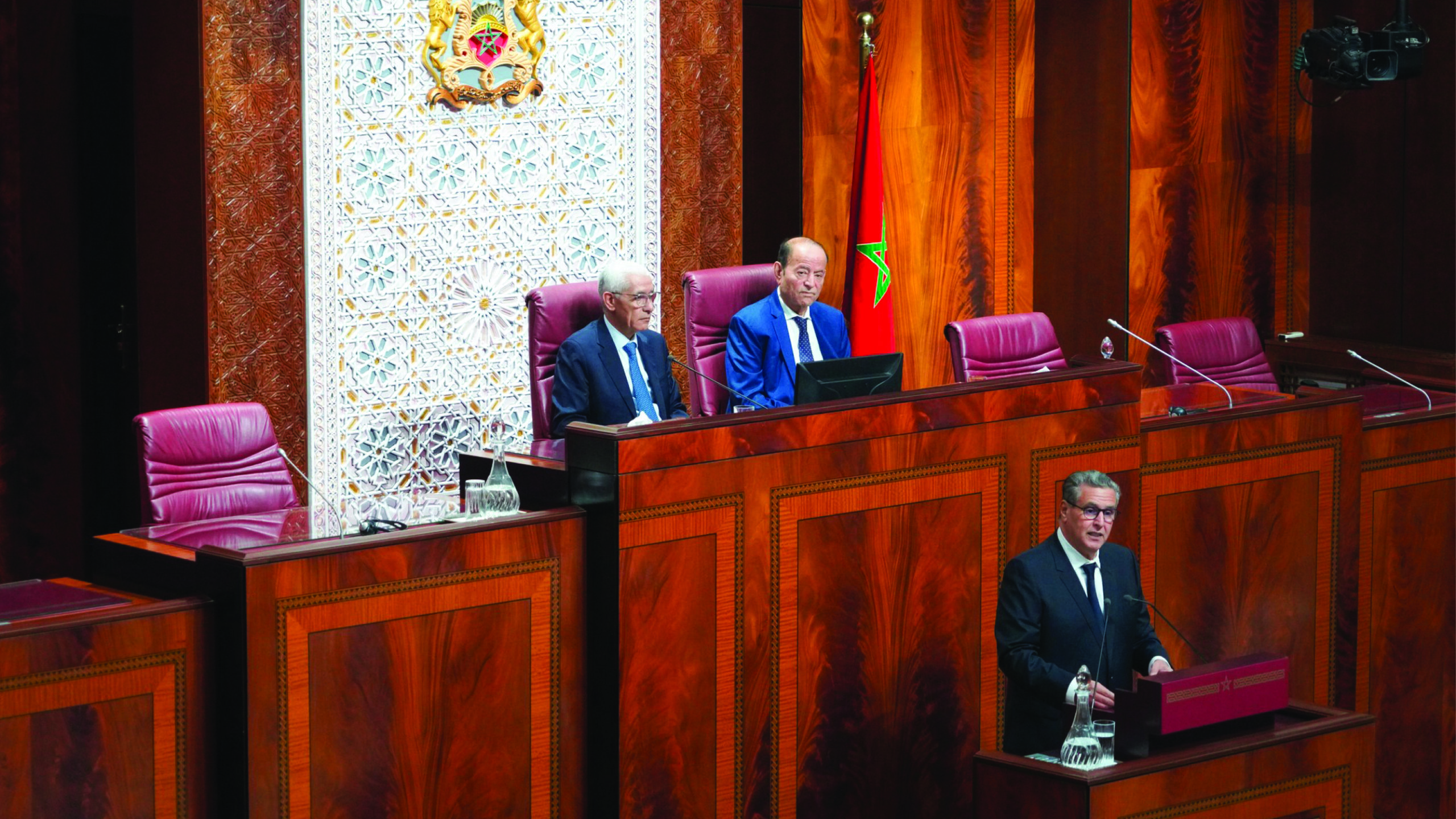
Aziz Akhannouch is pushing transparency and a sense of duty toward citizens to the fullest extent, while at the same time establishing what he calls a “constitutional custom.”
The head of government had already presented his mid-term review and is now repeating the exercise a few months before the end of his mandate. Article 101 of the Constitution does indeed provide for this exercise, but does not make it mandatory.
“This government team has made precision and clarity its mode of action, and efficiency and tangible impact its criteria for evaluation, since citizens do not measure intentions, but rather the results that affect their daily lives,” Akhannouch declared at the beginning of his lengthy speech (just over two hours) on Wednesday, April 15, before the two chambers of Parliament meeting jointly.
In doing so, by addressing elected officials—and through them, the citizens—the head of government also gives substance to a new democratic logic: the “legitimacy of achievements,” which reinforces and sustains over time that of the ballot box. “Democratic legitimacy is not acquired only on election day; it must be preserved every day through serious action and concrete results,” he stated.
And in terms of achievements and “concrete results,” the (almost) five years of the government’s term are far from lacking—quite the opposite. The most significant are those that citizens, or at least many of them, can quite literally feel: direct social assistance.
“The total amount of funds distributed to beneficiaries of aid reached, by the end of January 2026, approximately 52 billion dirhams, including 33 billion dirhams dedicated to child protection assistance and 19 billion dirhams in flat-rate aid,” the head of government said.
He added: “This assistance concerns, for example, 5.5 million children and more than 396,000 widows, including 308,000 without children,” not to mention more than one million beneficiaries over the age of 60.
In its program, the government had promised, it should be recalled, to create one million jobs. Nearly five years later—despite successive years of drought that have decimated rural employment—the government reports the creation of 850,000 net jobs between 2021 and 2025, an average of 170,000 jobs per year.
The target appears within reach, taking into account a promising agricultural season and a series of projects approved by the National Investment Commission.
In this regard, the head of government noted that “the National Investment Commission has approved 381 projects for a total amount of 581 billion dirhams, aimed at creating 245,000 direct and indirect jobs.”
Among these, he continued, “297 projects have been approved since the new Investment Charter came into force, for a total of 513 billion dirhams, expected to contribute to the creation of around 201,000 direct and indirect jobs.”
The new charter has not only attracted more investment, but also ensured its equitable distribution across regions.
With a view to strengthening territorial equity, the government has increased the share of local authorities in VAT from 30% to 32%, and raised annual transfers to the regions from 10 billion dirhams to 12 billion.
“A step that may seem technical, but which in practice translates into development projects, basic services, roads, and schools across Morocco’s regions,” Akhannouch emphasized, noting that “a region without financial resources remains a region with limited decision-making and action capacity.”
Another equally concrete example is the direct housing support program, which has enabled more than 96,000 families to access decent housing. This is “because housing is not a luxury, but the foundation of social stability and a cornerstone of human dignity,” the head of government stated.
All indicators are positive
Examples of tangible achievements experienced by citizens could be multiplied. The various rounds of social dialogue, now institutionalized, have resulted in a clear improvement in purchasing power and living standards for different social groups.
Reforms in health and education are progressing rapidly. “There should be no difference in access to care between a citizen living in an urban center and another in a remote region.
This is a clear commitment we make to citizens with full responsibility,” Akhannouch stressed while discussing progress in healthcare reform. At the same time, he affirmed that education and training have been made a fundamental pillar for building the country’s future.
“A state that fails in educating its children reduces its ability to face future challenges,” he said.
It is also hard to overlook achievements on the economic front, particularly regarding the health of public finances, the maintenance of budgetary balances, the surge in public investment, and, more broadly, the economy’s resilience to external shocks.
Likewise, certain sectors have flourished over the past five years, with tourism and industry standing out most prominently.
A key indicator: industrial exports reached 408 billion dirhams in 2025, an overall increase of 44.5% compared to the beginning of the government’s term. This growth has been driven by the strong performance of Morocco’s global industries, led by the automotive and aeronautics sectors.
Similarly, Morocco welcomed approximately 19.8 million tourists, an increase of 53.5% compared to 2019.
Ultimately, as the head of government emphasized, today’s achievements are also the foundations of tomorrow’s prosperity. They have contributed to the country’s progress, which “has been able to redefine its position on the international economic stage to become an active player rather than merely a recipient of what happens in its environment.”
This governmental record, the head of the executive concluded, “has provided proof that it was not merely a temporary response to constraints and crises, but a phase that made it possible to establish structural foundations based on efficiency and performance, as well as a real test of the sincerity of belonging to this nation and of the depth of the sense of responsibility toward its future.”