Kingdom
Street lighting: Who lights up our cities?
Quiet but massive, the modernization of public lighting is gaining momentum in Morocco. Between 2023 and 2026, contracts worth over one billion dirhams have been awarded. In the shadow of the streetlights, an industrial battle—as discreet as it is strategic—is being waged to illuminate the Kingdom’s cities. Spotlight on the companies shaping the urban night.

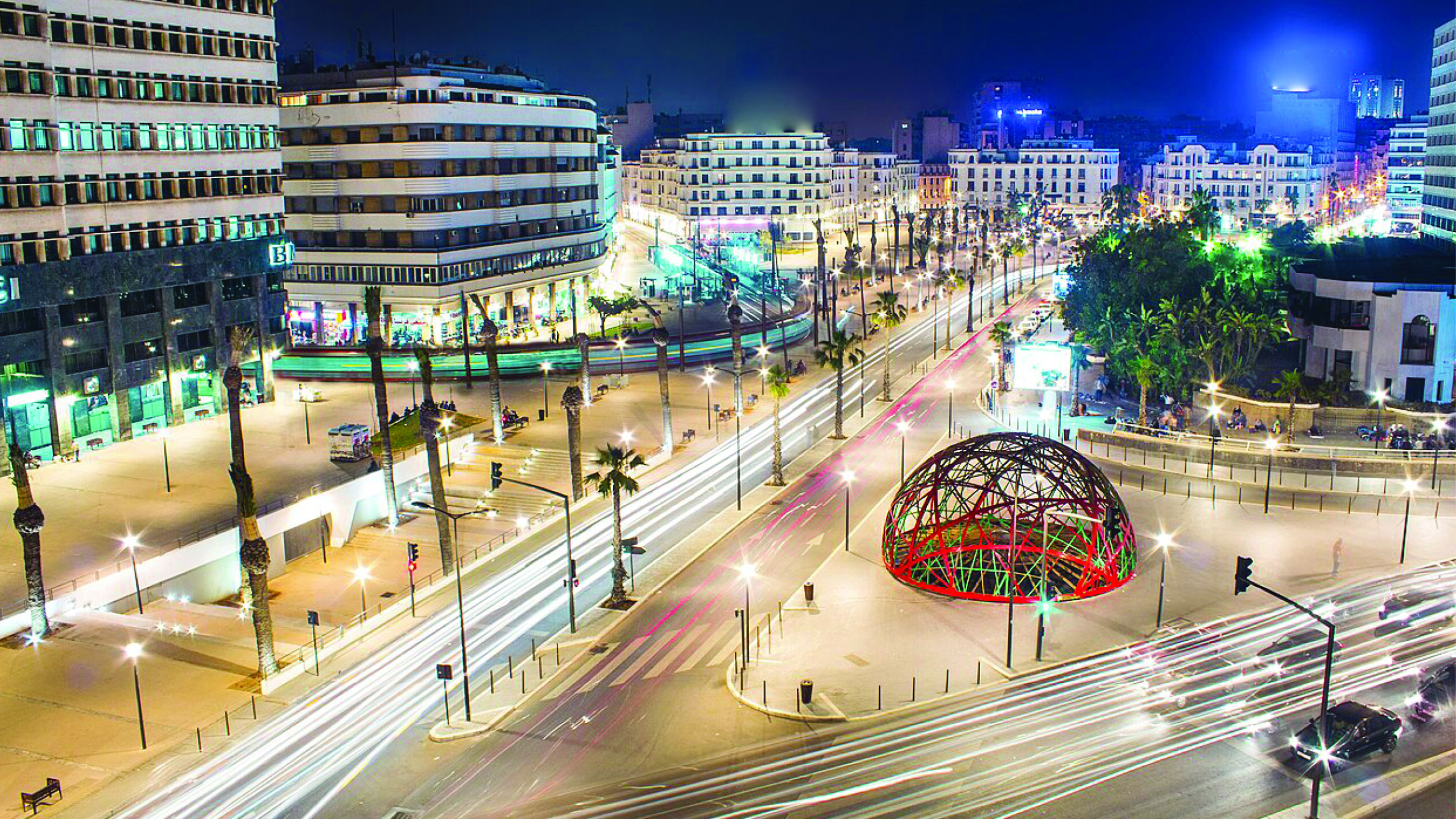
They switch on every evening without making a sound. At first glance, nothing seems to change. Yet the light is whiter, more uniform, more stable.
Behind this silent transformation, a vast project is underway: the modernization of public lighting.
Driven by the demands of the energy transition and increasing pressure on local finances, the sector is experiencing clear acceleration. Between 2023 and 2026, dozens of contracts have been awarded across the Kingdom, confirming this shift in scale.
From a sample of forty-five projects we selected, representing a total budget of 1.2 billion dirhams (MAD 1.2 billion), more than ten companies share the market.
At stake: the deployment of more than 420,000 lighting points, with an average project cost of 28 million dirhams (MAD 28 million). Some contracts also include signage, street furniture, and maintenance, reflecting an increasingly integrated approach.
The Rabat–Skhirate corridor leading the way
Geographical analysis highlights a strong concentration of investment. The Rabat–Salé–Témara–Skhirate corridor clearly dominates, with sixteen contracts totaling nearly 462 million dirhams, or more than one-third of the amounts committed.
Behind this hub, several major cities are picking up speed. Agadir is investing in its key infrastructure, particularly around the Grand Stadium. Tangier is capitalizing on its economic dynamism. Marrakech is boosting its tourist appeal by illuminating its main urban thoroughfares.
Other cities, such as Dakhla, Oujda, Kenitra, Fez, and Tetouan, are also part of this momentum. In Casablanca, long lagging behind in this segment, projects are now emerging, particularly in Bouskoura and along the Tit Mellil–Médiouna corridor.
It should be noted that in the economic capital, public lighting had long been absorbed into broader urban development projects. Until 2024, contracts launched by the municipality remained fragmented and were rarely dedicated exclusively to this function.
The creation of the Casablanca–Settat Regional Multi-Service Company (SRM), operational since October 2024, replacing Lydec, marks a turning point. Projects are now structured, large-scale, and centralized—a model expected to expand to other major cities.
Lamalif, the rise of a national champion
The SRM now manages more than 160,000 lighting points and is directing its investments toward modernization, energy efficiency, and network maintenance. Among its recent operations is a 15 million dirham contract for the Corniche and Atlantic Ocean boulevards.
Another example is a 59 million dirham contract dedicated to maintaining the network across several districts and surrounding municipalities: Ain Chock–Hay Hassani, Casa Anfa–El Fida, Ain Sebaâ–Sidi Bernoussi, Mohammedia, Bouskoura, El Jadida, and Ben M’sik–Sidi Othmane.
Behind the scenes, competition is intense. But one player clearly stands out: Lamalif. With twenty-two contracts won for a total of 703 million dirhams, the company alone captures more than half of the analyzed investments.
The companies that have won the most contracts
Founded in 1998 in Marrakech by Moulay Lakbir Ismaili Alaoui, son of the late General Moulay Ahmed Ismaili Alaoui—who describes himself as “a great enthusiast of art, Moroccan craftsmanship, and the smart city”—the company, which specializes in public lighting and urban furniture, has established a particularly strong presence along the Rabat–Salé–Témara–Skhirate corridor, where it holds fifteen contracts with a total value of 443.5 million dirhams.
Also active in Marrakech, it secured a mega-contract worth 74 million dirhams in July 2023 for public lighting and illuminated signage in the “Red City.”
Lamalif has also made its mark in Tangier, notably through the lighting of the Grand Stadium, as well as the renovation of public lighting in the Ibn Battouta urban hub; in Tetouan, where its streetlights illuminate Avenue 9 Avril; and in Casablanca, where it won a contract with the municipality of Bouskoura in March. The company claims more than 85,000 lighting points across the Kingdom and a turnover of 454 million dirhams.
The large-scale transition to LED
Facing this heavyweight, two challengers are trying to carve out a place. Nabilum, based in Tamesna since 2006, has secured six contracts totaling nearly 169 million dirhams, including a 68 million dirham contract for the renewal of public lighting in Kenitra.
For its part, Cegelec, a subsidiary of the French group Vinci Energies, has three contracts to its name totaling 116.4 million dirhams, including the public lighting of Mohammed V Boulevard in Dakhla for around 75 million dirhams.
Behind this trio, other companies such as Akachelec, Electad, Equelec, and Electriklim are positioning themselves on smaller-scale contracts, in a sector that is still in the process of structuring.
Beyond industrial considerations, public lighting represents a major expense item for local authorities after salaries. It often accounts for between 40% and 50% of their electricity bill. For example, this cost already reached 150 million dirhams annually in Casablanca and 85 million dirhams in Rabat in 2019.
This bill has likely increased since then, driven by urbanization and major projects launched in both metropolitan areas.
An emerging industrial sector
To address this, municipalities are accelerating the transition to LED, enabling energy savings of up to 60%, as observed in the majority of the contracts analyzed.
More than just an urban service, public lighting is thus becoming a concrete lever for budget optimization, as well as a pillar of the local energy transition.
To capture this promising market, more and more Moroccan companies, such as Lux Lighting, are strengthening their capabilities in manufacturing luminaires and streetlight poles.
Morocco would also benefit from structuring a local industrial sector capable of supporting this momentum.
Because behind every light point lies a more energy-efficient, smarter city—and an entire value chain that can be illuminated.
LED imports: Morocco activates the anti-dumping lever
Heavily dependent on imports, particularly from China, the Moroccan LED lighting market is facing increasing competition.
To support local production, the Ministry of Industry and Trade has, since December 23, 2025, imposed a definitive anti-dumping duty of 27% on imports of LED luminaires originating from Beijing intended for public lighting.
This decision follows an investigation launched in September 2024 at the request of Lux Lighting, which represents 82% of national production.
The findings revealed an equivalent dumping margin, which had significantly weakened the local industry.