Influences
Health professions : A race against time to train the caregivers of tomorrow
Long hidden in the shadow of medical professions, paramedical jobs are today becoming a strategic lever to strengthen access to care, fill shortages on the ground, and support the transformation of the health system in Morocco.


Faced with a rapidly growing population and an expanding demand for care, the Kingdom has undertaken a colossal task: to triple its ratio of health professionals to reach a stated goal of 45 caregivers per 10,000 inhabitants by 2030.
A major challenge, as the country had only 17.4 per 10,000 in 2021. To achieve this, unprecedented means are mobilized and the entire health ecosystem is being rethought.
The diagnosis was clear: Morocco suffered from a chronic shortage of caregivers. In 2022, there were about 68,000 health professionals nationwide, according to some estimates. To hope to reach the goals set for 2030, this number will have to grow significantly.
However, a recent advance draws attention: in 2025, the number of practicing health professionals in Morocco rises to 94,299, including 77,086 in the public sector and 17,213 in the private sector.
The ratio thus reaches 2.05 professionals per 1,000 inhabitants, or approximately 20.5 per 10,000, compared to the critical thresholds recommended by the World Health Organization (WHO) of 2.5 per 1,000 inhabitants (i.e., 25 per 10,000).
This development shows that a real effort is underway, but the road remains long. To catch up, Morocco has committed to an ambitious strategy: doubling the number of graduates from faculties of medicine, pharmacy, and dentistry, and tripling that of higher paramedical training institutes by 2025.
In short, the goal is to train several thousand doctors each year, but also nurses, health technicians, and specialists.
The teaching capacities are following suit: training institutes should be able to accommodate up to 11,900 students by 2029, compared to 8,360 in 2024. Additionally, the creation of new faculties (notably in Errachidia, Béni Mellal, and Guelmim) has been announced.
Recent reports confirm: the number of places reserved for general practitioner training increased from 2,650 in 2019 to 6,414 in 2025. The number of places in nursing training centers reached 9,500 in 2024 compared to 2,735 in 2019.
And from a university perspective, new doctoral study centers in nursing and health techniques will be created starting the 2025-2026 academic year.
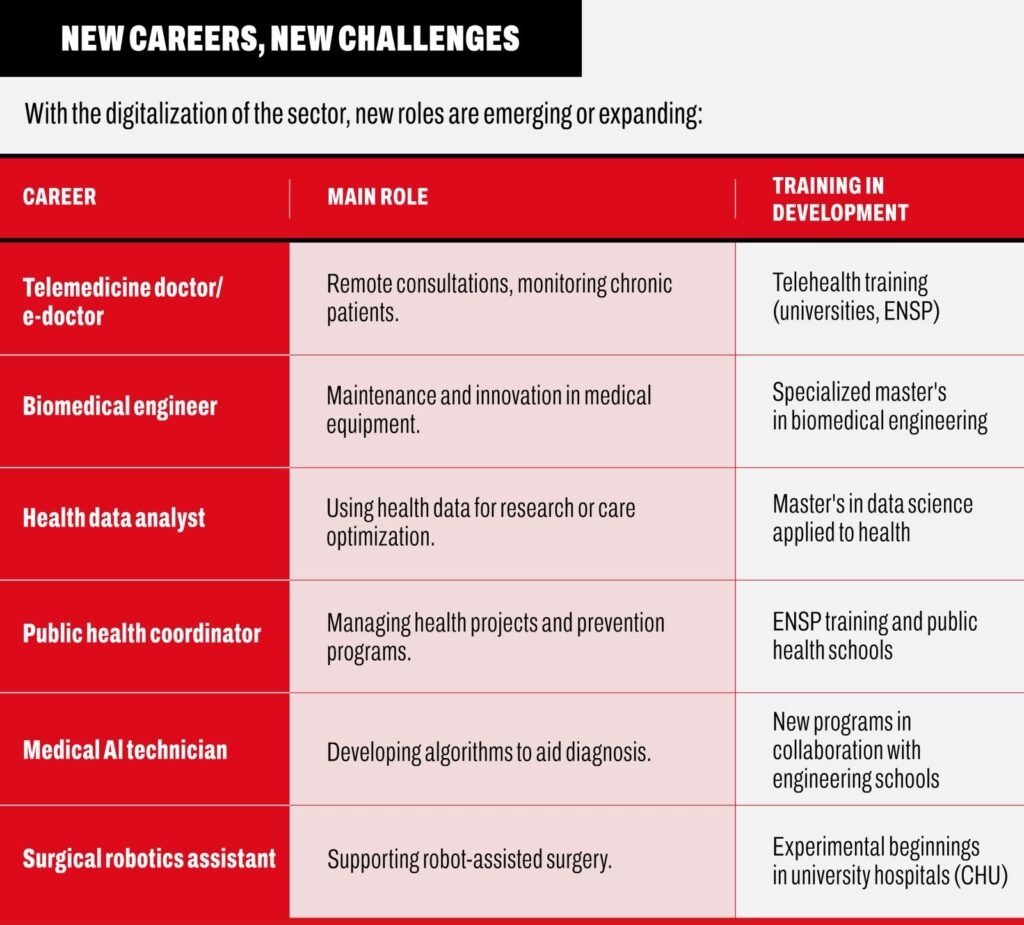
Massive training, diverse tracks
Beyond training, Morocco is implementing a true overhaul of the health system.
The objective is not limited to producing more graduates, but also to better distribute them across the territory, reducing inequalities in access between large cities and rural or mountainous areas.
Within this framework, the program plans to build or rehabilitate many hospitals and care centers in under-resourced regions. The 2025 health system reform also emphasizes universal access to care, the generalization of mandatory health insurance (AMO), and infrastructure modernization.
Enhancing health professions is another pillar of the reform. Behind the statistics, professionals are sometimes demotivated, facing difficult working conditions, low salaries, and a lack of career prospects.
Recognition of paramedical specializations, access to continuing education, and incentive measures are certainly on the table.
But another sign of progress appeared in September 2025. The Ministry of Health and Social Protection issued two circulars to restore order in hospitals: respect for schedules, discipline, professional environment safety, payment of allowances.
This shows that the reform concerns not only staffing but also management and work quality.
Retaining talent: The other battle
Morocco must also face another reality: brain drain. Every year, several hundred young doctors or caregivers choose to work abroad, attracted by better pay and more organized work environments. This hemorrhage weakens an already pressured system.
To reverse this trend, public authorities rely on an integrated approach: equipment modernization, digitization of care pathways focused on fine planning of human resource needs, and development of attractive professional paths.
The ministry’s continuing education plan, for example, fits into this logic of supporting skills and innovation. The 2020-2030 period thus promises to be a turning point for the Moroccan health system.
By training tens of thousands of additional caregivers, multiplying infrastructures, enhancing professions, and integrating technological innovations, the Kingdom is giving itself the means to meet its ambitions.
That said, recent figures show that ratios are still well below international standards, but the trajectory is now clear. The challenge remains major: to ensure that these caregivers are not only trained but also well distributed, well supported, and motivated to stay in the country.