Kingdom
Fight Against Corruption: Morocco Aligns With OECD Criteria
In a report published this Tuesday, the OECD notes, among other things, that Morocco meets 100% of the criteria related to the regulation of political financing and 100% in practice, whereas the Organization’s average is 76% and 58% respectively.

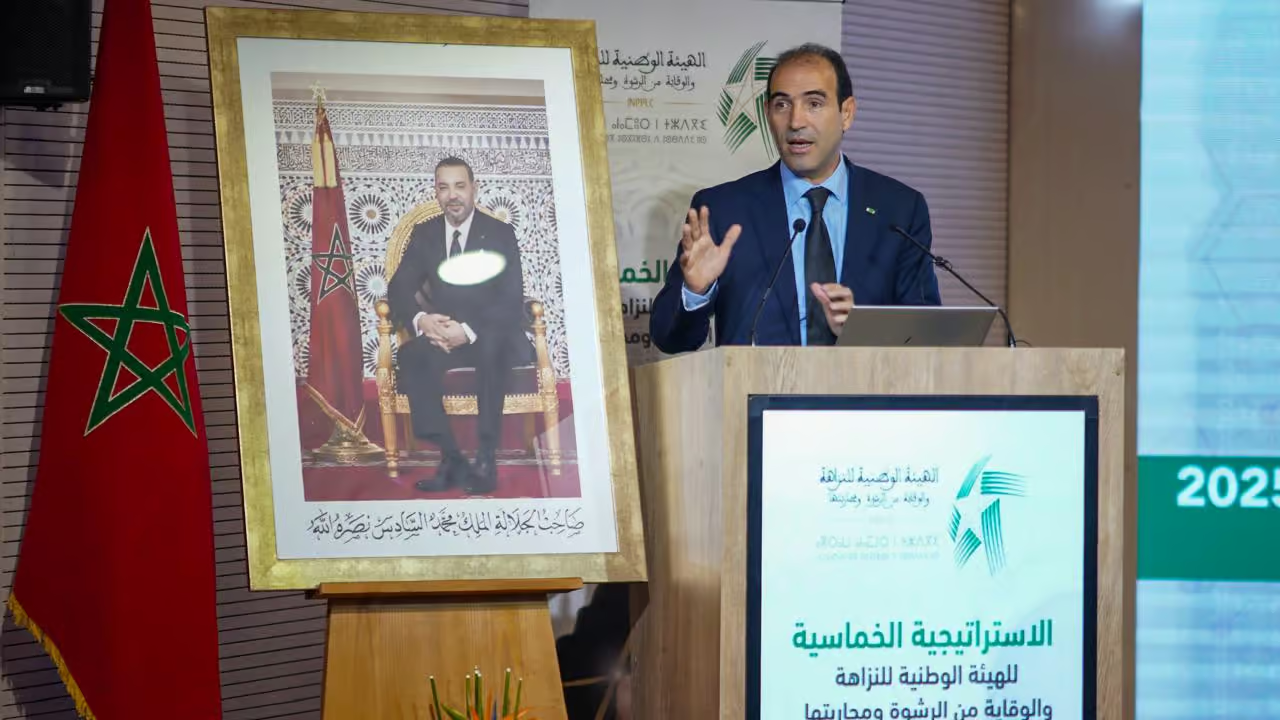
Morocco is aligning itself with the criteria of the Organisation for Economic Co-operation and Development (OECD) in the fight against corruption and in matters of public integrity, according to a report published Tuesday by the organization.
In this report entitled “OECD Perspectives on Integrity and Anti-Corruption 2026,” the Paris-based organization recalls the National Anti-Corruption Strategy (SNLCC) 2015–2025 adopted by Morocco, which reflects the Kingdom’s commitment to strengthening democracy through the principles of the rule of law, transparency, and accountability, while building a public integrity system capable of effectively preventing corruption.
The OECD also reviews the creation, in 2017, of the National Anti-Corruption Commission (CNAC), which serves as a steering body responsible for overseeing the overall implementation of the strategy, proposing measures to strengthen international cooperation in order to support national anti-corruption efforts, and approving annual evaluation reports.
The organization also emphasizes the role of the National Authority for Probity, Prevention and the Fight against Corruption (INPPLC), which coordinates and monitors anti-corruption policies and publishes analytical reports containing recommendations aimed at strengthening the integrity system.
The report notes in the same context that the Kingdom meets 73% of the criteria related to the robustness of the strategic framework and 53% in practice, whereas the OECD average is 38% and 32% respectively. Morocco, the same source adds, meets 100% of the criteria related to the regulation of political financing and 100% in practice, while the OECD average is 76% and 58% respectively.
The OECD recalls that the Moroccan regulatory framework governing the financing of political parties is established by several organic laws that prohibit anonymous donations, as well as contributions from foreign states, foreign companies, and public enterprises.
These texts also set caps on personal contributions to electoral campaigns and require political parties to submit annual and electoral financial reports, the report notes, adding that in practice, all Moroccan political parties have complied with these requirements by submitting reports within the legal deadlines.
It further adds that the Court of Auditors publishes these reports on a user-friendly platform and has the authority to impose sanctions on parties that fail to comply with the rules governing the financing of political life.
Moreover, the OECD notes that the Kingdom meets 78% of the criteria related to public information regulation and 54% in practice, compared to OECD averages of 72% and 62% respectively. In this regard, it recalls that Morocco enacted a Law on Access to Information governing the transparency of public information, noting that the Commission for the Right of Access to Information (CDAI) promotes transparency by regulating public access to information, issuing recommendations, and publishing annual implementation reports.
Furthermore, the report continues, the Digital Development Agency (ADD) plays a central role in advancing digital initiatives and open data. Morocco, the OECD adds, proactively publishes several key datasets related to integrity, including government session agendas, data on public tenders, and land registries.