Business
Artisanal crafts: Launch of the 3rd edition of the program “Treasures of Moroccan Traditional Arts”
Under the high patronage of His Majesty King Mohammed VI, the Secretariat of State responsible for Craftsmanship and the Social and Solidarity Economy, in partnership with the United Nations Educational, Scientific and Cultural Organization (UNESCO), organized, on Tuesday, November 11, 2025, in Rabat, the ceremony to launch the third edition of the “Treasures of Moroccan Traditional Arts” program.

Placed under the theme: “From the heritage of our ancestors to the creativity of descendants: youth as the torchbearers of Moroccan identity”, this new edition continues the efforts to preserve endangered craft industries, promote their knowledge, and enhance their value through the transmission of artisanal skills and knowledge to younger generations.
The program aims to train apprentices with master artisans who possess a living intangible cultural heritage, to foster values of excellence, creativity, and authentic Moroccan identity.
This edition follows the first two, held in 2023 and 2024, during which 17 master artisans and craftswomen were recognized and classified among the “treasures of Moroccan traditional arts.” They trained 157 young people over a 9-month practical learning period.
Expanding the circle of beneficiaries
For 2025, 15 new treasures of traditional arts have been designated, guiding 150 apprentices across various disciplines, bringing the total to 32 master artisans and 307 young people trained since the program’s inception.
“The program ‘Treasures of Moroccan Traditional Arts’ aims to open up to new partners and broaden the circle of beneficiaries to encompass all regions of the Kingdom, as well as different social categories, including detainees, within initiatives for reintegration and training of young people within penitentiary institutions”, declared Lahcen Es-Saâdi, Secretary of State for Craftsmanship and the Social and Solidarity Economy, in his opening speech.
He added: “A partnership agreement has been signed with UNESCO and the General Delegation for Prison Administration and Reintegration (DGAPR) to enable incarcerated artisans to share their know-how. Six experienced inmates have been selected to transfer skills to 90 young detainees in the fields of Tétouan zellige, embroidered saddlery, quilted leather poufs, southern basketry, and Salé embroidery”.
The Secretary of State also specified: “We have signed new partnership agreements to extend this program to southern provinces, particularly the regions of Guelmim-Oued Noun, Laâyoune-Sakia El Hamra, and Dakhla-Oued Eddahab. This approach illustrates the commitment of the Secretariat of State to strengthen social inclusion while ensuring intergenerational transmission of artisanal know-how, in service of local and regional development”.
Charif Ahmimed, Director of the UNESCO office for the Maghreb, stated that the UN organization “is proud to support, for many years, the Secretariat of State responsible for Craftsmanship and the Social and Solidarity Economy in safeguarding and promoting artisanal knowledge and skills threatened with disappearance in Morocco”.
15 new high-value patrimonial crafts
According to him, this partnership demonstrates the shared commitment of both parties to safeguarding intangible cultural heritage, true living memory of peoples.
“By recognizing 32 artisans holding ancestral knowledge and rare traditions, this program has paid tribute to their talent, creativity, and their essential role in transmitting centuries-old knowledge”, he insisted.
He also emphasized that this project exemplifies the strength of collaboration between national and international institutions “when they work hand in hand to preserve cultural diversity and promote sustainable economic development based on respect for peoples’ traditions and valorizations of human skills”.
This year, the program highlights 15 new crafts of high patrimonial value, threatened with disappearance, divided into the following domains:
Equestrian arts domain:
1. Saïd Thaljaoui – mokahla (traditional gun)
2. Omar Ennassiri – riding boots (tmak)
3. Hicham Essaïdi – stirrups
4. Lahcen El Hiri – bits
5. Yahya M’han – saddle structure (l’adam)
Leather domain:
6. Mahfouda Haïda – southern leather craft
Wood domain:
7. Abdellah El Moumni — thuya wood marquetry
Weaving and textile domain:
8. Fatima Slimani – Beni Ouarain carpets
9. Saïd El Hardak – Souiri haïk
10. Fatima Taghlaoui – Figuig bernous
11. Saleh Bigrnaf – taouka (tazarzit)
12. Abdelmajid Bballah – Hssira (traditional mats)
13. Zohour Idrissi – Rbati carpets
14. Hanan Ben Bellal – traditional zouaq
15. Mohamed Aït Ahmed – vegetal dyeing
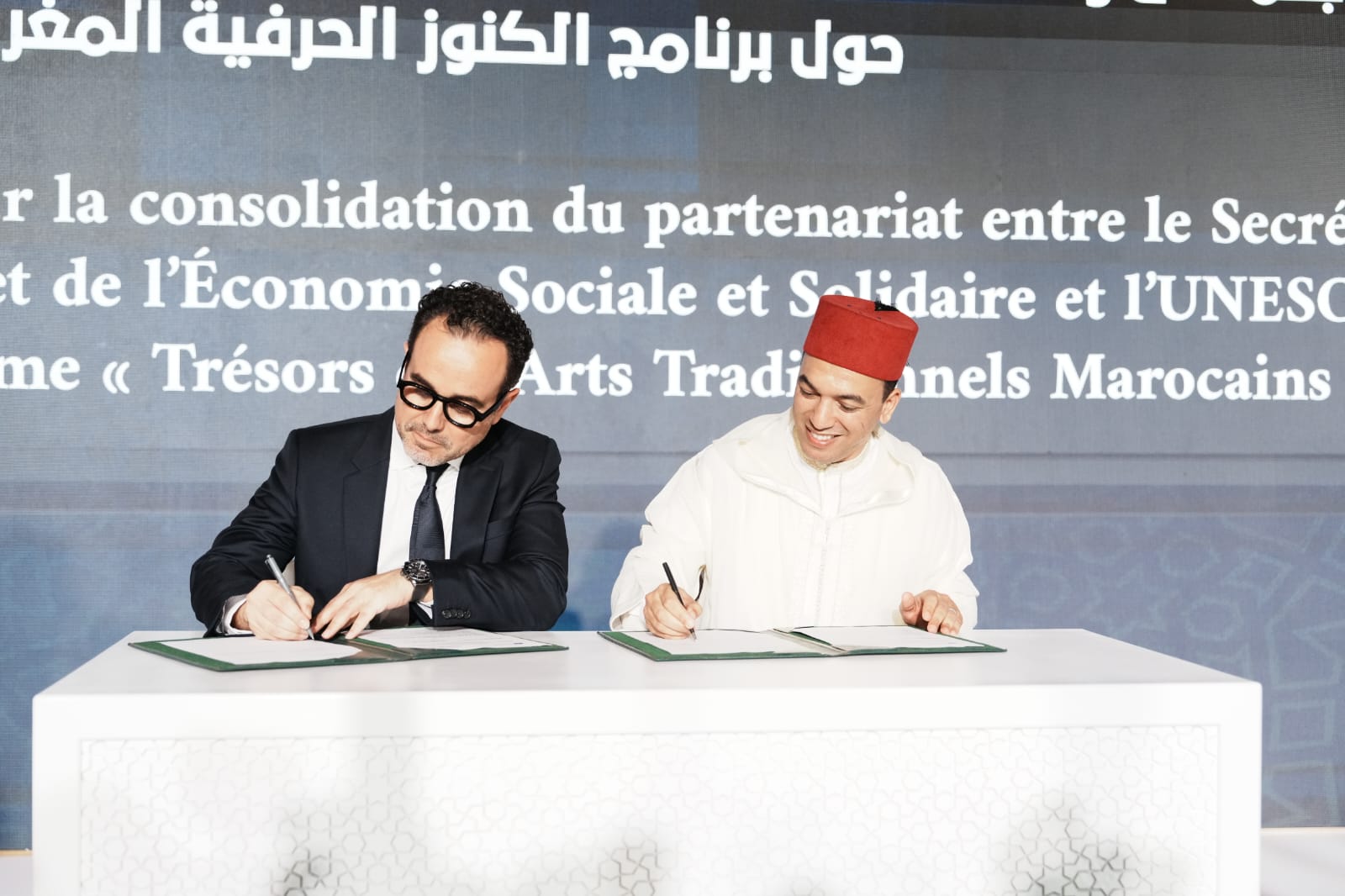
Signing of an extension agreement for the partnership
Given the success of this program, an extension agreement between the Secretariat of State and UNESCO has been signed, extending the “Treasures of Moroccan Traditional Arts” program until 2031.
The ceremony featured a visit to the pavilion dedicated to the crafts preserved from previous editions, as well as a friendly gathering with all 32 master artisans and craftswomen, in a moment of homage and recognition of their vital role in preserving national cultural identity and promoting Moroccan artisanal crafts on national and international stages.
The event concluded with honoring a group of master artisans embodying, through their skills and creativity, the richness and diversity of Moroccan heritage, and continuing to transmit their skills to young apprentices within a 9-month qualifying training program, in partnership with institutes and craft training centers.
This edition marks a new step in strengthening the role of craftsmanship as a driver of human and territorial development, and is a concrete illustration of the royal vision that elevates the preservation of intangible cultural heritage to a collective responsibility and a source of inspiration for future generations.