Kingdom
After the Bad Weather, a Aay in Ksar El-Kébir…
Life has returned to normal in the city. As with the preventive evacuation, residents’ return took place under the best possible conditions—thanks to the exemplary coordination among all the stakeholders involved on the ground, with the required smoothness and calm.

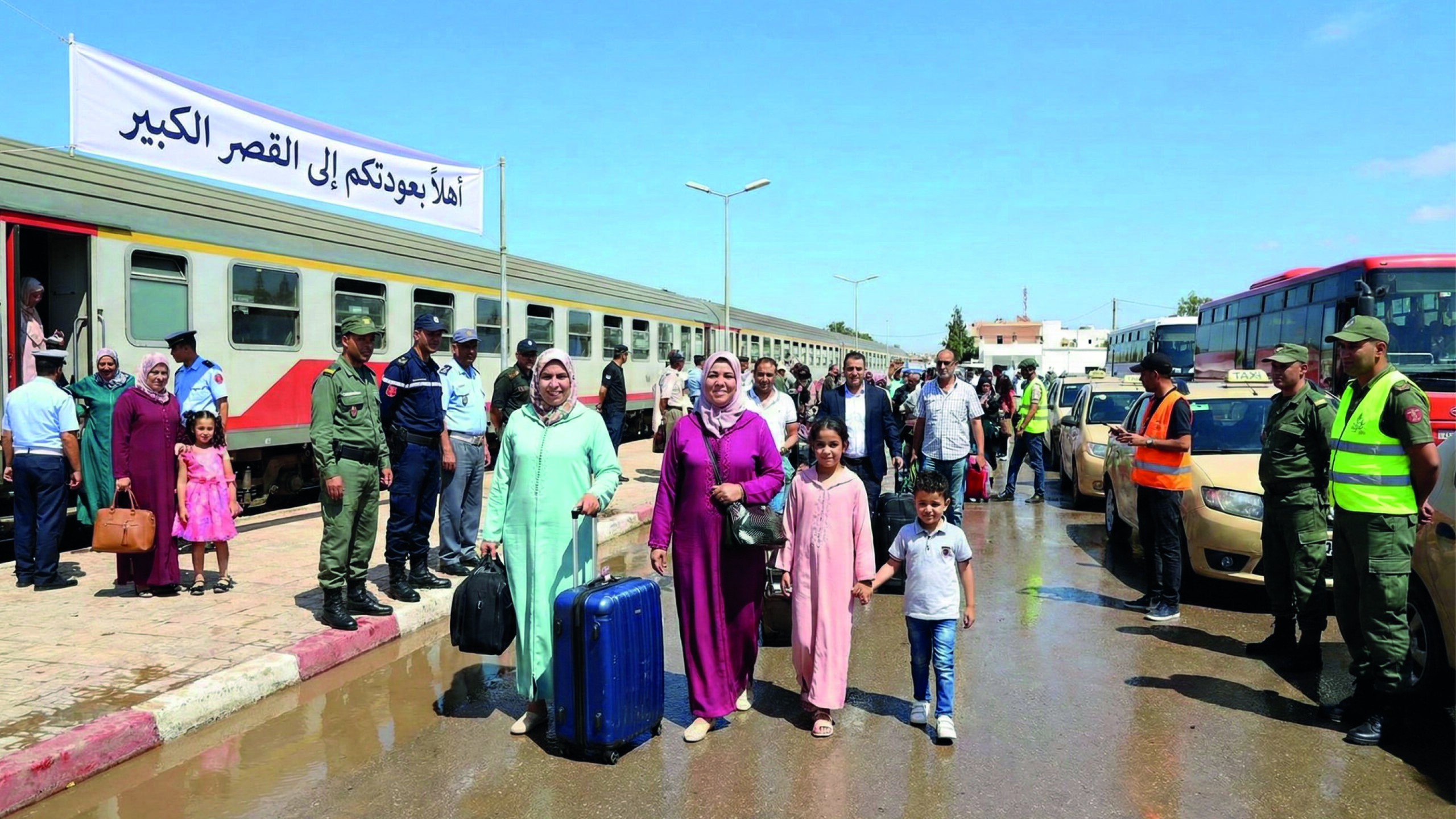
It is Thursday, February 19. On the road from Kénitra to Ksar El-Kébir, the air is rather cool under a timid sun. The rays barely shimmer through the filter of light clouds. From time to time, there is a light drizzle in places. The green landscape breaks with the drought that had persisted for several years.
We slowly cover the 150 kilometers separating the two cities. In the sky, flocks of birds wheel about. There we are in front of the sign indicating our destination. A glance at the Oued Lokkous. The earlier threat is already a thing of the past. The floodwaters have receded and the river has resumed its normal course toward the ocean.
Here we are at the entrance to the city. Hardly any traces of the torrential rains the province of Larache experienced—except here and there a few puddles and some mud, witnesses to the bad weather. On the spot, one realizes that the city was in the midst of redevelopment work on its streets and alleys.
And it is at that moment that the good news falls for residents who have still not been able to return to their homes since the return process initiated on Sunday, February 15. Indeed, the local authorities, through a statement, announced that it was “now possible for all residents to return to their homes. An announcement that came after the completion of on-the-ground interventions undertaken by the public authorities and the competent technical services in the city of Ksar El-Kébir’s various neighborhoods and housing clusters, and after verifying that the situation had improved and that safety conditions were in place,” the statement says.
Recalling, not without emotion, the difficult moments, the president of the municipal council assures us that residents’ return, like their evacuation, took place without incident. Better still, Mohamed Simou tells us—whom everyone here calls Lhaj Simou—each family found food aid placed in front of its home.
In any case, residents were eager to go back home and see the state of their property, even though the authorities had reassured them: “The situation was under control and they had nothing to fear.”
That is because the security services kept a close watch. And “no act of looting was recorded.” And then, the use of sandbags and barriers proved effective in saving what could be saved inside the affected homes, we are told.
Liveliness at its peak
That said, here we are in the center of a superbly lively city. The first indication comes from these shops and other grocery stores that are open. Confirmation comes when one reaches the area of the famous Souk Sebta and its surroundings.
With relaxed faces, women and men are stocking up for the breaking of the fast on this first day of Ramadan. The alleys are packed, and shopkeepers bustle about fulfilling the orders of a clientele they are seeing again.
This is the case with this butcher’s shop, whose counters offer an abundant selection at reasonable prices, a woman tells us as she stands with her daughter, surrounded by residents. The same observation applies at this seller of foodstuffs and spices.
Displaying the prices of his products, the man—who happens to be the “amine” (trade representative) of the profession—reassures: “We have everything we need to meet our customers’ demand, and the prices are reasonable.” A customer waiting to be served confirms with a nod. The situation is the same with this fruit and vegetable seller, who loudly touts his goods.
Nor is the scene any different at this woman’s stall selling the city’s most popular item: “Rezzat El Kadi,” which some translate as “the judge’s turban”! The price is the same for the ten women lined up in the same row: 20 dirhams per kilogram.
Demand is such that, just minutes before the muezzin’s call for the fourth prayer of the day, latecomers would have been better advised to shop earlier.
In the same vein, we learn that the operation to distribute direct financial assistance—6,000 dirhams per household—is continuing. The reaction of a father we meet nearby is as telling as can be: “It couldn’t have come at a better time before the advent of this sacred month, when we even doubted we’d be able to get back into our house anytime soon!”
The operation was very simple and very smooth, this head of household tells us. All he had to do was send his national ID number and his date of birth to 1212. Shortly afterward, he received a code to collect the compensation amount, after which he went to a money-transfer agency where he was able to withdraw the stated sum.
As for other potential beneficiaries of the aid—especially merchants and those whose homes collapsed—committees are in the field to identify them. And if they meet the conditions, they will be taken care of, Lhaj Simou assures. Meanwhile, the authorities are continuing their efforts to eliminate the last traces of the bad weather, especially the mud.
At that point, another problem emerged: the city lacks manpower. We learn, in fact, that the 250 workers the city had been relying on switched course by opting for harvesting work on nearby farms.
A rational choice, since their pay doubles, if not quadruples. Especially given that these workers were earning, under the mutual-aid scheme, 100 dirhams a day. Faced with the shortage, the city had to call on sanitation workers. A solution that leads to another problem: household waste.
Be that as it may, officials are managing the constraints while also appealing to residents’ understanding by asking for their involvement in dealing with the difficulties encountered. The message has been received, this municipal official tells us, as he explains matters to a city resident who stops him in the street.
Gradually, the hubbub fades. The breaking of the fast is in a few minutes. “Allahu Akbar…,” the muezzin calls out. The streets empty. We are already on our way back, in the opposite direction—this time via the national road linking Ksar El-Kébir to Kénitra.