Business
After 2030: Turning the Equipment Drive into Sustainable Growth
The 2030 World Cup is already acting as an accelerator for investment in Morocco. Roads, railway lines, airports, stadiums and hotel capacity are reshaping the country and stimulating activity. But one question arises: what will remain once the construction projects are completed?

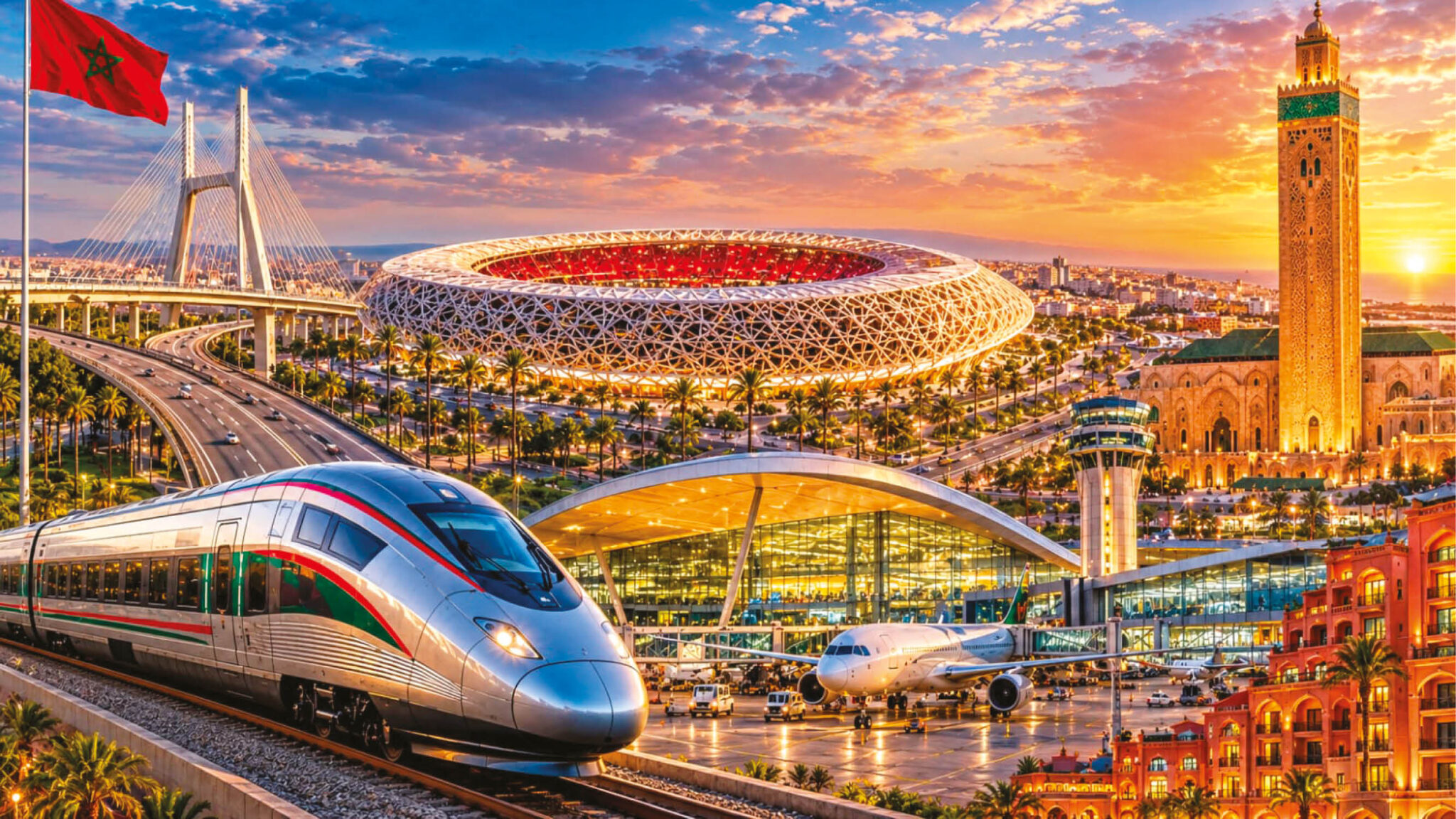
As 2030 approaches, Morocco is experiencing a phase of investment on an exceptional scale.
The co-hosting of the World Cup is accelerating projects that the country needed: modernization of the road network, expansion of the railway system, strengthening of airport and hotel capacity, renovation of urban facilities and construction of new sports venues.
Beyond the event, this mobilization is improving the country’s connectivity, supporting public procurement and driving a large part of the economy.
Construction and public works is one of the main beneficiaries. In its 2026 Economic Forecast Budget, the High Commission for Planning estimates that the sector’s value added increased by nearly 6% in 2025, after 5% in 2024, notably as a result of the acceleration of strategic infrastructure projects.
The institution nevertheless forecasts a slowdown to 4.1% in 2026, alongside the gradual completion of several major projects.
This slowdown already foreshadows the challenge of the post-2030 period: avoiding a powerful investment cycle being followed by a sudden economic downturn.
The Risk of an Economic and Social Backlash
The first challenge will concern employment. Thousands of workers are currently mobilized in construction, public works and related activities.
Once the projects are delivered, part of this workforce could find itself without employment opportunities if no retraining mechanism is prepared.
The paradox is already perceptible: while unemployment remains high, major projects are absorbing an increasing share of the available workforce and contributing to a shortage of skilled labor in construction and public works.
Tensions are also being felt in agriculture and certain segments of the real estate sector.
Cover Story. Investment: After Volume, the Challenge of Returns
“The current momentum is necessary for the country, particularly to modernize its road, railway and hotel infrastructure. However, the post-2030 period must be anticipated starting today. Some of the workforce mobilized by these projects could find itself without employment opportunities once the work is completed,” warns Youssef Ennaciri, an expert in economic inclusion and territorial governance and an economic analyst.
The other risk concerns the future use of the facilities. Railway infrastructure should retain strong economic value by sustainably facilitating the mobility of people, tourism and the integration of economic activity centers.
The socioeconomic profitability of certain roads, mainly developed to serve the new stadiums, will, however, be more uncertain if they are not integrated into urban and productive areas that remain active throughout the year.
A facility that is little used after the competition generates maintenance costs without producing enough activity to justify the investment made.
The same vigilance applies to stadiums and certain hotel capacities. Their viability cannot depend solely on major sporting events. It will require a regular schedule of events, the development of business and sports tourism, as well as better connections with transport, shops and local services.
Success will therefore not be measured solely by the delivery of infrastructure before 2030, but by its use and the value it creates over the following decades.
From Infrastructure to New Growth Hubs
To avoid the cliff effect, the next government will have to make each major facility the core of a broader territorial development project.
Around stadiums, mixed-use neighborhoods, activity zones, commercial spaces, leisure facilities and new urban centers can be developed.
The objective is to generate permanent flows of workers, residents, visitors and businesses, so that the roads and services built for 2030 continue to be used after the event.
“To prevent certain investments from becoming underutilized infrastructure, it will be necessary to rethink the development of areas surrounding major stadiums by creating new urban centers, industrial zones and permanent economic activities,” recommends Ennaciri.
This approach requires coordinating transport, urban planning, housing and productive investment policies from the design stage, rather than treating each project in isolation.
Anticipation must also concern skills. Workers mobilized by the construction projects must be identified, trained and directed before 2030 toward the sectors that will subsequently be recruiting.
Short certification programs, developed with companies and adapted to the needs of each region, would facilitate their redeployment into industry, maintenance, logistics, agri-food, tourism, modernized agriculture and services.
It is not simply a matter of managing the exit from construction projects, but of transforming temporary professional experience into lasting human capital.
The country has several avenues to achieve this. In the automotive and aerospace sectors, the challenge will be to increase the rate of local integration and enable more Moroccan SMEs to access value chains.
In agriculture, priority should be given to productivity, adding value to production and creating regional agri-food hubs.
Phosphates also offer a lever for linking rational fertilization, agricultural innovation and industrial processing.
Fishing, tourism and exportable services can also absorb part of the skills and capacities released after 2030.
These sectors are joined by the jobs of the future. Artificial intelligence, data, cybersecurity, renewable energy and industrial technologies can become new drivers, provided that investment in training and the entrepreneurial ecosystem begins now.
“Morocco will have to consolidate its traditional sectors while preparing for the jobs of the future, with artificial intelligence set to be one of the main engines,” emphasizes Ennaciri.
The post-2030 period is therefore being prepared well before the World Cup kicks off. True performance will not consist solely in successfully hosting the event, but in converting the investment effort into lasting productivity gains, stable employment and territorial development.
If infrastructure becomes the foundation for new activities and if the workforce is redeployed toward promising sectors, 2030 could mark not the end of a cycle, but the beginning of a new growth model.