Influences
Alternative Medicine: Moroccans Are Seeking Treatment Differently
Acupuncture, traditional Chinese medicine, naturopathy, osteopathy, phytotherapy, hijama… So-called alternative or complementary practices, driven by word of mouth, are attracting more and more Moroccans. But behind this growing enthusiasm lies an essential question: how to regulate a rapidly expanding market.

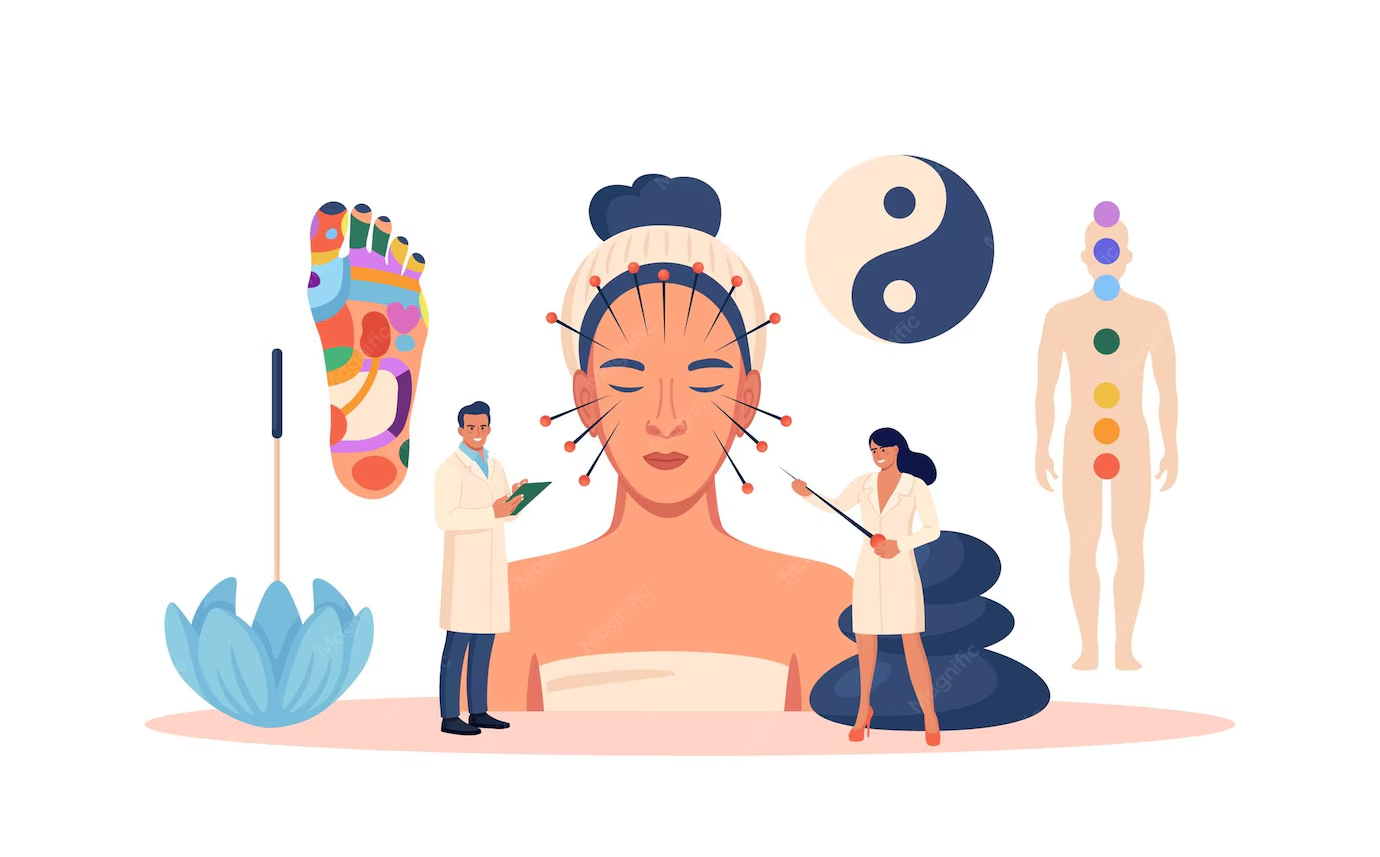
In this Chinese medicine center, the change of scenery begins as soon as you enter. On the walls, anatomical diagrams and representations of meridians immediately set the tone. Here, medicine is practiced according to another tradition.
The doctor receives, listens, observes and asks questions. But language creates a first barrier. The young woman at reception switches from Chinese to French or Arabic, then relays the doctor’s answers.
Patients come with very different ailments: neck pain, lower back pain, migraines, stress, sleep disorders or simply the need to feel better. Some have already consulted several doctors.
Others are seeking to complement conventional treatment. Still others say they want to “avoid medication.” The atmosphere in the waiting room alone sums up a trend that is gradually taking hold in Morocco: the search for other ways, other than conventional medicine, to take care of oneself.
Acupuncture, hijama, cupping, traditional Chinese medicine, naturopathy, osteopathy, phytotherapy… There are many practices and their boundaries are sometimes unclear. Some are presented as wellness practices. Acupuncture, hijama, therapeutic massages, phytotherapy…
Others claim to have a therapeutic purpose. Some are used alongside conventional medical care, while patients may be tempted to use them as a replacement for conventional treatments.
The phenomenon is not new. Moroccans have long resorted to different forms of traditional medicine. What is changing today is the diversity of the offer and its apparent professionalization.
For patients, the motivation is often pragmatic. “I’ve tried several things and I’m looking for something that can relieve me,” summarizes one patient.
For others, the approach is more of a philosophy of life: favoring approaches considered natural and limiting, whenever possible, the use of medication.
The phenomenon is therefore part of a broader evolution in the relationship with health, according to a sociologist who states that “patients no longer only want to be treated; they also seek to understand their bodies and participate more actively in their care journey.”
Is the approach therefore complementary or alternative? The distinction is not insignificant. A complementary practice is used alongside conventional medicine.
The patient therefore continues to be monitored by their doctor and seeks an additional contribution, for example to manage certain types of pain or stress.
The situation is different when the patient abandons medical treatment in order to turn exclusively to a practice whose effectiveness has not been established for the condition concerned. And this is precisely where doctors are calling for caution.
“A complementary practice should not lead to delaying a diagnosis, interrupting an essential treatment or giving the patient a false sense of security,” explains a neurologist, who adds that “the debate is therefore no longer necessarily about being for or against alternative medicine.
It is more about indications, the evidence available, the qualifications of practitioners and the information provided to the patient.” For doctors, the issue is therefore less about systematically condemning all practices than about avoiding confusion.
They emphasize above all that resorting to a complementary practice should never prevent a patient from consulting a doctor when a symptom requires a medical diagnosis.
In Casablanca, several establishments now offer services related to Chinese medicine or similar practices borrowed from several therapeutic traditions.
Chinese acupuncture thus exists alongside reflexology, Tuina massage, cupping or phytotherapy. Within this landscape of alternative and holistic practices, Chinese medicine is a particular case.
Its presence in Morocco dates back further than it might seem. In 1975, an agreement was signed between Morocco and China for the dispatch of Chinese medical teams to the Kingdom.
Since then, doctors and nurses have taken turns working in several public establishments, particularly in remote regions. Acupuncture, for example, had found its place in Mohammedia, where a specialized Chinese medical unit had been established at the Moulay Abdellah provincial hospital center.
A session costs between 150 and 500 dirhams
Cooperation has taken on a new dimension in recent years. Thus, in 2019, the two countries decided to establish a center in Casablanca dedicated to treatment, training and research.
In July 2025, the Ministry of Health announced the opening of an acupuncture center in Mohammedia. Half a century after the arrival of the first missions, Chinese medicine is therefore no longer merely a component of health cooperation between Rabat and Beijing. It is now part of the healthcare landscape to which some Moroccans turn.
Morocco has developed cooperation with China in this field, and acupuncture has an institutional presence in certain facilities. This cooperation does not, however, mean that every private establishment offering acupuncture or presenting itself as a “Chinese medicine center” automatically has ministerial approval.
This is precisely one of the questions patients ask themselves when they walk through the door of a private center: what is the status of the establishment and who is authorized to practice there? Doctors, physiotherapists, paramedical professionals, practitioners trained abroad or therapists operating under another status now offer care in private centers or clinics.
According to the managers of the centers, although they do not provide figures, some are approved by the Ministry of Health and others are not. They emphasize that only centers run by doctors, as well as those located within public health establishments, are authorized by the ministry.
Furthermore, in medical practices, particularly general medical practices, and in certain clinics, the practice of alternative medicine does not require specific authorization, provided that the establishment has received authorization from the General Secretariat of the Government.
This diversity of statuses is also reflected in the prices charged. In the absence of a framework and identical status for all centers offering these practices, prices are far from uniform. They vary from one establishment to another, depending on the nature of the treatment, the practitioner’s qualifications and the type of facility.
Thus, prices recorded at several establishments in Casablanca show significant differences. An acupuncture session may be advertised at 150 DH in some centers, while a practice specializing in Chinese medicine and naturopathy offers a one-hour session for 500 DH. The same disparity applies to hijama.
Some services are charged at around 150 DH, while certain establishments offer dry hijama for 350 DH or hijama with bloodletting for 400 DH.
In the field of Chinese practices, recorded prices reach 250 DH for a Gua Sha or Chinese cupping session, 500 DH for a foot reflexology session and 550 DH for one hour of Tuina massage, with services reaching up to 700 DH for 1 hour and 30 minutes.
And the actual cost for the patient is not always limited to the price of a session. When a “course of treatment” involves five, ten or fifteen sessions, the bill can quickly reach 2,500 or 3,000 dirhams. An expense that remains the patient’s responsibility, as there is no reimbursement from insurance companies or other mutual insurance funds.
Seeking treatment “differently” can represent a substantial budget for households, particularly when it involves repeated treatments. The patient must then weigh the cost of a session, the number of sessions offered and the benefits they expect from them.
This is undoubtedly the most sensitive question. For the patient, caution therefore consists of distinguishing three things: what falls under comfort or well-being, what can potentially accompany medical care, and what claims to treat a disease.
This distinction is all the more important for people suffering from chronic illnesses, elderly people or those taking several medications. The more the offer develops, the more patients must be able to access complete information about these practices, for which enthusiasm is currently undeniable. This calls for regulation of this highly visible and rapidly expanding healthcare market.
Because behind the success of acupuncture, hijama, Chinese medicine or naturopathy, there are above all healthcare consumers. And as in any area of healthcare, their primary expectation should be to know whom they are entrusting their bodies to, what the limits of the proposed practice are and how much their course of care will cost.