Kingdom
Advertising: 425 Million Dirhams Invested During the First Ten Days of Ramadan
Advertising investments reached 425 million dirhams during the first ten days of Ramadan 2026, a slight increase of 1% year-on-year, according to data from the Moroccan Observatory Les Impériales, which reveal a generally stable market still dominated by television.

Advertising investments in Morocco reached 425 million dirhams (MAD) during the first ten days of Ramadan 2026, compared with 421 million MAD during the same period in 2025, representing an increase of 1%, according to data published by the Moroccan Observatory Les Impériales (OMLI) based on statistics collected by Imperium.
In a statement, the Observatory indicated that this development reflects a generally stable market in a context marked by a certain degree of budgetary caution. After several years of strategic adjustments, advertisers are increasingly prioritizing the optimization of advertising investments rather than a significant increase in budgets, the same source specified.
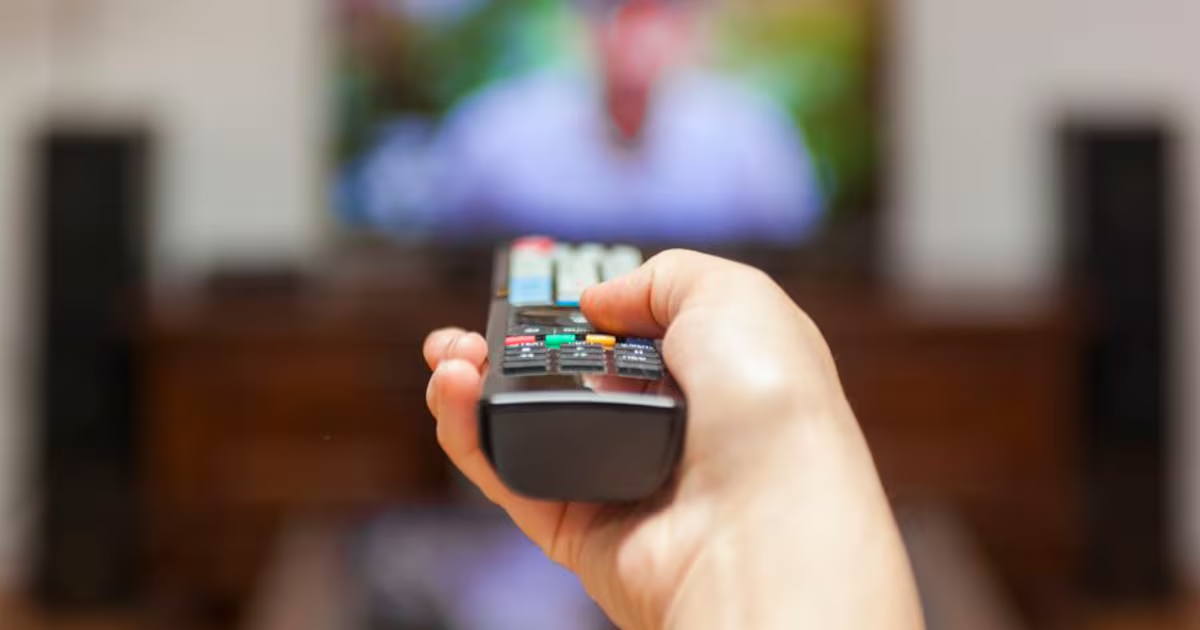
The distribution of investments by media confirms the clear dominance of television, which captured 65.3% of advertising spending during the first ten days of Ramadan, compared with 67.7% during the same period the previous year, the OMLI noted. Despite this slight decline, television remains the main advertising medium during this period, particularly due to the high audience levels recorded at the time of ftour, the statement emphasized.
Behind television, outdoor advertising represents 13.6% of investments, followed by radio with 12.2%, while digital reaches 6.7% and records an increase compared with 2025. In contrast, the press captures only 1.9% of advertising investments, confirming a downward trend in the allocation of budgets, according to the data provided.
The analysis of the number of advertisers also highlights a growing concentration of investments. Thus, the number of advertisers on television decreased from 91 in 2025 to 83 in 2026, while the press recorded a sharper decline, dropping from 295 to 175 advertisers, the same source indicated. Radio, for its part, counts 135 advertisers compared with 125 the previous year, while outdoor advertising decreased from 510 to 487 advertisers.
According to the Observatory, this development reflects a stronger concentration of investments around players with larger budgets, while some advertisers with more limited resources are redirecting their spending toward other channels or reducing their advertising presence.
By sector, the food industry remains the leading advertising investor with 39.3% of spending, despite a decline of 7.5%, followed by telecommunications with 21.1%, down by 3.4%, the statement noted. Conversely, some sectors recorded significant increases, notably insurance (+138%), automotive and transport (+80.7%), as well as maintenance products (+46.4%). Other segments, however, experienced notable declines, particularly banking (-35.5%), retail distribution (-33%), and hygiene and beauty (-44.2%).
Lamia Ajana, director of the OMLI, indicated that the first ten days of Ramadan outline “a stable but cautious advertising market, strongly dominated by television and increasingly concentrated around major advertisers,” also marked by contrasting sectoral dynamics.
Finally, Ramadan continues to constitute a strategic period for advertising investments, while also reflecting a phase of realignment within the sector, where considerations of performance, efficiency, and budget arbitration occupy a central place, the statement concluded.