Influences
Mustapha Hadji, the genius who made defenses dance
There are players who mark a generation and others who mark a continent. Mustapha Hadji belongs to the second category. African Ballon d’Or winner, hero of the AFCON and the 1998 World Cup, his name remains synonymous with talent and passion.

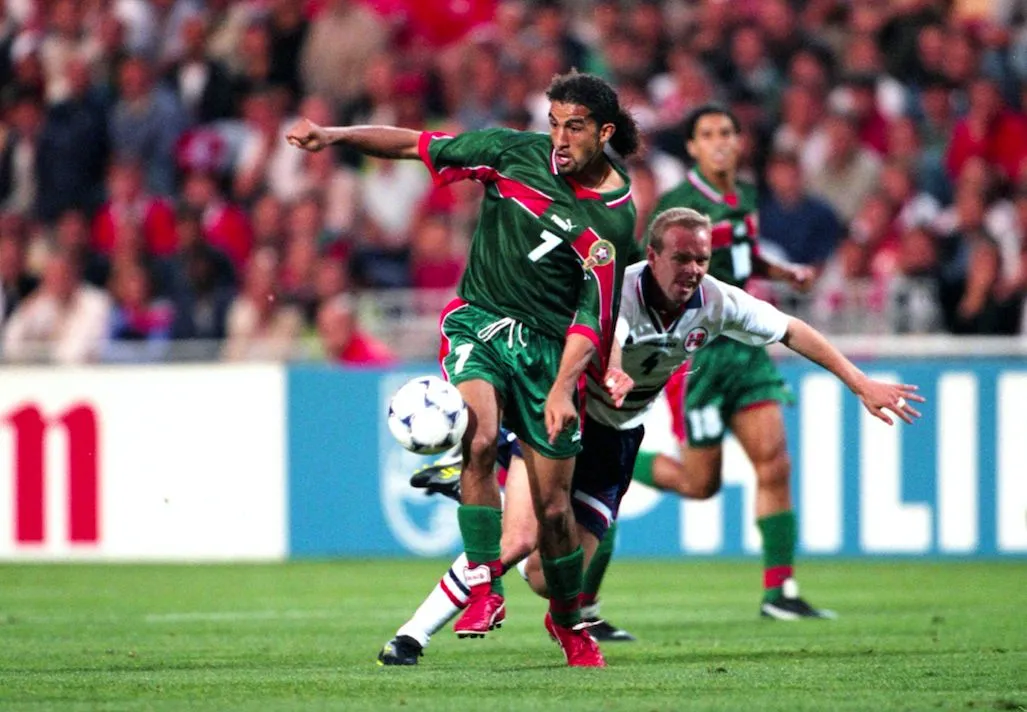
Nutmeg, stepovers, a low shot into the net: when Mustapha Hadji touched the ball, the spectacle was guaranteed. With AFCON 2025, it is impossible not to think of one of the finest jewels of Moroccan football, the one who enchanted stadiums and screens around the world in the 1990s.
Born in Ifrane, Mustapha grew up among mountains, livestock and wells. “We made do with what we had”, he says with a smile. School, farm work and dusty football fields were his daily life. At the age of 10, he crossed the Mediterranean.
From the raw nature of the Middle Atlas to the mining towns of Montceau-les-Mines and Creutzwald, the cultural shock was immense, almost unreal. “It was as if I went from Mars to Jupiter”, he confides. Someone then offered him a simple and brilliant solution: “Play a team sport to improve your French!”
Football became his language, his refuge, his horizon. At 15, Nancy spotted him while he was still playing in the Moselle regional league. Alain Perrin believed in him and gradually transformed him: the young defender with a silky touch became this luminous, unpredictable playmaker, above all a dream player.
“I never wanted to pass it”, he laughs today. At Marcel-Picot, he exploded, charmed and established himself. A boy with rare instinct and daring technique was discovered, with that extra soul we call, for lack of a better word, genius.
Birth of a Lion
In 1993, Raymond Domenech called him up to join the France Under-21 team. Hadji refused. His choice was clear, visceral: it would be Morocco. “Morocco promised me a more beautiful destiny”.
First cap against Zambia, participation in the 1994 World Cup, continuous rise in power: the trajectory was set. And 1998 would set everything ablaze.
A few months before the World Cup in France, the AFCON in Burkina Faso marked a turning point. Against Egypt, an unbeaten team and future champion, Mustapha Hadji scored an unforgettable acrobatic overhead kick, an exceptional gesture that gave the Lions victory (1–0) and qualified Morocco for the quarterfinals.
A goal of anthology, still cited today among the most beautiful in the history of the Africa Cup of Nations. Then came the World Cup, that childhood dream that came to life in a country that was almost his own.
“Playing in a World Cup is a childhood dream”, he confides. Family and friends in the stands, familiar landmarks, a familiar atmosphere: everything contributed to fulfillment. On the field, Hadji shone.
His goal against Norway, a 60-meter run down the left side finished with a precise shot into the side netting, remains an unforgettable memory.
“It wasn’t the most beautiful, but the strongest. When you know that 40 million Moroccans are celebrating… it wasn’t even for me, but for an entire people”.
Morocco believed in qualification after a resounding 3–0 victory against Scotland, but the cruel scenario of Brazil’s defeat against Norway buried those hopes. “We went from joy to sadness in a fraction of a second”, he recalls.
Transmission
When the magic of the dribbles fell silent and the boots stopped carving up the pitches, Mustapha Hadji did not leave the stage. He simply changed roles, trading the spotlight for the benevolent shadow of the staff.
Another way to love Morocco, another way to continue the fight. Indeed, he continued to serve his country as a member of the Lions of the Atlas staff. “I’m a bit like a big brother: I listen, I support, but I keep the necessary distance”.
For him, the national team remains above everything. “What you win with a national team is priceless. Playing for your country, you have to do it with your guts, with your heart”. With AFCON 2025, he admires the country’s evolution: “Since 1988, Morocco had not hosted the AFCON. Today, with the infrastructure and the vision of His Majesty King Mohammed VI, our country has become a key player in football”. But he warns: “Other African nations have progressed. We will have to play at 150%, show commitment and fighting spirit to go all the way”.
And when he thinks of the children who shout his name, who dream while watching him, he smiles: “Seeing those kids running after the bus after a match, seeing them dream, that’s more beautiful than all the trophies. Offering hope—that’s the real reward”.
African Ballon d’Or 1998, best player of the AFCON the same year, winner of the Intertoto Cup with Aston Villa in 2001, runner-up of the Portuguese league with Sporting CP in 1997, finalist of the Portuguese Cup in 1996, and elected “Legendary Player” by the CAF in 2011: the mark left by Mustapha Hadji is immense.
But beyond the titles, he will above all remain the artist who made defenses dance, the man who offered beauty to an entire people and hope to millions of children.
The legacy of the Lions: 50 years of glory and transmission
Long before Mustapha Hadji left his luminous mark on continental football, other Lions had already shaped the first pages of this Moroccan epic.
Their legacy, patiently built, tells a story of talent, self-sacrifice and national pride. It is within this lineage of giants that Hadji belongs and, now, those who take over.
In this continuity, several emblematic figures paved the way: the unforgettable Ahmed Faras, legend of Chabab Mohammédia and African Ballon d’Or in 1975; Mohamed Timoumi in 1985, magician of AS FAR whose grace guided the game; then Badou Zaki in 1986, the heroic last line of defense of the Mexican World Cup.
It would take until 1998 for Morocco to reconnect with the supreme distinction thanks to Mustapha Hadji, at the end of a radiant year, illuminated by a vibrant World Cup and an AFCON that entered the collective memory.
Today, twenty-seven years later, the torch passes to Achraf Hakimi, leader at PSG and pillar of the Lions of the Atlas. Hadji celebrates a success that is both individual and collective: “Hakimi has been consistent for 5–6 years at the top of his game. Statistically, it’s exceptional. But even if the prize is individual, it carries the success of the collective. You don’t succeed alone in football”. He also recalls the symbolic, almost invisible weight carried by this trophy: “In my time, facing a team with a Ballon d’Or changed the level of respect. Now, it’s his turn to embody that”.