Influences
Social and solidarity economy: The inflection by law
Promised thing, due thing. The State Secretariat in charge of Crafts, social and solidarity economy has just finalized a framework law project on ESS. A device supposed to give new impetus to an ecosystem already considered as an economic sector in its own right.


The government multiplies initiatives to give the social and solidarity economy (ESS) sector all its letters of nobility in view of enhancing the potential it contains.
This is precisely in this framework that the framework law project 17-26 submitted for public consultation on the website of the General Secretariat of the Government (SGG) enters. Calendar coincidence, the text, of about thirty articles, was injected into the circuit at the moment when the national week dedicated to the social and solidarity economy sector is organized.
An entry into the circuit that comes to confirm that we are in the presence of an action government that, when it engages, honors its commitments. Indeed, this framework law project is the concretization of one of the flagship recommendations of the 5th National Assemblies of social and solidarity economy.
It should be noted that one of the key objectives of this framework law project is to consider that it is indeed an economic sector in its own right, alongside public and private sectors, that it needed to be equipped with a legal arsenal, in view of structuring and framing it, while facilitating access to financing for structures operating there.
Concretely, the text, once the public consultation stage is crossed, will be validated in Government Council before being deposited at Parliament, introducing several unprecedented concepts and mechanisms to modernize the sector.
To begin with official recognition. ESS is now recognized as an economic sector in its own right, like public and private sectors.
The future framework law, after setting up a transparent accreditation system with the creation of an “social and solidarity economy organization” accreditation status, will allow precisely defining the sector’s perimeter and targeting beneficiaries of State aid. The text also foresees opening to commercial companies.
Thus, contrary to the traditional framework (cooperatives/associations), private commercial companies can now obtain ESS accreditation if they respect sector principles and pursue social utility.
Of course, a new legal framework is also new governance. The framework law project foresees, in this sense, the transformation of the Cooperation Development Office (ODCO) into a strategic national institution, named “Moroccan Agency for Social and Solidarity Economy”.
Other novelties: the establishment of a labeling system to classify organizations and valorize territories engaged in ESS, as well as the creation of an ESS observatory for data analysis and a national register to guarantee transparency and follow-up of organizations.
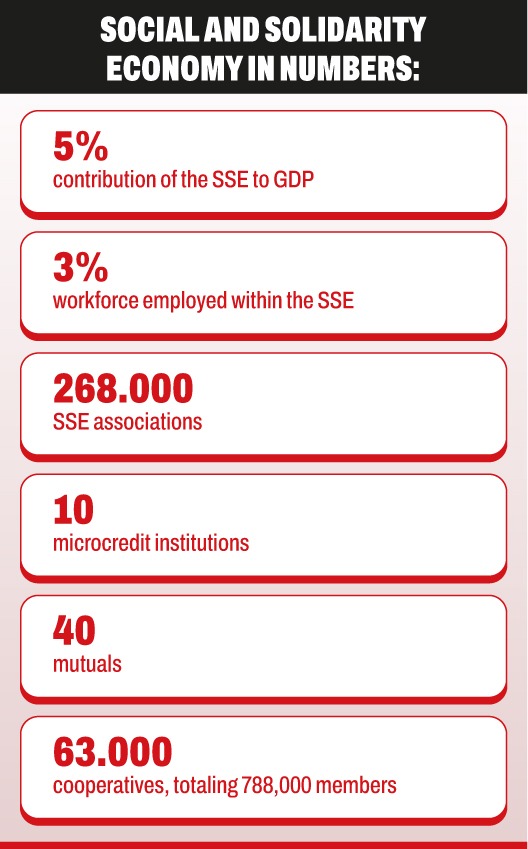
In essence, this major inflection is even more necessary when we know that, notwithstanding its importance as a lever of economic inclusion, job creation and contribution to reducing social and territorial disparities, the ESS sector, which contributes 5% to GDP, to reach more than 8% by 2030, greatly needed a transversal legal framework covering cooperatives, mutuals and other associations with economic vocation.
Institutional levers
Also, the legal device in gestation also tends to integrate informal activities into the formal economy, which should participate in strengthening social inclusion, certainly, but also in reinforcing the productive and managerial capacities of organizations operating in the social and solidarity economy sector.
It should be noted, moreover, that this new legal framework establishes an accreditation system that said organizations must benefit from. The door is also open for commercial companies and legal entities.
Still, the text specifies, that any potential accredited must respond to a certain number of criteria including, among others, the necessity of giving priority to the human element, democratic and participative governance, as well as limitation of the gain aspect.
Remains the contribution of the label. Structures that will have the “social and solidarity economy organization” label will benefit, among others, from specific support and accompaniment, but also from an incentive customs and fiscal system. What will be of nature to ensure financing, professional networking, promotion of product commercialization, without forgetting promotion of digitalization, etc.
Even better, the institution of this label also aims to facilitate access to public markets. This said, in practice, institutional levers are foreseen, to begin with the restructuring of the Cooperation Development Office to which must substitute a strategic national establishment under the name of national agency for social and solidarity economy.
This structure is, notably, expected to fulfill technical framing missions to accompany sector actors. In the same vein, a national commission for social and solidarity economy is also announced, as high consultative instance, without forgetting the establishment of an observatory for social and solidarity economy that will be responsible for collecting and analyzing data on the sector with an open account with the High-Commissioner for Planning.
To note also that in this new dynamic that announces itself, it is foreseen to set up a national register of social and solidarity economy organizations, in order to gather transparency and follow-up conditions, as read in the framework law project.
Likewise, a national observatory for ESS is expected with the objective of gathering and analyzing data on this sector. In the wake, we will also assist the creation of a national commission that will have a consultative role.
This means nothing has been left to chance in view of an upgrade that announces itself already promising.
A framework law and strategic objectives
The framework law project rests on fundamental pillars to energize social entrepreneurship:
• Fundamental principles: Organizations must respect the primacy of human over capital, democratic and participative governance, as well as limited lucrativity, with notably the reinvestment of profits in the activity.
• Fiscal and customs incentives: The State commits to setting up an incentive fiscal and customs regime, mainly adapted to ESS specificities.
• Access to financing: Creation of integrated financing systems and dedicated guarantee funds to facilitate access to capital for social projects.
• Integration of informal: One of the key objectives is to use ESS as a lever to formalize unstructured activities, thus favoring economic inclusion.
• Support for commercialization: The project foresees the creation of marketing platforms, obtaining conformity certificates and use of product labels to strengthen competitiveness of ESS products.