Kingdom
The Companies Shining in the Shadow of Giants
Alongside the historical leaders, a handful of Moroccan construction companies are gradually establishing themselves on the Kingdom’s strategic sites. Less publicized but solidly entrenched, they secure multi-billion dirham contracts, driven by the revival of public investment and the acceleration of major infrastructure projects ahead of the 2030 World Cup.

On the Kingdom’s major construction sites, the spotlight most often shines on SGTM, TGCC, or Jet Contractors. But in the shadow of these giants, several Moroccan construction companies are patiently carving their path. They are securing strategic contracts one after another, establishing themselves as essential players in the sector.
We focused on six of them, which have won no less than 42 projects totaling 13.5 billion dirhams between 2022 and 2025 (see infographic). These projects cover diverse sectors such as health, sports, culture, and transportation.
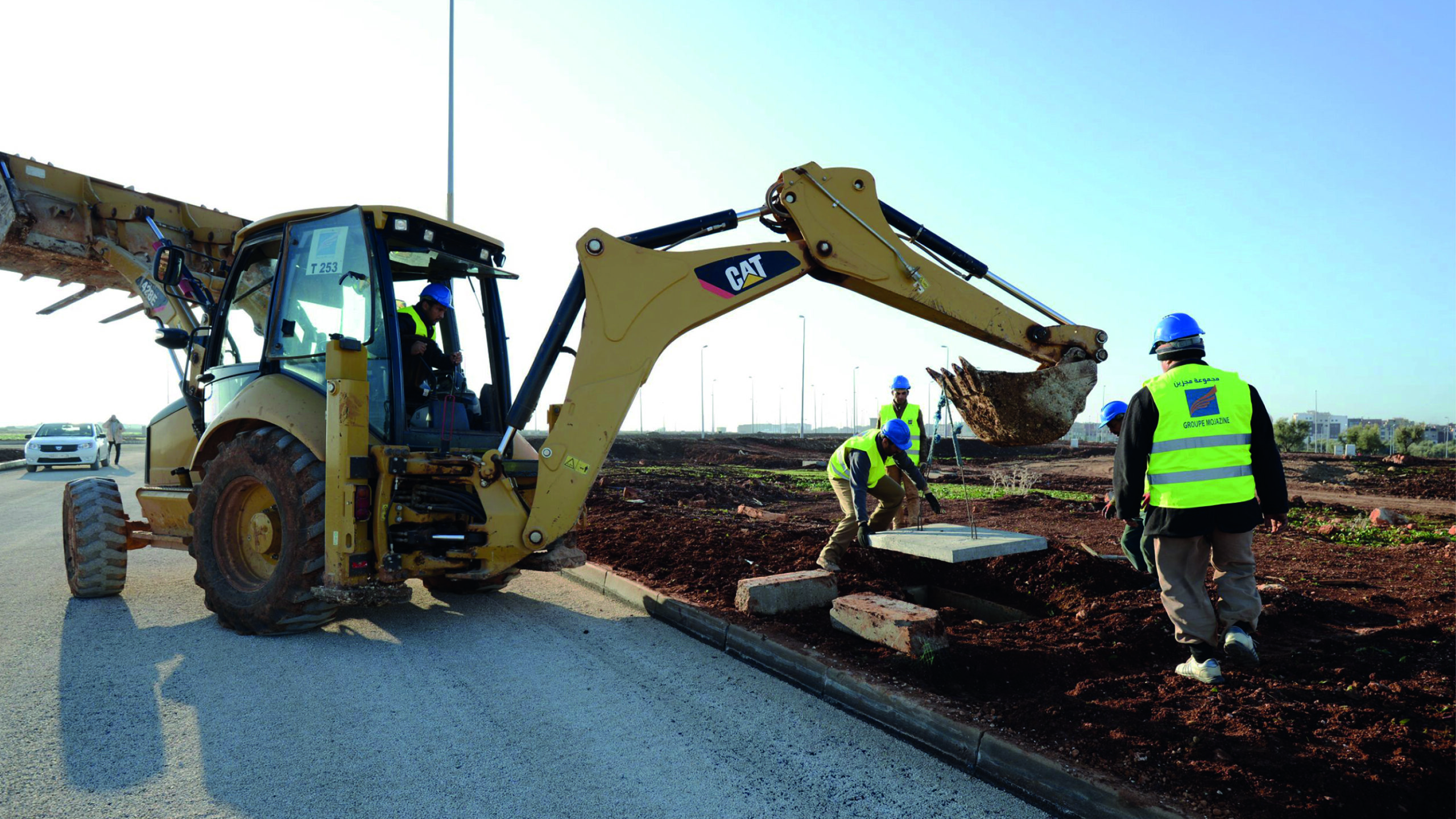
Groupe Mojazine: The All-Out Offensive on Major Projects
Founded in 2001 by the former president of the Béni Mellal-Khénifra region, Brahim Mojahid, this company specializing in transport infrastructure and urban development has become one of the most prominent players in the national construction ecosystem in recent years. It is no coincidence that the group holds 10 projects worth 5.2 billion dirhams.
Its latest win is the 586 million dirham contract for the works on lot 1 of the Saka-Driouch section (40.5 km) of the future Guercif-Nador highway, secured in mid-November 2025, beating competitors like the French NGE Contracting and China Road and Bridge Corporation. Stretching 105 km, this strategic infrastructure will connect the Nador West Med port to the national highway network and is expected to be operational in 2028.
The group is also among the companies selected for the construction of the new Rabat-Casablanca continental highway (59 km), scheduled for delivery in 2029. In May 2025, it secured lot 1 of the Casablanca-Oued El Maleh bypass for 653.4 million dirhams. Two years earlier, Mojazine had already made its mark by winning the contract for the first section of the Tit Mellil-Berrechid highway, for nearly 780 million dirhams.
Nearly 2 Billion Dirhams for the Kénitra-Marrakech High-Speed Rail Line
Measuring 30 km, this highway, inaugurated on November 27 last year, directly connects the Casablanca bypass highway (A1) at the Tit Mellil junction to the Casablanca-Marrakech highway (A3) and the Berrechid-Béni Mellal highway (A4) at the Berrechid highway interchange.
With an initial estimated traffic of 20,000 vehicles per day, this strategic infrastructure will help improve safety and traffic flow through Greater Casablanca and reduce the length and duration of trips for users coming from the north and east and heading to the south and center of the Kingdom.
Having already secured, in 2022, the second lot of the Casablanca bypass highway (517.4 million dirhams), Mojazine reached a milestone in October 2024 by winning a 1.9 billion dirham contract for the civil engineering works on the 7th section of the Kénitra-Marrakech high-speed rail line, through its subsidiary under the holding company Abrar Invest.
To this already substantial portfolio are added the completion of the Tiznit-Guelmim section of the Tiznit-Dakhla expressway, the development of Mohammédia’s road network, the tripling of the Azemmour road, and the works on the RN11 section connecting Sidi Maârouf to the A1-A3 interchange.
El Hallaoui, the King of Underpasses
One might think that underpass construction contracts are his exclusive domain. Indeed, the company, founded in 2000, has won about ten of them in recent years, including those at the intersection of FAR and Al Fath Hassan II avenues and the P4022 road in Aïn Atiq, as well as the Salé underpass at the crossing of Hassan II, Abdelkrim El Khattabi, and Zarbi avenues. Three projects totaling 173.9 million dirhams.
But El Hallaoui is not limited to urban structures. Last May, it secured lots 1 and 2 of the new Rabat-Casablanca continental highway, for a total package of 1.6 billion dirhams. It is also responsible for the second section of the Tit Mellil-Berrechid highway (Deroua-Médiouna), for nearly 770 million dirhams.
Beyond highway axes, the construction company also stands out in other strategic projects, such as the extension of the Rabat agri-food platform (25.5 hectares), located near the Youssoufia industrial zone. It will also carry out the development works for Place d’Italie in Rabat and build an underground parking lot there.
SBTX, a Heavyweight in Civil Engineering
Founded in 1999 by Abdenbi Bioui, SBTX, formerly Bioui Travaux, has established itself as one of the national leaders in public works and civil engineering. Last November, the company made headlines by securing lots 2 and 3 of the Saka-Driouch section of the Guercif-Nador highway, for over one billion dirhams.
A few months earlier, in March, the company led by Amine Benabdellah had been selected by the African Development Bank for the development works of the Nador West Med activity zone (367.6 million dirhams). SBTX is also present on the Tit Mellil-Berrechid highway (third section, 792 million dirhams, in a consortium with GTR) and on the first lot of the Casablanca bypass highway.
Rouandi, Builder of Hospitals and Sports Facilities
By winning the contract for the works on the Grand Stade de Dakhla (265 million dirhams) in January 2025, the company founded in 2014 and led by Hicham Rouandi confirmed its role as a key player in the Moroccan construction field.
The venue, which will be operational in 2028, will have a capacity of 15,000 seats, including 4,000 covered. It will also have 150 VIP seats, a media stand, computer rooms with a studio for TV interviews, and a conference room. The project also includes an infirmary, refreshment stands, and technical rooms for electricity and IT equipment.
A 500-space outdoor public parking lot is also planned. Last December, Rouandi was also entrusted with the utility works for the future federal football training center in Casablanca, for the Royal Moroccan Football Federation (FRMF).
Outside of sports facilities, its footprint is also found in several hospital projects, including the construction of the Mohammédia Provincial Hospital Center (CHP) and the Guercif CHP.
The construction of the Marrakech-Safi City of Trades and Skills (CMC) and that of Dakhla, the platform for essential reserves in Fès-Meknès (20 hectares), as well as the completion of the works for the Souss-Massa regional headquarters, also bear its signature.
Alam Equipement, from Rabat to Dakhla
Based in Rabat, Alam Equipement (Aleq) specializes in roadworks, road networks, and various utilities. One of its major achievements are lots 5 and 6 (749.2 million dirhams and 574.1 million dirhams respectively) of the new Rabat-Casablanca continental highway, won in partnership with China Road and Bridge Corporation.
It is also at work in Marrakech, where it secured the contract for the redevelopment of Jamaâ El Fna square (114 million dirhams), as well as in Rabat-Salé-Kénitra with the second phase of the platform for essential reserves (68.4 million dirhams). In Dakhla, Aleq carried out the rehabilitation works for the drinking water distribution network as part of the 2022-2027 priority program.
As Morocco accelerates its investments in infrastructure, the map of the national construction sector is being redrawn. Behind the historical leaders, these five companies are asserting themselves and often even shaking up the hierarchy. Builders from the shadows who could become major players in the coming years.
AHMA, Specialist in Hospital Infrastructure
Alongside the five companies listed, other entities, often not very publicized, also stand out. This is the case of the company Ait Haj My Abdelghni (AHMA), founded in 1998 by Abdelghni Ait Haj. Based in Marrakech, the company distinguishes itself in many projects nationwide.
The most recent one: the extension of the Guelmim Regional Hospital Center (CHR) (157 million dirhams) won last September. The construction works the company must complete over twelve months notably include site installations, supply, transport to site, storage, installation, and adjustment of all materials.
The company will also build, in Zénata, a sports complex including an indoor swimming pool, football fields, tennis courts, and multi-sport fields. The Bab Rha underground parking lot (9,000 m²) in the medina of Meknès, the Charifa hospital and semi-olympic swimming pool in Marrakech and the Court of First Instance in Tahnaout, under the Marrakech-Safi region, the Tinghir hospital in the Drâa-Tafilalet region, and the Skhirat local hospital, are also part of its portfolio.