Kingdom
Track Equipment: These Suppliers Who Will Make the Future Kenitra–Marrakech High‑Speed Line Run
Behind the rails of the Kenitra–Marrakech high‑speed line, an armada of European and Asian suppliers is shaping Morocco’s high‑speed rail. Track equipment, high‑technology switches, specialized machinery… These manufacturers are building and driving the national railway network. Discover.

On February 26, 2025, ONCF shifted into high gear. As part of renewing its fleet and extending the Kenitra–Marrakech high‑speed line (LGV), 168 new‑generation trains were ordered for 29 billion dirhams.
Objective: support the surge in traffic expected during the 2030 World Cup and develop rapid and metropolitan shuttle services (RER) throughout the Kingdom. The French company Alstom will deliver the 18 high‑speed trains, Spain’s Construcciones y Auxiliar de Ferrocarriles (CAF) will supply 40 intercity trains, while South Korea’s Hyundai Rotem secured the contract for 110 RER trains.
But without rails, there are no trains. Aware of this reality, the public company led by Mohamed Rabie Khlie simultaneously secured ten contracts for the supply of high‑performance track components for a total amount of 3.2 billion dirhams, in order to modernize and increase the capacity of the future high‑speed line.
The most recent order: the one approved on January 27 with China Railway Materials Track Technology Service (CRM Track Technology) for the supply of 60,000 tons of 60 E1‑type steel rails for 451.5 million dirhams including tax.
A specialist in railway infrastructure—particularly track components (switches/turnouts) and fastening systems—the subsidiary of the state‑owned China Railway Materials (CRM) group was chosen for having submitted the lowest bid, ahead of the Indian giant Jindal Steel and JSW Steel Italy Piombino, the Italian subsidiary of the Indian group JSW Steel.
This contract, lasting sixteen months, covers the manufacturing, transport, and loading of the rails onto flat wagons made available by ONCF.
More than 80,000 tons of steel rails
With 60,000 tons of steel, ONCF is securing the equivalent of 250 km of double‑track high‑speed line, i.e. more than half of the Kenitra–Marrakech route (around 430 km). The choice of the 60 E1 rail, better known as UIC 60, is no coincidence: it is the European standard for lines subjected to heavy loads and high speeds.
The same logic applies to R260Mn manganese steel. Its increased resistance to wear and fatigue makes it an essential ally for ensuring the durability of tracks under heavy traffic.
Beyond its major contract in Morocco, CRM Track Technology is deploying its expertise on several strategic railway projects around the world, particularly in the wake of China’s Belt and Road Initiative, the massive project aimed at connecting Asia to Europe and Africa through land and maritime corridors.
Among its major references is the China–Laos high‑speed railway (414 km), a key link in the China–Southeast Asia economic corridor, the Jakarta–Bandung line in Indonesia, as well as the East Coast Rail Link (ECRL) project in Malaysia. The supplier is also involved in major projects in Europe, such as the Belgrade–Budapest line intended to link the port of Piraeus (Greece) to Central Europe.
Also active in Africa, the group is involved in the Lagos–Kano project, stretching more than 1,300 km and considered one of the largest railway projects financed by China on the continent.
Predominance of Chinese groups
CRM Track Technology adds to an already substantial list of Chinese suppliers mobilized by ONCF as part of the colossal Kenitra–Marrakech high‑speed line project.
In June 2025, the state‑owned giant China Railway Construction Corporation (CRCC), already heavily involved in civil engineering works, won a strategic contract worth more than 600 million dirhams for the supply of additional rails made of 60 E1 manganese steel. According to the group, this was its first export of this type of equipment to Africa, with deliveries scheduled during 2026.
Two months earlier, on April 8, its subsidiary China Railway Material Group Hong Kong Macau Company, associated with Angang Steel Company Limited, a subsidiary of the state‑owned steelmaker Ansteel Group, secured a similar contract worth around 472 million dirhams, strengthening the holding’s successful run in the Kingdom.
On the agenda: the supply, over eighteen months, of steel rails intended mainly for the Sidi Ichou–Fès section. On November 21, Chinese media also announced the shipment of a first cargo of more than 6,400 rails from the port of Bayuquan, equivalent to about 54 km of double‑track high‑speed line.
China Railway Shanhaiguan Bridge Group (CRSBG) is also among the selected suppliers. Between July and October 2024, this subsidiary of China Railway Hi‑Tech Industry Co secured two contracts for the supply of track components intended for the conventional line, as part of the railway capacity increase project between Kenitra and Marrakech, including the Casablanca hub.
Total amount: nearly 503 million dirhams. The push continued in April 2025 with the award of a contract worth 143 million dirhams to the Chinese consortium formed by Car Beijing Railway Equipment Technology and Tengmin Jiangsu Nano New Material.
At stake: the supply and delivery of 322 track components, including 162 in the firm tranche and 160 in the conditional tranche. Chinese manufacturers largely dominate the track‑equipment market. Of the nine suppliers selected, seven come from the Middle Kingdom and alone account for 2.1 billion dirhams, or two‑thirds of the overall market estimated at 3.2 billion dirhams.
Their strength? An “all‑in‑one” offer integrating design, manufacturing, storage, and maritime transport. A turnkey formula that strengthens their competitiveness in ONCF’s strategic markets.
Italy and India also in the race
Chinese groups are not, however, the only ones equipping ONCF. The national operator is diversifying its sources of supply by relying on other heavyweights of the railway industry.
This is the case of JSW Steel Italy Piombino SPA, a subsidiary of the Indian group JSW Steel, which in December 2024 won a contract worth 560 million dirhams for the supply of 36‑meter 60 E1 rails.
These high‑strength steel rails will be produced at the Piombino industrial site in Tuscany, with deliveries spread over twelve to eighteen months. The contract comes in a context of industrial expansion.
In April 2025, the historic supplier of Italy’s national railway infrastructure manager Rete Ferroviaria Italiana signed an agreement worth 143 million euros with the Italian government to increase the plant’s annual capacity from 300,000 to 600,000 tons of rails.
Vossloh, German expertise serving performance
The German company Vossloh has also established itself as a strategic partner of ONCF in the expansion of Morocco’s railway network. Its subsidiary Vossloh Cogifer, a global reference in the design and manufacturing of switches and turnouts, was selected in early October 2024 for the supply of high‑technology track components and rail fastening systems, for an amount of 490 million dirhams.
These systems, expected by 2028, will equip the Casablanca–Marrakech section of the high‑speed line (around 245 km). The manufacturer is also expected to deploy smart sensors there to monitor the condition of the switches in real time (temperature, operating force, etc.), facilitating predictive maintenance.
A month earlier, in July, the same entity had secured an additional contract worth 32 million dirhams for the supply of expansion devices intended for engineering structures. These systems will be installed on the numerous viaducts along the route, particularly those crossing the wadis between the metropolis and the ochre city.
Their role: to absorb structural movements linked to temperature variations while ensuring rail continuity and the safety of trains running at 320 km/h.
These two contracts also helped push Vossloh Group’s order book to a record level of more than 1.3 billion euros in 2024, illustrating the growing weight of the Kenitra–Marrakech high‑speed line project in the international momentum of major railway equipment suppliers.
Vossloh is not new to Morocco. Long before this project, the supplier had provided most of the switching systems for the Casablanca tramway network, including track components reaching 98 meters in length and incorporating up to 17 junctions.
Track machinery: Italians and Swiss in force
The German group could further strengthen its position in the Kingdom’s railway markets after finalizing, on October 2, the acquisition of the European concrete sleeper manufacturer Sateba for around 450 million euros. A structuring operation, given that Sateba had already supplied the concrete sleepers for the Tangier–Casablanca high‑speed line.
By integrating this new industrial component, the manufacturer strengthens and diversifies its offering, allowing it to cover a larger share of the railway value chain in Morocco.
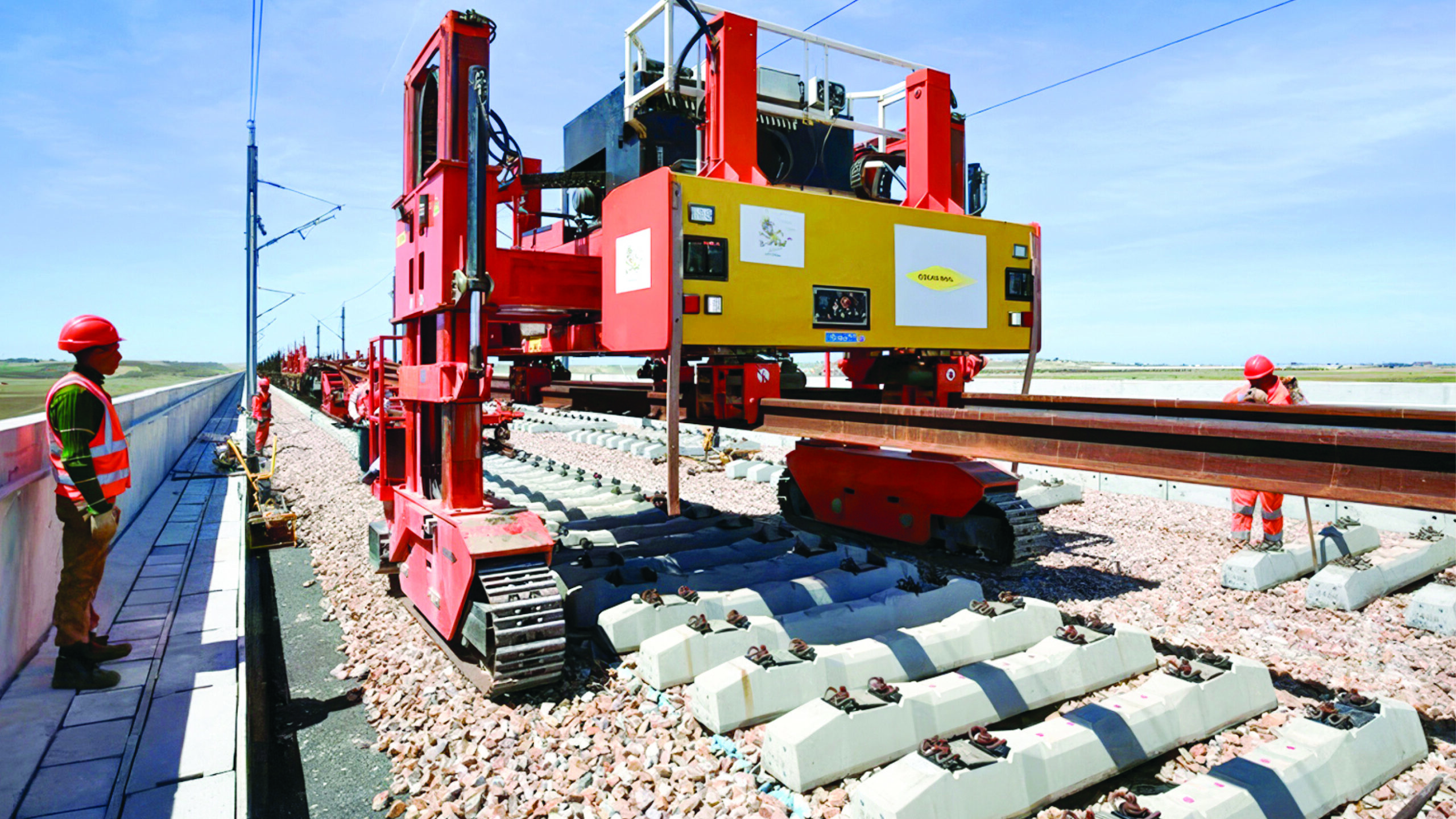
Installing track components is strategic. Maintaining them is vital. To support the works on the Kenitra–Marrakech high‑speed line and the expansion of the national network, ONCF has therefore strengthened its arsenal with a fleet of specialized machines: EMVs, line tamping machines, turnout tamping machines, ballast regulators with hopper, as well as catenary draisines.
In this highly technical segment, the Austrian company Plasser & Theurer and its French subsidiary Framafer stand at the head of the pack, with contracts totaling nearly 445 million dirhams, or about 48% of a global market estimated at 930 million dirhams.
In November 2024, ONCF also awarded Framafer a maintenance contract worth 52.8 million dirhams. This contract covers preventive and corrective maintenance of railway works machines (tamping machines, ballast regulators, and other specialized equipment), as well as the supply of original spare parts, in order to guarantee the operational availability of track equipment.
The Italians are not left out. Società Vetraria Italiana (SVI), Tesmec Rail, and Platform Basket are among the preferred suppliers, with cumulative orders totaling 216.5 million dirhams. A similar dynamic exists on the Swiss side with Matisa Matériel Industriel and Speno International, whose contracts amount to around 267 million dirhams.
This deliberate diversification will enable ONCF to align Moroccan railways with the most advanced international standards, while securing the performance and durability of its network.
ONCF: 96 billion dirhams to move to a new scale
These massive orders for track equipment and machinery are part of the 96‑billion‑dirham investment program launched by ONCF for the 2024–2030 period to thoroughly modernize the national railway system.
In addition to the project to extend the high‑speed line from Kenitra to Marrakech—covering infrastructure and equipment for an amount of 53 billion dirhams, with commissioning scheduled for November 2029—the plan also includes the acquisition of 168 new trains for 29 billion dirhams.
These trainsets will be used to renew the office’s existing fleet as well as to support network development projects. The whole program also falls within the framework of the “Morocco Rail Plan 2040,” a long‑term master plan aiming to expand the high‑speed rail network to 1,100 kilometers and the conventional lines network to 1,600 kilometers.