Kingdom
Natural Disasters: The Attributes of a “Lifesaving” Fund
The recurrence and intensity of climate shocks (floods, earthquakes, drought, etc.) striking the country reinforce the leading role of the coverage scheme against the consequences of catastrophic events. Analysis.

As long as one pays even a little attention to the harmful consequences of climate change, it is easy to see that the natural disasters hitting Morocco have grown in intensity and frequency over the past ten years (drought, floods, storms, earthquakes, etc.).
This adverse reality—damaging to public and private property and, above all, to the peace of mind and safety of the population—has durably frozen the public debate around whether the FSEC (Solidarity Fund against Catastrophic Events) should be activated during flood episodes that are increasingly frequent in Morocco.
Concretely, this public instrument is an answer to the question of repairing damage and compensating victims of natural disasters that dominate national news.
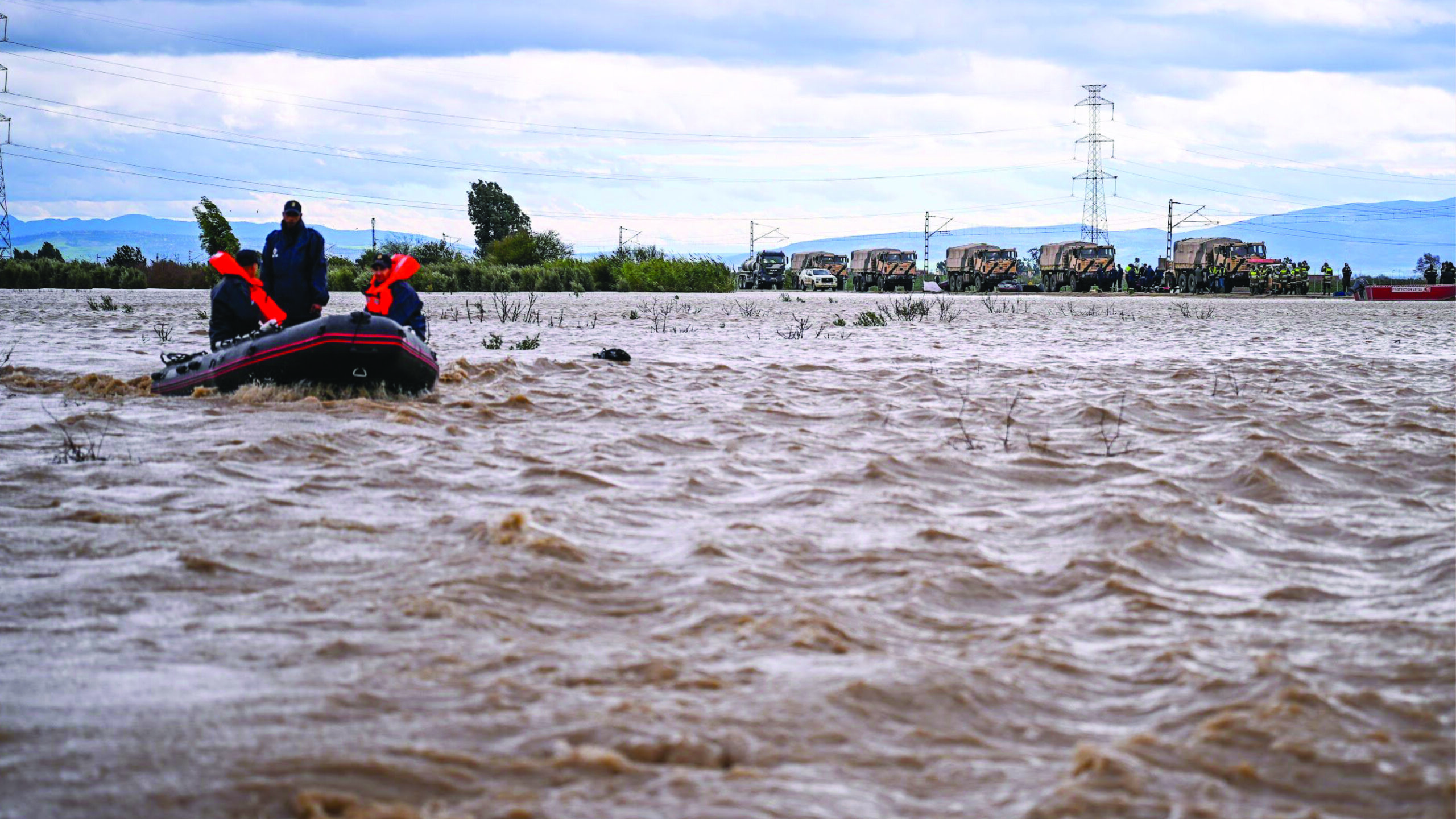
As evidence, the latest spell of bad weather, which began in late January 2026 with heavy rainfall causing a sudden rise in water levels in Ksar El-Kébir and Sidi Kacem, in the rural areas of the Gharb and beyond, resulted in considerable material damage.
The devastating floods that followed (which isolated several neighborhoods in the country’s northwest), making roads impassable, prompted the authorities to carry out the preventive evacuation of nearly 155,000 people to communes less exposed to flood hazards.
This speaks to the intensity and scale of the weather-related risks that prevailed during this month of February in the northwest of the Kingdom.
In short, these natural disasters further justify a closer look at the Fund’s financing and the conditions for its activation, established by Law No. 110-14 (promulgated as early as 2016), which covers both abnormal-intensity natural phenomena such as earthquakes and floods, as well as violent human actions such as terrorist acts.
Increase in financial resources
Since 2020, the FSEC has been funded by the parafiscal solidarity tax against catastrophic events, levied on insurance contracts. Set since 2019 at 1%, this tax has been increased to 1.5%. The increase is now in effect.
The objective behind this increase is clear: to strengthen the financial resilience of the solidarity mechanism in a new context marked by both the proliferation and heightened intensity of natural disasters.
From an insurance standpoint, this increase takes into account the frequency and scale of compensation payments, as well as the rise in international reinsurance costs.
Another factor explaining this upward trend: the experience of the Al-Haouz earthquake in September 2023 doubled the financial burden inherent in seismic risk and showed the need to raise the initial rate to 1.5%.
Two complementary components
It is important to recall that the originality of Law 110-14, which established a catastrophic-risk coverage scheme in Morocco, lies in two components—namely, an insurance component and a benefit-based component.
While the (mandatory) insurance component is managed directly by insurance companies, the benefit-based (solidarity) component is overseen by the FSEC, headed by Nouaman Al Aissami.
A real instrument for correcting shortcomings in the insurance system, the FSEC can be set in motion when private guarantees are absent or when victims of catastrophic events do not have insurance coverage.
However, the cardinal condition for accessing this solidarity scheme—particularly for uninsured persons—is the publication of an administrative act by the Head of Government officially declaring a state of catastrophe.
As a reminder, the Head of Government, Aziz Akhannouch, declared the Al-Haouz earthquake of September 8, 2023 a “catastrophic event” by signing an order published in the Official Bulletin on October 19, 2023.
One of the immediate implications of the publication of this administrative act identifying six disaster-stricken areas (Al-Haouz, Taroudant, Chichaoua, Ouarzazate, Azilal, and the Prefecture of Marrakech) was the activation, for the first time in Morocco, of the implementation of the guarantee against the harmful consequences of catastrophic events, as well as the repair and compensation of victims of the Al-Haouz earthquake.
The publication of the order, which expressly mentioned the duration of the earthquake (as stipulated by Law 114-10), was followed by the census (up to January 16, 2024) and the registration of victims in a register whose opening was announced by the Ministry of the Interior.
Compensation mechanisms
With regard to compensation, it should be specified that uninsured victims may claim compensation from the Fund, notably for material damage to the primary residence (up to a limit of 250,000 dirhams).
By way of illustration, in the specific case of a death, the law provides for the payment of a lump sum to the beneficiaries. The amount of this lump sum is determined on the basis of 70% of the scale set by the 1984 dahir relating to compensation for victims of road traffic accidents.
With a view to modernizing this scheme, the Ministry of Justice has introduced into the legislative process a bill aimed at amending and adapting the aforementioned dahir to the current economic context.
The FSEC also covers bodily injury for the uninsured, and up to 70% of the compensation granted by insurance companies to insured persons for bodily injury.
Overall, the solidarity mechanism established by Law 114-10, in the event of catastrophic events officially recognized as such (by administrative act), covers bodily injury, loss of income for the beneficiaries of deceased persons, as well as damage affecting primary residences.
Among the strengths of the aforementioned legal framework are the precise specification of deadlines for all key stages, as well as the scales used as a basis for determining compensation.
While some participants in the public debate believe it would be appropriate to activate the FSEC for victims of the latest bad weather in the country’s northwest, at the time of writing no official decision had been taken to that effect.
That said, the legal framework has equipped the coverage scheme against the consequences of catastrophic events with bodies (including, for example, the Catastrophic Events Monitoring Commission) and mechanisms better suited to determining whether it is appropriate to activate the Solidarity Fund.
A vehicle whose usefulness is growing, given the frequency and intensity of the climate shocks striking the country.