Influences
Tbourida: At Moulay Abdallah, Tents Rise and Passion Soars!
Under the scorching August sun, the lands of Moulay Abdellah echo with the thunder of hooves and the crackle of gunpowder. Each summer, its moussem hosts a majestic showcase of tbourida. More than a spectacle, it’s a choreography of gunpowder and dust, where passion, heritage, and increasingly, female daring collide.

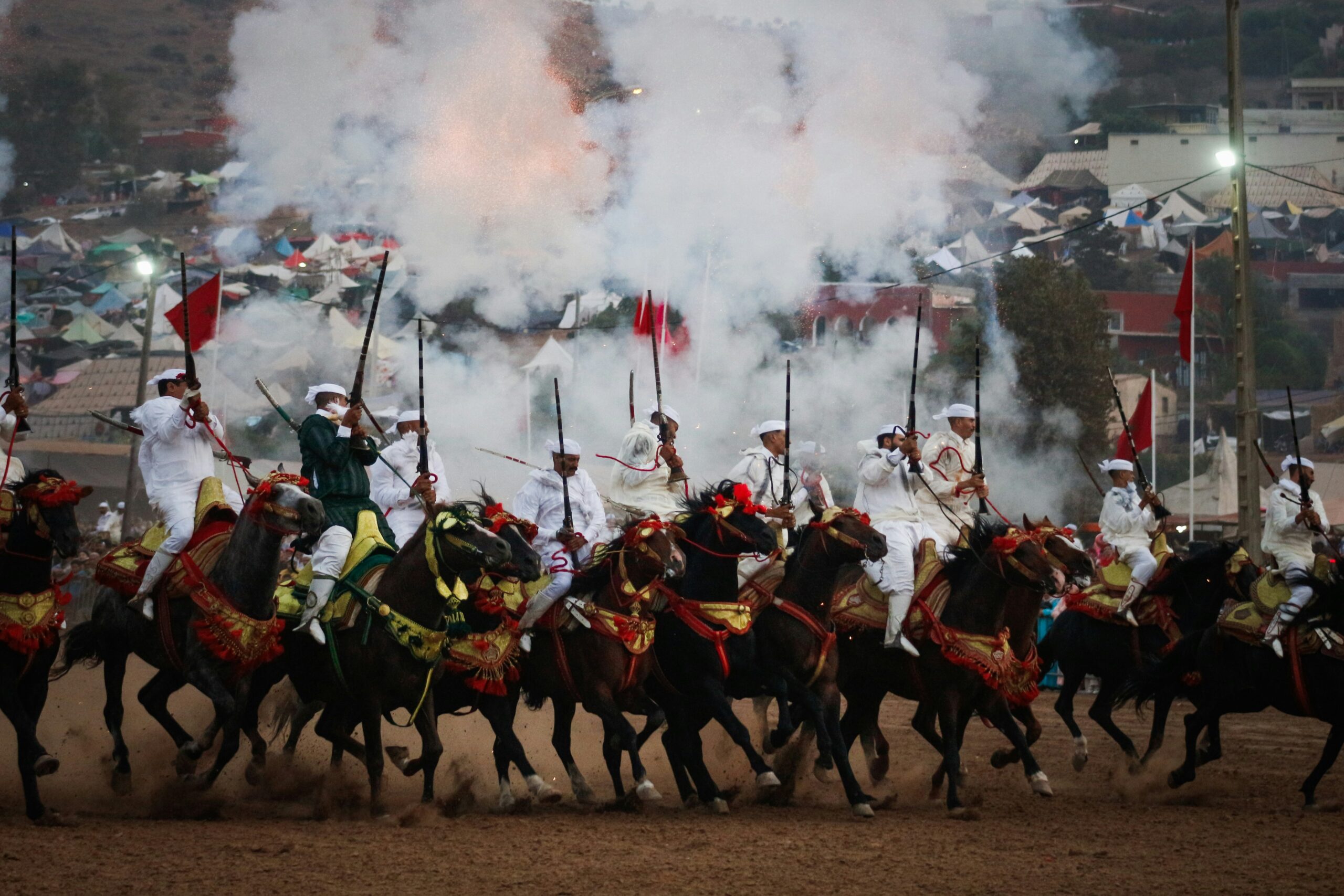
In the Moroccan imagination, tbourida—that flamboyant cavalcade—is indissolubly entwined with the moussem, the festive gathering where the sacred mingles with jubilation.
Nearly 700 of these seasonal assemblies dot the calendar, oscillating between the fervor of religious moussems, centered around Eid al-Mawlid (the Prophet’s birthday), and the vigor of agrarian moussems, celebrated amid the euphoria of harvests.
But let there be no mistake: all of them, without exception, vibrate with a spiritual aura, if only through the tutelary presence of a saint, around which everything revolves.
Religious moussems, draped in solemnity, banish worldly frivolities. Agrarian ones, however, indulge freely in them, offering a salutary escape for farmers worn by three seasons of backbreaking—and often thankless—toil.
Here, in the heat of reunions, people surrender to revelry and chase simple pleasures. Yet the crown jewel, the sheer delirium that sets hearts racing and electrifies crowds, is tbourida. To witness it, one need only journey at the right moment to Moulay Abdallah Amghar, a stone’s throw from El Jadida, on the windswept Atlantic shores.
“L’wali l’hninne”
Each summer, a majestic, ephemeral city of tents rises nine kilometers from town, a vibrant tribute to a past where faith in Islam intertwines with love for ancestral lands.
This sacred site, dedicated to Saint Moulay Abdallah Amghar, transforms into a grand theater hosting one of Morocco’s largest moussems—a cornerstone of the Kingdom’s cultural and spiritual heritage.
For centuries, the Chorfa Amgharyine (noble descendants) and locals have pitched their khyam (tents) at the foot of the fortified sanctuary, erected in divine glory, to celebrate—with fervor and joy—the memory of victories against occupiers and the legacy of their forebears.
From August 8th to 15th, we recorded no fewer than 5 to 6 million visitors, all witnessing an exceptional surge of enthusiasm.
Imagine: 42,000 tents stretching eight kilometers long and two wide, sheltering up to 400,000 campers, evoking a colossal Mehala—a nomadic encampment standing like a fleeting fortress against the walls of a city. The spectacle was breathtaking.
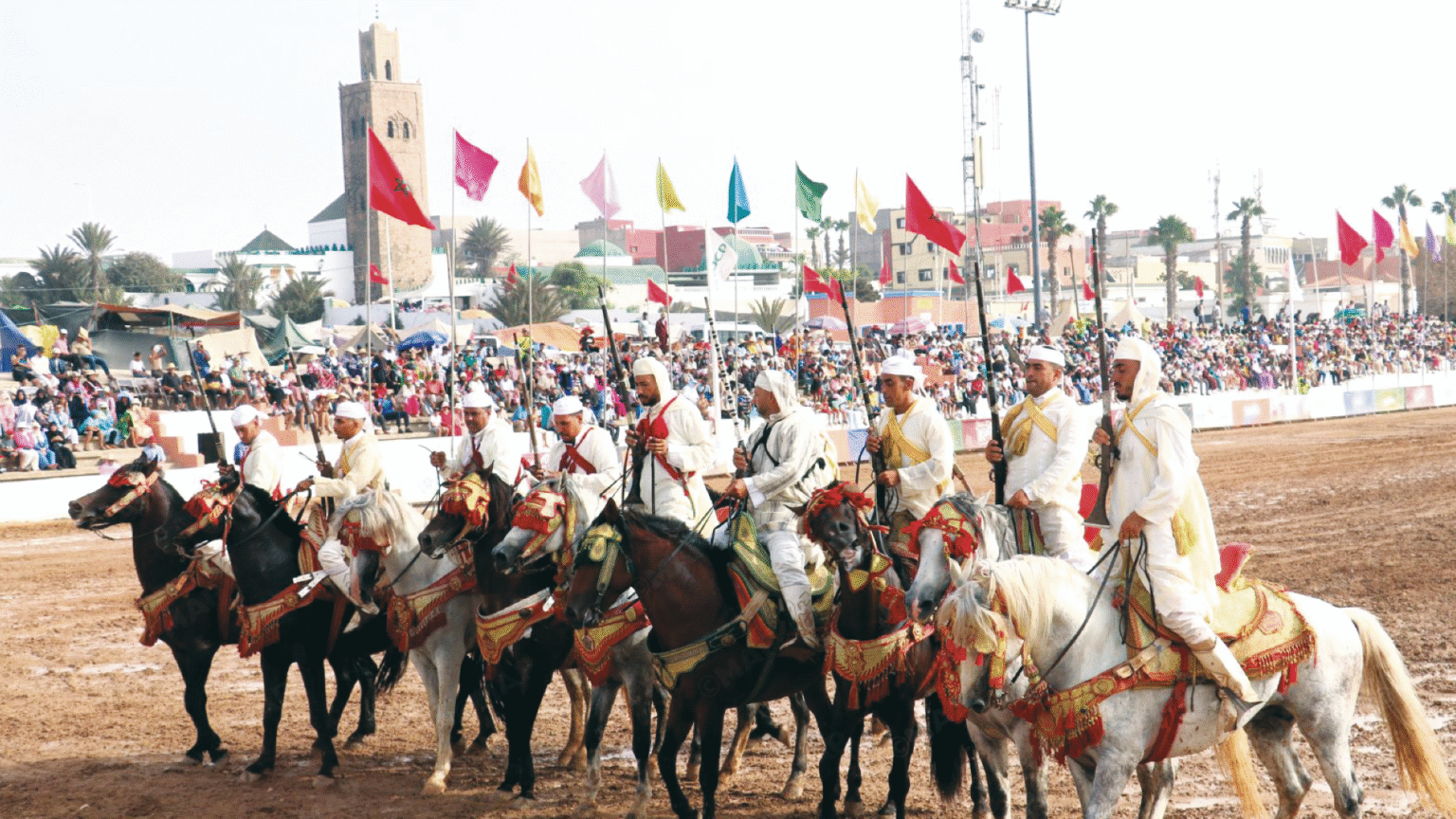
Festivities blur sacred and secular: tbourida, the undisputed queen, this year mobilizes 130 male sorbas (troupes) and 3 female ones, with 2,200 horses thundering in a warrior’s choreography, punctuated by the resounding volleys of the final hadra (gunpowder salute).
Falconry (to which the Doukkalas cling fiercely), folk music, performances, carnival games—the packed program pulses with energy. But it’s when the sun, finally relenting, loosens its grip that tbourida takes center stage.
Riders adorned in dazzling attire, steeds cloaked in elegance—the arena ignites. An hour prior, the dense crowd floods the grounds, scaling walls in a fever bordering on hysteria.
Each cavalry charge unleashes a whirlwind of piercing youyous (ululations), ochre dust, and smoke, while the audience roars, screams, and thrums in unison.
The next day, under a leaden sky and the scorching breath of the chergui (desert wind), they return—these insatiable spectators—ready to lose themselves anew in a spectacle they never tire of. Tbourida, more than tradition, is an addiction, a primal life force pulsing to the rhythm of hooves and souls.
Elegance at a Gallop
Tbourida—a game? Certainly, but one taken deadly seriously. Here, it is the tribe’s honor at stake, prestige and pride rearing high under watchful gazes.
Each sorba (equestrian troupe) is scrutinized by an invisible jury: riders’ mastery, flawless synchronicity, splendor of attire, and refinement of harnesses.
In this equestrian theater, panache must match prowess. A sloppily dressed rider? Unthinkable. Elegance is no mere detail—it is the very soul of tbourida.
The dress code? Rigorous, almost monastic, dominated by immaculate white—save for the bluish jellabas of Saharan formations, a nod to the desert. Riders, swathed in linen, don billowing trousers, turbans meticulously wound by tribal custom, starched-collar shirts, and often haughty babouches (leather slippers).
Bound by a wide fabric sash, they tuck a curved dagger—sheathed in velvet—at their waist and sling a leather bag across their shoulder, safeguarding Quranic verses. In their hands: a long rifle, silver-engraved, its stock adorned with ivory and mother-of-pearl, brandished like a standard.
Yet it is the steed that steals the spotlight, adorned with opulence that nearly overshadows its rider. The harness, a masterpiece of craftsmanship, blends silk and satin in a riot of embroidery. The saddle, draped in a brocaded cover, is secured by a leather strap etched with delicate motifs.
Stirrup leathers—silken ribbons—support copper or cast-iron stirrups, while the bridle glints with gold thread. Practical details remain vital: blinkers shield the horse’s eyes from sand and smoke; layered saddle pads ensure rider comfort; a high pommel and leather-clad cantle grant regal posture.
In this ballet where every gesture is a declaration, tbourida transcends spectacle: it is an ode to tradition, a defiance of the ephemeral.
Impressionist Universe
On a track barely 200 meters long, a squadron of 10 to 20 riders bursts forth in a choreography as precise as it is mesmerizing.
First, a nonchalant trot—almost aristocratic—then, a pragmatic crescendo: the gallop quickens, hooves pound the earth, rifles whirl in an acrobatic ballet. Riders showcase their skill, twirling rifles one-handed above their heads, mirroring Arab warriors who used this gesture to deter enemies from advancing.
Next, at the mqaddem’s (leader’s) command, gunpowder speaks. Volleys crack in synchronized unison as riders rein their horses to a sudden halt, pivot, and gaze ahead with the pride of a mission accomplished.
It is an equestrian symphony: an inaugural adagio, a moderato that escalates, a presto that ignites—culminating in an explosive finale. But beware the misstep: each rider, like a virtuoso, must “tune their instrument”—here, a horse—over weeks of preparation.
For this partner is no mere tool, but a living being: powerful, agile, sensitive, a comrade whose intelligence and spirit cannot be dominated by force, only won through subtlety.
And what nobler ally than the Barb horse? This desert sovereign—hardy and noble—embodies the soul of tbourida. No brutes here: only a skilled trainer, attuned to the animal, offering the space for shared brilliance. The Barb, obedient under an expert hand, responds with the elegance that elevates this ritual to legend.
“Rkoub l’khayl”
Tbourida, this equestrian art where tradition gallops full-tilt, continues to upend our assumptions. For decades, we thought we knew all its codes, its frenzied charges. Wrong! Recent gatherings dedicated to the discipline reveal its secrets with breathtaking audacity.
We imagined riders firing skyward in theatrical flair? The Sahrawi, instead, aim at the ground—as if pinning their rivals to the dust. We pictured only men in the saddle? Surprise: the Aït Baâmrane troupe, astride proud mares, charges in and shatters stereotypes.
Their leader, with a sly grin, explains: “Our ancestors triumphed this way. Enemy stallions, distracted by our mares, would rear and throw their riders.” In war, all tactics are fair.
And what of the stubborn notion that tbourida was reserved for men? Swept aside! Women are joining the fray—and with unmatched flair. From Mohammedia, the pioneer, to other regions, female troupes (sorbas) are multiplying, demolishing taboos.
It began in 2005, sparked by a horse-breeder’s daughter, madly in love with tbourida, who rallied her fellow riders to form the first all-female sorba. The gripping documentary Les Rebelles de l’Atlas (The Rebels of the Atlas) by Othman Essakali traces their journey: a band of women, united by passion, smashing conventions and stampeding into the spotlight.
Since then, they’ve inspired a movement, transforming what seemed forbidden into a rallying cry. Tbourida, far from static, is now written in the feminine—with a boldness that commands awe.
This year, tbourida takes a decisively new turn under the hooves of three female sorbas, electrifying the tracks of the first and second mehrek (performance zones). Among these modern Amazons is Zahia Abou Layth, an allama (master rider) from Doukkala, her passion forged in childhood.
Under her father’s wing—a devoted horseman—she haunted moussems, mesmerized by tbourida. From this sacred fire, she forged her female sorba, breaking norms with quiet daring.
Leading the sorba Ouled Amrane, Zahia imposes her vision. “Discipline, respect for the horse and fellow riders,” she insists to the press, ensuring her riders gallop by the book.
In a rare gesture of deference, male riders now yield space to them, exempting them from rotations required of men—a hard-won freedom carried with pride. Nora El Badaoui, a member of Zahia’s sorba, is on her third ride at the Moussem Moulay Abdallah Amghar.
She embodies this new wave, where feminine grace merges with the power of ancient ritual. And when the dust settles, when gunpowder’s scent fades into the hot air, what remains is the same ancestral fervor: binding rider to steed, humanity to faith, community to roots.
At the Moussem Moulay Abdallah Amghar, tbourida is a gallop through collective memory, thundering between earth and sky in a blaze of powder and eternity. “Voici les âmes paisibles qui arrivent en visiteurs / jaw khayl Laâounate / a lalla, jaw khayl Oulad Frej / jaw khayl Jaaidane / jawna l’Qouassem …”
(Here come the peaceful souls as visitors / Jaw khayl Laâounate / A lalla, jaw khayl Oulad Frej / Jaw khayl Jaaidane / Jawna l’Qouassem…)