Kingdom
Tadaroj Programme: Implementation underway
The rollout of the public initiative aimed at training 100,000 trainees per year through the generalisation of apprenticeship-based training is now on track. Executive agreements have been concluded in the crafts, agriculture and fisheries sectors.

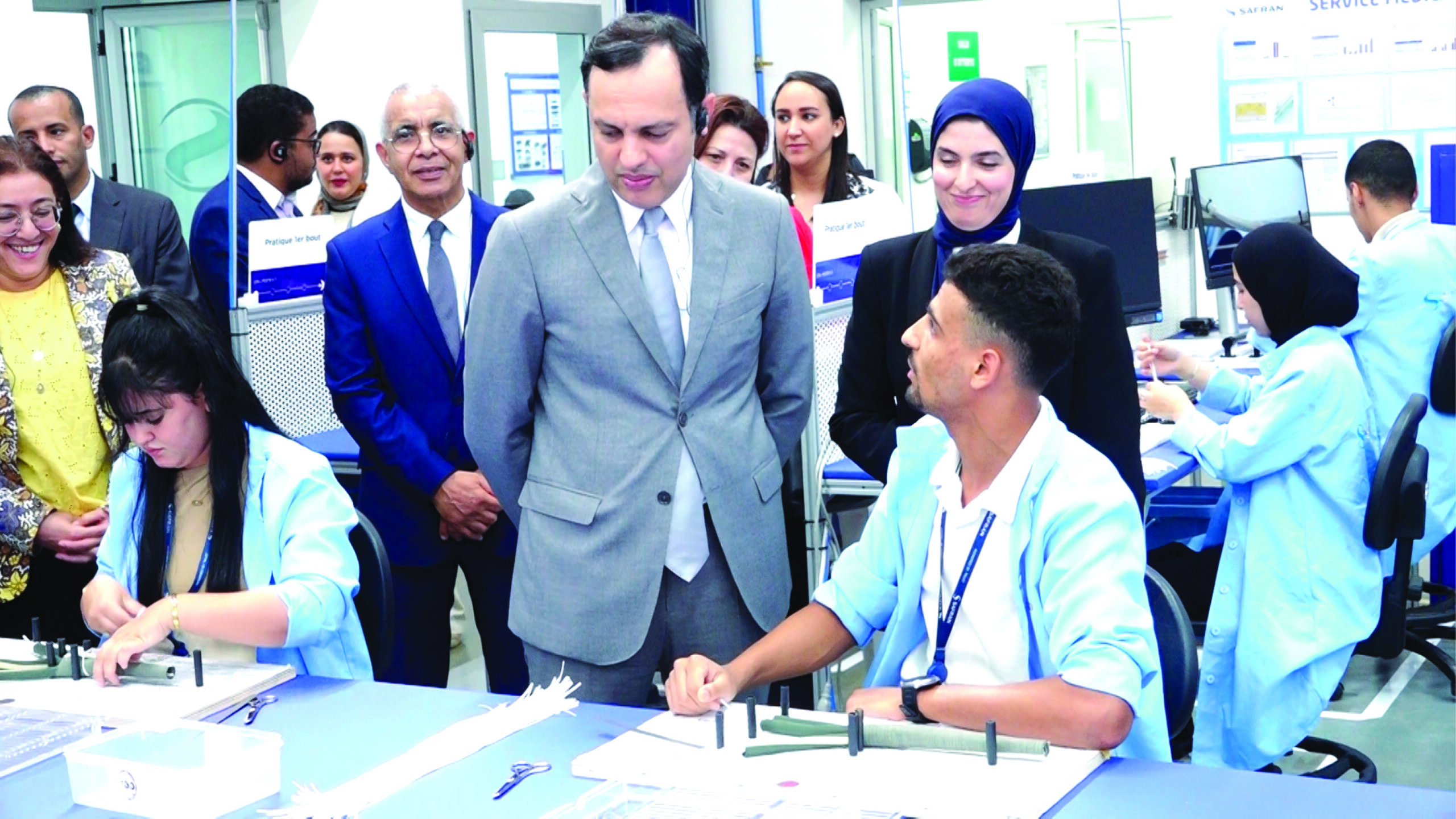
One of the government’s priorities is to improve the employability of young people and women.
Indeed, several public initiatives have emerged as a result of the Executive’s efforts, aimed at bringing about a substantial reduction in the unemployment rate and building a more inclusive economy.
One of the flagship schemes reflecting the government’s strong commitment to boosting employability in Morocco is the Tadaroj Programme. Its main strength lies in the involvement of the private sector, which is known for its strong capacity to recruit large numbers of workers each year.
Specifically, the initiative pursues an ambitious objective: to train 100,000 trainees annually through the widespread rollout of apprenticeship-based training.
The challenge is significant, particularly given that between 2020 and 2024, workplace-based training declined by nearly 26%, while work-study programmes and apprenticeships fell by 30% and 16% respectively. Moreover, very small, small and medium-sized enterprises (VSMEs), which account for more than 95% of the business fabric, are unable on their own to absorb the country’s training needs in the area of workplace-based learning.
Launched on 27 October 2025, the programme offers training in 200 occupations, including 80 in the crafts sector, and is intended as an appropriate response to the multiple skills-upgrading challenges faced across several sectors of activity.
At this stage, it is relevant to focus on the implementation process of the programme. It should be recalled that this State-funded initiative is designed to generalise workplace-based apprenticeship training across various key production and service sectors in the Kingdom.
Crafts: a central pillar
In terms of annual commitments, the programme plans to train 30,000 apprentices in the crafts sector, 8,000 in the solidarity economy, 15,000 in agriculture, 4,200 in youth-related activities and 2,000 in fisheries.
By way of illustration, by the end of November 2025, no fewer than 10,000 young apprentices had been enrolled in 56 in-company apprenticeship training centres (CFA-IE), notably in the automotive industry, tourism, hospitality, textiles, crafts and aeronautics.
Given the numerical targets, the crafts sector is undeniably crucial to the successful implementation of the Tadaroj Programme. A particularly telling fact is that the operational rollout of the public initiative began with this sector, which saw its exports increase by 11% in 2025.
The effective implementation of Tadaroj was further consolidated, by the end of last October, through the signing in Rabat of numerous executive agreements involving 12 Regional Chambers of Crafts and four associations managing Training and Qualification Centres for Crafts Trades (CFQMA).
In detail, the apprenticeship-based vocational training network in the crafts sector comprises 67 centres and more than 100 annexes, accommodating nearly 30,000 apprentices over the 2025–2026 period.
Its purpose is to help structure the training offer and provide responses tailored to the skills needs of different territories.
The programme, with an average duration of 11 months and led by Younes Sekkouri, Minister of Economic Inclusion, Small Enterprise, Employment and Skills, includes a significant incentive component, notably a 20% increase in support to apprenticeship training centres and an allowance of 300 dirhams per young trainee for trainers.
Programme beneficiaries (apprentices) also receive an annual grant, revised upwards to 5,000 dirhams. This public funding is intended to strengthen apprentices’ commitment to learning pathways conducted in real working conditions.
That said, the State Secretariat in charge of Crafts and the Social and Solidarity Economy acknowledges that the model proposed by the programme represents one of the most effective mechanisms for developing human capital, owing to its closeness to the realities of the trade and its direct link to the productive environment.
In this respect, it enables apprentices to acquire genuine practical skills through alternation between applied training with artisans and theoretical instruction within training institutions.
Agriculture and fisheries as additional pillars
Following the first wave of executive agreements signed in the crafts sector, the implementation of the public policy aimed at boosting the employability of young Moroccans was extended to two highly strategic sectors for the national economy: agriculture and fisheries.
Specifically, two agreements signed in November 2025 between the Ministry of Employment and Skills and the Ministry of Agriculture and Maritime Fisheries, covering the period 2025–2030, will make it possible to achieve Tadaroj’s objectives in both sectors.
As outlined, the ambition is to train 15,000 apprentices per year in agriculture over the 2025–2030 period, 1,600 young people in the first year in the maritime fisheries sector, and 2,000 apprentices per year between 2026 and 2030.
Operationally, the agreements provide for the Ministry of Agriculture and the State Secretariat for Maritime Fisheries to make available the human, material and pedagogical resources required for training.
It should be noted that the Department of Vocational Training has allocated a budget of 375 million dirhams for the implementation of apprenticeship training in the agricultural sector and 48 million dirhams for the maritime fisheries stream.
As for ANAPEC, it is involved in the recruitment and selection of apprentices, contributes to mobilising host enterprises, and supports programme graduates in their professional integration.
In the agricultural sector, Tadaroj focuses on developing apprenticeship training within Agricultural Vocational Training Establishments (EFPA), targeting young farm operators, skilled workers, technicians and entrepreneurs in occupations related to agricultural production, processing and value enhancement.
In the fisheries sector, the programme concerns the development of apprenticeship training within Institutes of Marine Fisheries Technology (ITPM) and Maritime Vocational Qualification Centres (CQPM) located along the entire national coastline.
Ultimately, regarding the Kingdom’s progress in generalising apprenticeship training across key sectors of the economy, it is encouraging to note that the ministry led by Sekkouri is prepared to provide the necessary support and assistance to companies wishing to establish in-company apprenticeship training centres.