Kingdom
Social State: These Words That Are Changing the Lives of Moroccans
Education, health, social protection, employment, housing and investment: this glossary brings together the main reforms shaping and consolidating the social state in Morocco.

Major reforms are sometimes embodied in institutions, figures and budgets. But they first take shape in words.
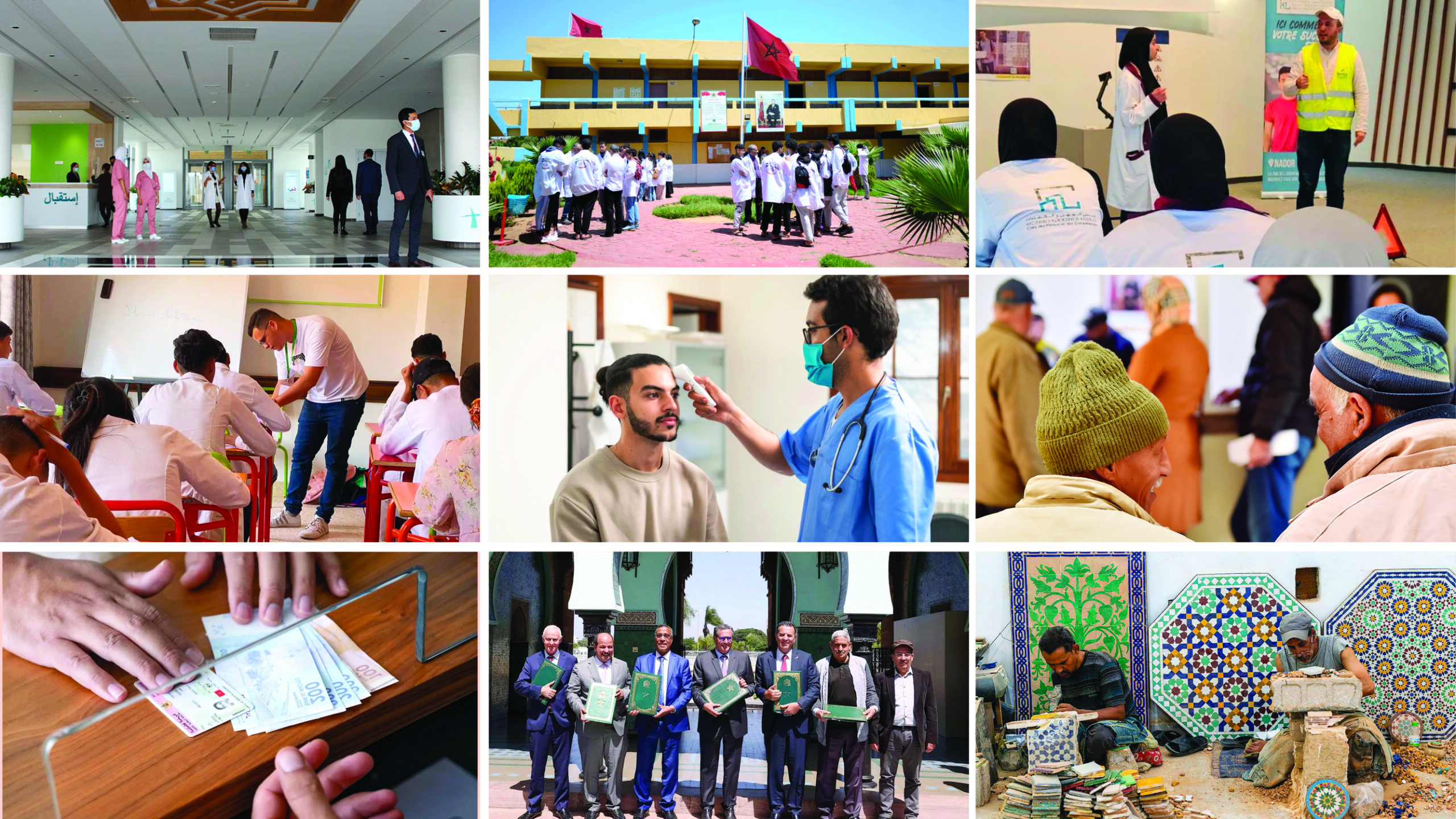
In Morocco, the consolidation of the social state has brought about a fairly new vocabulary, which has gradually become part of citizens’ everyday lives. “AMO Tadamon”, “Unified Social Register”, “Direct Social Assistance”, “Pioneer Schools”, “Cities of Trades and Skills”, “Territorial Health Groups”: these are no longer items of administrative jargon, but lived realities.
Behind each term lies a structuring policy endeavour: ensuring equitable access to healthcare, combating school drop‑out, strengthening vocational training, supporting productive investment, improving pensions, or facilitating access to housing.
This lexicon tells the story of a profound transformation of the social model, founded on more accurate targeting of assistance, the modernisation of public governance, and the expansion of social rights.
This glossary therefore offers a cross‑cutting reading of the public policies underway.
It highlights the overall coherence of a project: building a more inclusive, more effective social state that is closer to the expectations of Moroccans.
Pioneer Schools
Launched in 2023, the Pioneer Schools programme has emerged as one of the key pillars of the transformation of human capital in Morocco.
Designed as an experimental model intended for nationwide roll‑out, it introduces a new approach to public schooling based on pedagogical performance, outcomes assessment, and strengthened support for teachers.
The objective is clear: to improve basic skills from primary education onwards and reduce learning inequalities, considered a major obstacle to economic and social development. It should be noted that four out of five schools will be affected from the next academic year, pending full generalisation the following year.
Pioneer Lower‑Secondary Schools
Like the Pioneer Schools, the “Pioneer Lower‑Secondary Schools” programme is one of the flagship initiatives of the reform of Morocco’s education system. For the 2025–2026 academic year, the network has expanded to include 786 institutions, catering for around 678,000 pupils and supported by more than 23,000 teachers.
The main objective is to support pupil achievement through innovative pedagogical approaches, personalised support, and enriched extracurricular activities.
The scheme combines preventive and remedial interventions: intensive remediation periods, differentiated pedagogy, psychological and social support, as well as the use of digital tools.
Unified Teaching Staff Statute
The adoption of the Unified Statute for Teaching Personnel marks a major turning point in the government‑led education reform.
Presented as a framework for modernising and harmonising career paths, this new text aims to unify staff regimes within the National Education system, enhance the attractiveness of the profession, and improve governance of the school system.
It introduces new mechanisms for evaluation, mobility and career progression, alongside a reorganisation of grades, clarification of pedagogical and administrative duties, and more structured supervision of continuing professional training, accompanied by significant salary increases.
Second‑Chance Schools
The idea of a “second chance” rests on the principle that a life path is never permanently closed and that early failure should not amount to a sentence.
This concept has taken institutional form through Second‑Chance Schools, educational and reintegration structures targeting young people who have left the school system early, generally aged between 14 and 25.
Conceived as transitional re‑entry pathways rather than parallel classes, they combine basic skills upgrading, personal skills development, personalised support, and initial professional experiences.
In 2025, Morocco’s network of Second‑Chance Schools comprised more than 230 centres accommodating nearly 24,000 young people, with a target of reaching 35,000 beneficiaries by 2026.
University Hospital Centres
The Kingdom aims to equip each region with a university hospital centre, expanding access to specialised healthcare, decentralising medical training, and modernising hospital infrastructure.
Currently, five centres are under construction in Laâyoune, Béni Mellal, Errachidia, Guelmim and Dakhla, which will increase national bed capacity by approximately 2,200 additional beds.
These new centres will reinforce the existing network, notably the six CHUs located in Casablanca, Rabat, Marrakech, Oujda, Tangier and Fez. This effort, which also includes hospital rehabilitation works, is scheduled for completion by 2030 and requires total investment of 13 billion dirhams.
Local Health Centres
Equitable access to healthcare, reduction of territorial disparities, and strengthened prevention and patient follow‑up: these are the three objectives of the national programme for the rehabilitation, reconstruction and equipping of healthcare facilities across the country.
To date, 1,400 health centres have been refurbished in both urban and rural areas.
Their modernisation required a budget of 6.4 billion dirhams. The remaining phase—covering 1,600 local health centres—is currently underway in cities and rural regions, with an additional allocation of 6.8 billion dirhams.
Territorial Health Groups
Territorial Health Groups (GSTs) constitute one of the main pillars of the health system reform underway in Morocco.
They seek to overcome the sector’s historical fragmentation by establishing integrated regional governance. Concretely, each GST brings together, at the regional level, all public health structures—hospitals, health centres and specialised facilities—under a unified management.
The dual objective is to improve care pathway coordination and ensure better allocation of human and material resources.
This approach also promotes more efficient budget management and planning tailored to the specific needs of local populations.
AMO Tadamon
Part of the compulsory basic health insurance system, AMO Tadamon is a mandatory scheme fully funded by the state, with an annual allocation of 9 billion dirhams.
Intended for individuals unable to pay contributions, it replaced RAMED. As a result, 11 million people (insured persons and dependants) were transferred to this scheme, which provides medical and hospital care coverage and reimbursement of healthcare expenses at the same level as standard insurance schemes.
AMO Achamil
Designed within the framework of the generalisation of health coverage, this scheme targets individuals who have an income but do not hold stable permanent employment.
Eligibility requires meeting the social criteria defined by the Unified Social Register, not being covered by another scheme, and satisfying the social score criteria determining the contribution level. AMO Achamil is currently being deployed and covers nearly 390,000 insured persons.
It constitutes another pillar of universal medical coverage alongside AMO Tadamon, AMO for non‑salaried workers, and the CNSS scheme for salaried employees.
Retirement Pensions
Pensions have been increased, with two major innovations. First, the minimum contribution threshold required to qualify for an old‑age pension has been lowered from 3,240 to 1,320 contribution days, with a minimum pension amount ranging between 600 and 1,000 dirhams, now including AMO coverage.
Effective from 1 May 2025, this measure applies retroactively to January 2023. The second measure, in force since 1 January 2026, concerns total income‑tax exemption on pensions under the CMR, RCAR, CNSS and CIMR schemes. Nearly 165,000 retirees are expected to directly benefit, at a cost of 1.2 billion dirhams per year borne by the state.
Investment Charter
This is the legal framework defining the rules, incentives and objectives of state investment policy. In Morocco, a new charter came into force in 2022, replacing the one adopted in 1995.
Established by framework law 03‑22, it sets out a comprehensive investor support system through four dedicated schemes: core, strategic, SME and export. Incentives take into account criteria such as sustainable development, inclusivity, regional balance, job creation and support for priority sectors.
Public subsidies can reach up to 30% of project value. Since its launch, 297 investment projects worth a total of 513 billion dirhams have been approved, generating 201,000 direct and indirect jobs.
Support Scheme for Very Small, Small and Medium‑Sized Enterprises (TPMEs)
One of the four investment support schemes under framework law 03‑22, this mechanism became operational on 6 November 2025.
It provides cumulative incentives—employment‑based, territorial and sectoral—of up to 30% of the investment amount, for projects ranging from 1 to 50 million dirhams.
Eligible companies must have turnover between 1 and 200 million dirhams and provide at least 10% equity contribution. At the beginning of January, 89 investment projects worth over 1.28 billion dirhams had been approved.
Cities of Trades and Skills
These are the new generation of vocational training institutions in Morocco, initiated by OFPPT.
A cornerstone of the new roadmap for vocational training development presented to the Sovereign in 2019, these establishments are equipped with cutting‑edge pedagogical tools and full‑scale platforms, characterised by multi‑pole and multidisciplinary design.
They offer innovative, up‑to‑date training across 13 professional clusters and more than 170 courses. Twelve Cities of Trades and Skills are planned—one per region—seven of which are already operational, with five in the final deployment phase. In total, they will be able to accommodate 34,000 trainees per year.
Tadaroj
The Arabic term “Tadaroj”, referring to apprenticeship‑based training, best captures the spirit and purpose of the programme, whose ambition is to train 100,000 apprentices per year by 2030.
Conceived as a powerful lever to improve youth employability in Morocco, this initiative combining practical training and theoretical instruction was officially launched in October 2025 in the crafts sector.
Now extended to agriculture and fisheries, it aims to cover all high‑employment‑potential sectors. Incentives include a subsidy of 5,000 dirhams per apprentice and a 20% increase in support to apprenticeship training centres.
Social Dialogue
It is the first time a government has signed two social agreements (2022 and 2024) during a single term. The institutionalisation of social dialogue has restored trust among social partners: government, trade unions, the CGEM, and, for the first time, COMADER, representing agricultural employers.
The establishment of two annual sessions (April and September) enables closer monitoring of negotiations. Gradually, this institutionalisation has shifted social contestation from the street and social media into a responsible and credible institutional framework.
Vocational Training
Vocational training has become a central driver of employability. Long perceived as a secondary pathway, it has undergone an unprecedented shift, fuelled by modernised programmes, the expansion of apprenticeships and the deployment of the Cities of Trades and Skills.
For the 2025–2026 academic year, 746,500 trainees are expected across OFPPT institutions—a 38% increase over four years.
This expansion reflects a clear objective: to align training with real business needs and make vocational qualifications a catalyst for durable youth integration.
Housing Assistance
A public support programme for first‑time home buyers, launched in January 2024 and running until the end of 2028. It provides direct financial assistance ranging from 70,000 to 100,000 dirhams. By April, nearly 97,000 people had benefited.
Distribution figures show 46% women, 54% under‑40s, and 24% Moroccans residing abroad. The total value of housing exceeds 30 billion dirhams, with a state contribution of 6 billion dirhams. This year, the programme has been extended to heirs jointly owning property.
National Population Register
Established under law 72.18 on the targeting of social assistance beneficiaries, the National Population Register (RNP) is a secure national database designed to assign every individual a digital civil and social identifier (IDCS).
It forms the backbone of the social identification system, enabling fair targeting of social assistance, reducing duplication, and preventing fraud.
Covering Moroccan citizens and foreign residents holding residence permits, the RNP also feeds into the Unified Social Register (RSU).
Unified Social Register
This system was created to organise equitable and transparent access to social support programmes. In practice, it consists of a social index—also called a socio‑economic index—assigned to each household.
This unique numerical score reflects the household’s socio‑economic situation, calculated on the basis of objective data declared by households and verified by competent authorities. It determines eligibility for social assistance, taking into account household size and composition, levels of expenditure (water, electricity, etc.), housing conditions, employment status and durable assets.
Direct Social Assistance
First disbursed in December 2023, this direct financial assistance aims to improve living conditions for families with school‑age children or households in vulnerable situations not previously benefiting from family support.
The goal is to provide a social safety net and support purchasing power among the most vulnerable.
Targeted families receive monthly support varying by household composition, with a minimum of 500 dirhams per month, subject to eligibility criteria—most notably the threshold score in the Unified Social Register. By the end of 2025, the platform had supported 4 million families, representing more than 12 million beneficiaries.
Specific Assistance
Approximately 390,000 widows benefit from direct social assistance: 300,000 (78%) without children, and 87,000 caring for children.
Each child with a disability is entitled to additional assistance, without limits on the number of children in the household, granted to widowed mothers regardless of the child’s age.
Additionally, orphans and neglected children placed under social services guardianship receive a monthly allowance of 500 dirhams to ensure a minimum level of support until they reach adulthood.
There is also a birth allowance for the first two births: families receive 2,000 dirhams for the first birth and 1,000 dirhams for the second.