Kingdom
Programs for the Territories and Through Consultation
The process of developing the new generation of integrated territorial development programs is in full swing across all regions of the Kingdom. The approach is participatory and bottom-up.

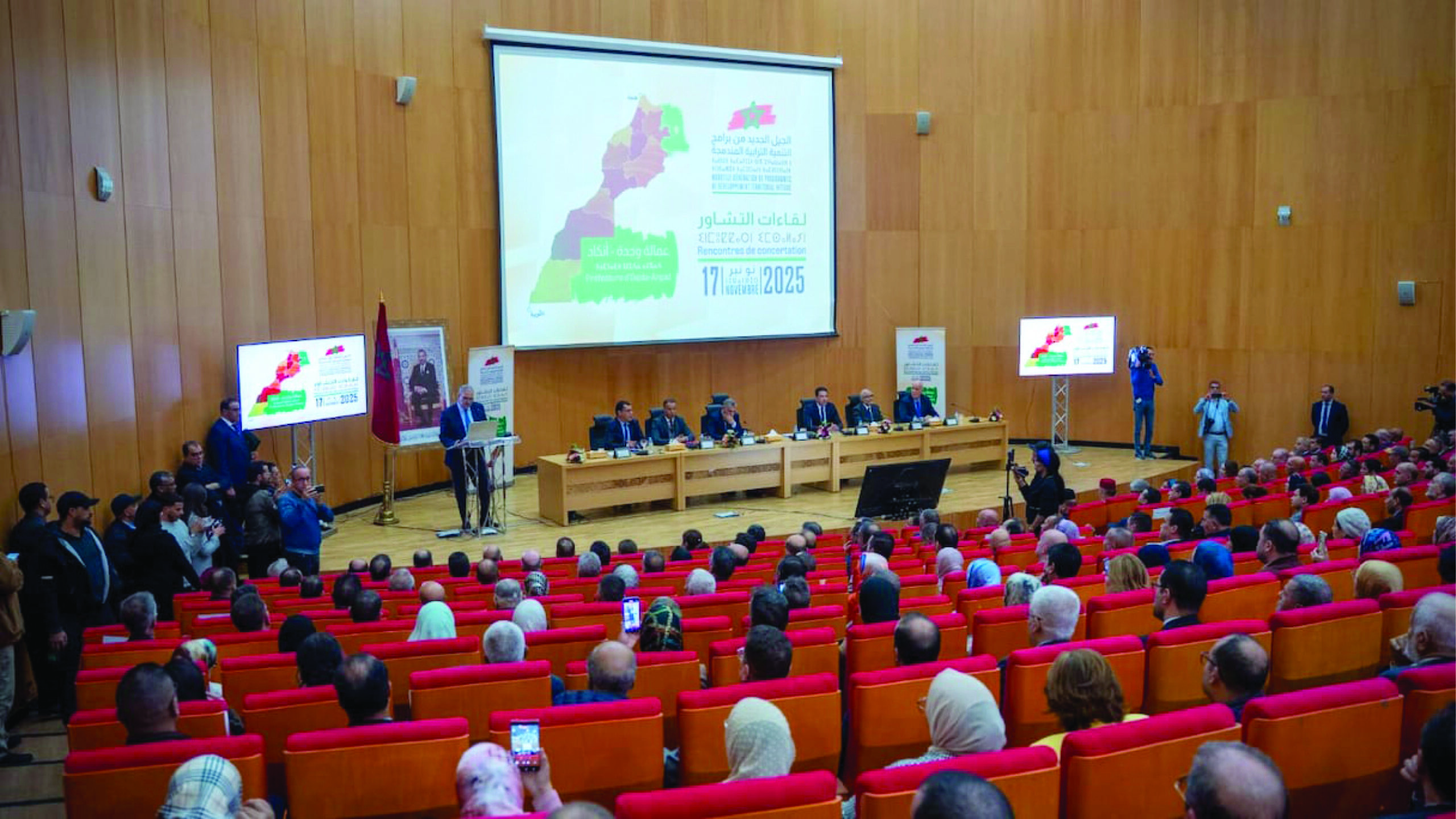
These past weeks have been marked by the effective launch of the consultation process related to the development of the new generation of integrated territorial development programs.
And this, under the leadership of walis and governors and with the participation of all stakeholders, including elected bodies, academics, other civil society actors, and economic operators at the territorial level.
Against the backdrop of a “participatory and inclusive approach,” the idea was to give “the floor” to stakeholders so they could express their expectations and needs. A dynamic, it must be recalled, that concerns 75 provinces across the entire Moroccan territory.
Now, while the broad meetings had a general character, other restricted meetings, in a “workshop format,” followed at the prefecture level, even at the territorial entity level, to better refine the approach. The objective being to better identify the issues and lead to feasible proposals that translate into projects.
Moreover, it is no coincidence that the subject was addressed, quite emphatically, by the Minister of the Interior during the presentation of his department’s sectoral budget.
In early November, before the members of the Commission of the Interior, Territorial Communities, Housing, and Urban Policy of the House of Representatives, Abdelouafi Laftit recalled the triggering of this process, marked by the circular sent last August to walis and governors to determine the modus operandi and guarantees to ensure the success of the new generation of Integrated Territorial Development Programs (PDTI).
Following this, walis and governors moved into action for the development of said programs at the territorial scale, and this, in perfect coordination with all territorial stakeholders.
Public Speaking to Better Understand Expectations
The objective being that all stakeholders can appropriate the adopted working methodology based on “a participatory, integrated, and results-oriented approach.” It should be noted that in this dynamic, Laftit pointed out, a third step will be dedicated to developing a methodological guide to frame field actions, as well as the formation of dedicated task forces and steering committees at the provincial and regional levels.
These will have the mission of developing, monitoring, and evaluating the implementation processes of the finalized and validated programs. This process is also marked by the launch of in-depth territorial diagnostics, which consist of collecting data that will be submitted for analysis.
While taking into account the territories’ potential, local dynamics, as well as projects programmed or underway, without forgetting, and this is of cardinal centrality, the expressed needs. However, this diagnostic itself will undergo post-analysis focusing on four essential themes.
Namely employment, basic social services, sustainable management of water resources, and integrated territorial upgrading, specified the Minister of the Interior. Once this work is completed, we should expect the production of a needs mapping, coupled with the determination of proposed action programs, while proceeding to establish a prioritization scale.
The next steps will follow almost naturally, as it will be a matter of putting down in black and white the final document relating to the finalized programs. Likewise, it will be a question of specifying the financial contributions that the different stakeholders will have to bring, taking into account their respective capacities according to ministries, territorial entities, or public establishments.
In this dynamic of consultation and listening, embodied in a “bottom-up approach,” one of the main objectives is to participate in reducing the spatial disparities suffered by certain regions, notably mountainous areas and remote rural perimeters. However, following the various meetings already organized, a common thread emerges weaving through the expectations and needs.
Notably the issue of employment, management of water stress, and, of course, the sectors of education and health. Key sectors that, moreover, are the subject of particular interest within the framework of government policy, in application of Royal High Instructions, carried out on the front of strengthening the foundations of the social State.
However, one of the indicators, beyond the ongoing actions, is found in the draft Finance Law currently under discussion. Indeed, for Education and Health alone, a record budget of 140 billion dirhams is to be injected.
This indicates that the year 2026 is shaping up to be a new step of accelerating the achievements of various projects, particularly those related to social sectors.
The Prefecture of Casablanca Designs Its PDTI
On Monday, November 17, 500 personalities converged within the premises of the wilaya of the Casablanca-Settat region. Among them, representatives of local authorities, elected bodies, socioeconomic actors, academics, and numerous representatives of civil society.
This broad meeting was especially marked by numerous interventions from associative actors who expressed their expectations of this PDTI development process for the prefecture. A meeting that was followed, on November 20 and 21, by others organized at the level of the eight prefectures of the metropolis’s districts.
The latter indeed took place in a “workshop format,” focused on the main selected themes, notably employment, management of water resources, education, and health.