Kingdom
Mririda: Euloge’s Thematic Game
Mririda n’Aït Attik: Poetess of the Megdaz Lands or Mere Colonial Fantasy? Between the enchanting verses of The Songs of Tassaout and the mystery of a voice without an echo, the legend falters. To untangle reality from myth, Syham Weigant—art critic and sharp-minded scholar—deciphers this palimpsest where Berber feminism and ethnographic mirage converge.

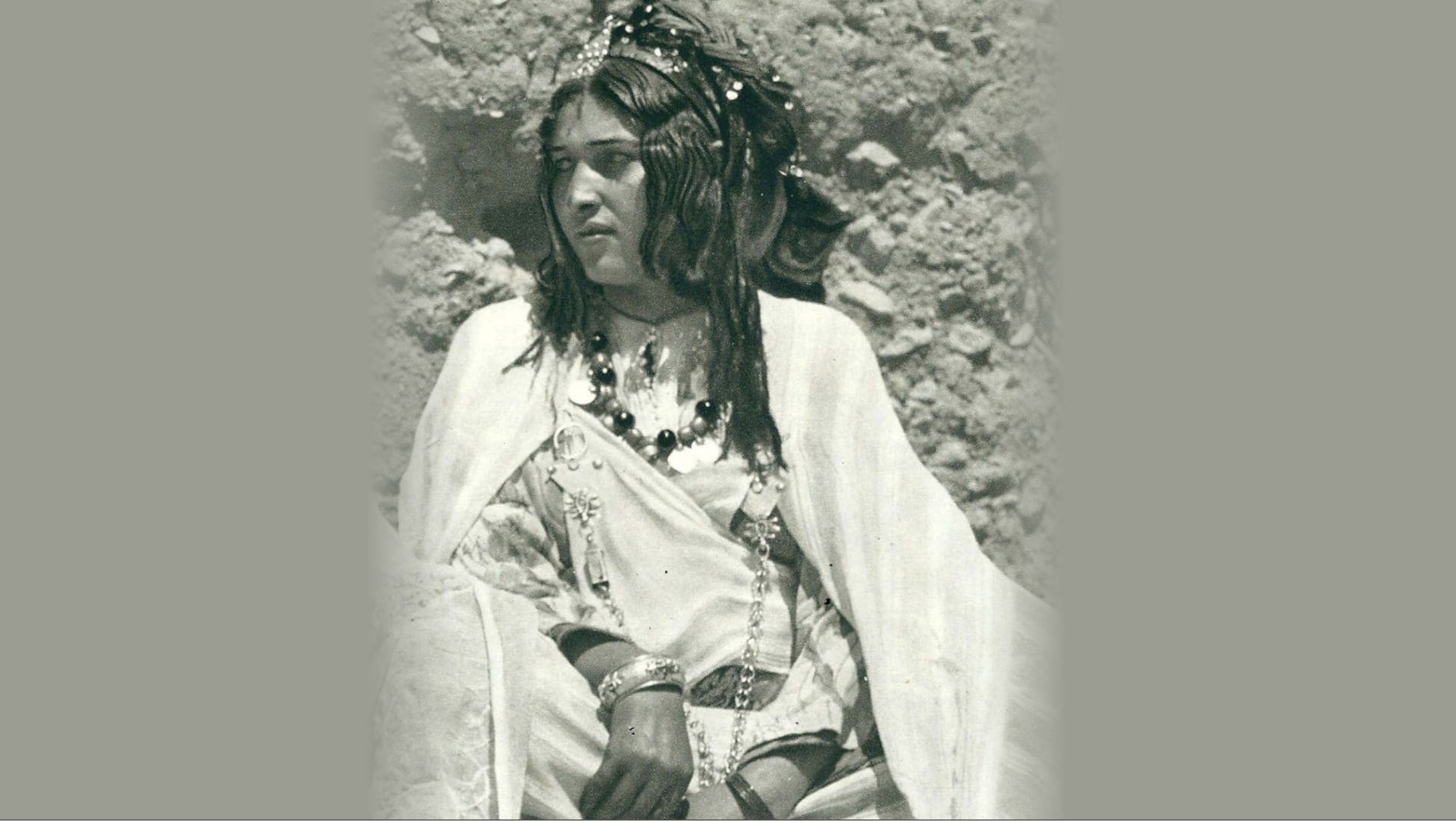
In The Songs of Tassaout, a feminine voice rises from the arid lands of the Souss. Described as an “Afro-Berber matriarchal feminism,” it is carried by an enigmatic figure: Mririda n’Aït Attik. Yet of this poetess, there are no archives, no tangible mark in history.
Her name resonates nonetheless, and the collection bearing it celebrates a power that seems to defy time. A nagging question remains: Was Mririda flesh and breath, or is she merely a mirage woven into the imagination of a man, René Euloge, the collector of these fiery verses?
Syham Weigant, curator and art critic (an unbearably sharp-minded thinker), proposes a hypothesis as charming as it is unsettling: Mririda, she says, would be a “composite figure,” an alloy of feminine archetypes drawn from the crucible of Berber valleys.
René Euloge, that foreigner on the prowl, embedded among the Chleuh—did he, knowingly or not, fuse these fragments of voices into an icon? A filter, a prism—that of an outsider who transforms what he hears into a coherent legend. The Songs he brings back vibrate with raw force, a poetic truth that astounds. But is this truth that of the women of Tassaout or that of a gaze romanticizing them?
For language here is an abyss. From Tachelhit to Euloge’s French, what remains of the original beauty of the word? Oral memory, however faithful in these lands, delights in dancing with time. The Songs of Mririda, if never truly spoken, may have blossomed under other lips before washing up, altered, in the ethnographer’s notebook.
In the Souss, the Rif, or the Middle Atlas, some Berber women have always carried the Amarg—that declaimed poetry interweaving love, sorrow, and quiet revolt. “They call me Mririda, the agile meadow frog / I have my zerarit / Admired by men, envied by women,” she sings.
These verses, saturated with earthy imagery, are not alone: Amazigh poetesses, for ages, have become streams, mountains, or wind to voice their being.
So, what were The Songs of Tassaout? Several dreams present themselves. Perhaps Euloge encountered a Mririda, whose stanzas he captured with wavering fidelity, but whose existence fades for lack of a witness other than him.
Perhaps he gathered, here and there, the murmurs of a thousand women, which he bestowed upon a single figure, Mririda, to give flesh and breath to his narrative. Or—and this hypothesis entices—these songs were partly born from his pen, dipped in local folklore yet swollen with a fiction resembling himself. Mririda, then, would be but a muse forged to drape his work in authenticity.
Weigant, skeptical, calls her a composite figure or, worse, pure invention. And with reason: René Euloge seems to have had a taste for literary games. Did he not elsewhere embroider tales of a “Lady Huguette,” born from a fantastical “Fassi adventure” and a Lisbon manuscript snatched from the pirates of Mehdia? One smiles at such audacity. Ethnographer or storyteller? Likely both.
That Mririda left no trace does not confirm her nonexistence. But this void, this silence around her, invites doubt—a doubt Euloge may have chiseled and polished into a double-bottomed jewel: a Berber poetess, yes, but also a heroine of a Western fable.